When I was a kid, sports on TV was a big deal. The local colleges played football seasons that were eleven or twelve games long, but less than half of those games were on TV. Only about half the people I knew had cable, so sometimes televised games weren’t even available to everyone. When something was on TV, I made the effort to watch. I liked watching BYU’s football and basketball games as well as Utah Jazz games with the occasional Oakland A’s game when they were featured on national TV. As I got older, there were more things on TV, particularly more Jazz games, and I still tried pretty hard to watch as many of those as I could. Nowadays, with work, family, and other more pressing matters, I hardly ever watch the Jazz games and watch BYU games less frequently than before. I have never been an NBA fan or a college football fan, though, and, in general, couldn’t care less about other teams or what’s happening in various leagues or conferences. I care about my favorite teams and that’s all. Every so often, something happens in the sports world, though, that makes waves and casual fans like me or even non-fans have to take notice.
 Why I Stand by Jonathan Isaac (ISBN: 978-1-956007-06-0) is a book that exists because of one of those moments. After the protests and riots that occurred after George Floyd’s death, many athletes used their position (“platform” being the buzzword everyone liked to use) to advocate for a message they believed in. One of the more controversial ways they did this was to kneel during the national anthem. Jonathan Isaac, a very promising NBA player, chose to buck the trend and stand during the national anthem. He stood out even more because he did not choose to wear the Black Lives Matter apparel that most others did. Like most things, his decisions in that matter were not just sudden, spur-of-the-moment thoughts. They were based on a lifetime of experiences and a large body of personal beliefs. The book recounts Isaac’s childhood, high school and college experiences and rather meteoric rise in the sport of basketball from a no-name kid playing inconsistently in high school to a top-10 NBA draft pick. It also discusses Isaac’s struggles with anxiety and belief in his own worth, which were ultimately helped more than anything by a spiritual journey that led to a firm belief in God. He writes about going to church as a kid, but not really knowing why and not applying what was being taught. Like many people, he had some negative experiences with organized religion along the way, and by the time he was playing in the NBA as a rookie, he was connected to religion in name only. A neighbor who was a church leader and a few setbacks in his basketball career provided opportunities for Isaac to re-evaluate his relationship with God, and his honest approach to that led to a conversion that led to action that ranged from feeding the poor to becoming a pastor in his church. Ultimately, those convictions led him to stand while his teammates knelt during the national anthem, but he believed that incident was just one instance of standing for truth and right and that God asks that of His followers in many other situations, too.
Charles Barkley, another famous basketball player, once said in an advertisement that he was not a role model. It was a controversial advertisement because basketball players and other famous people in the spotlight are role models whether they want to be or not and whether they should be or not. I find that most of them should not be, but a guy like Jonathan Isaac is a role model by virtue of his position and his actions. His account came across and genuine and humble. He was open about his struggles and did not shy away from the fact that he made mistakes in his life and is still far from the perfection that God has commanded us to stive for. However, he has not tried to dodge hard work and responsibility at all and has put forth the effort necessary to effect change in his life for the better. His willingness to stand alone for his beliefs is admirable, no matter where someone comes down on the issues (he notes in his book that many did not agree with him, but that some teammates and others told him they found his courage and determination to be character traits worthy of respect and emulation). I thought he had well-articulated reasons for doing what he did, and I happen to agree with them, but I found the book’s message of finding one’s self-worth in Christ and in knowing that we are beloved children of God to be the main message. The byproduct of knowing those things is that one is then willing to stand for truth and right even when it’s uncomfortable.

|
This work, including all text, photographs, and other original work, is licensed under a Creative Commons Attribution-NonCommercial-NoDerivatives 4.0 International License and is copyrighted © MMXXI John Pruess. |


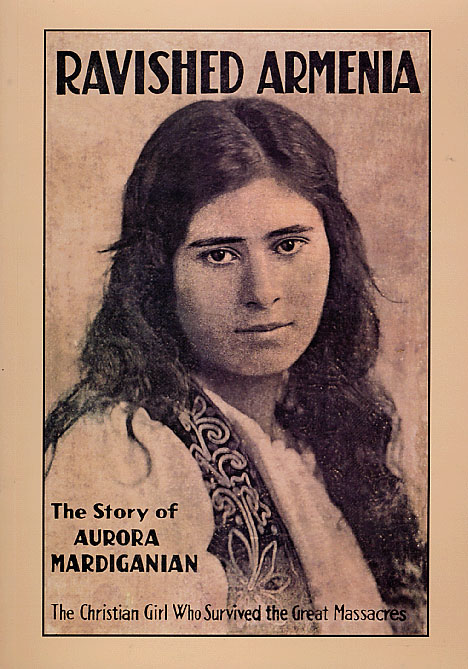 Ravished Armenia: The Story of Aurora Mardiganian, the Christian Girl Who Survived the Great Massacres by Aurora Mardiganian (Arshalyus Mardiganyan) is an autobiographical account of the Turkish oppression of the Armenian people in the Ottoman Empire starting in 1915. The Mardiganian family, relatively wealthy financiers, are warned by their shepherd that he had a dream about the Armenians’ imminent destruction, but his prediction is dismissed. Soon, though, it comes true, as the family is driven from their home, along with all the other Armenians. Occasionally, leniency is shown to those who will renounce their Christian faith and adopt Islam, but even then, the freshly converted Armenians are killed by their Turkish and Kurdish oppressors. Aurora, like most of the women and children, is driven from place to place, guarded by Turkish policemen. Those who are too slow to keep up during forced marches are dispatched quickly and usually cruelly, although Mardiganian’s account does point out a few instances of decency and humanity from guards or locals in the places the Armenians were marched. Her story, like many of those who lived during this time, is made all the more tragic because she was there to see the deaths of her father, mother, a sister, and a brother. She was sold multiple times to be a harem girl. This never worked out for the buyer because Aurora was never willing to accept Islam. It really didn’t work out for her, either, though, because her refusals were usually met with abuse and deprivation. After wandering the Ottoman Empire under the care of the Turkish police or as the property of various rich Turks, having seen so much killing, rape, and pillaging, her old shepherd friend, then working for a Turk trying to get Aurora to submit to Islam before being fully accepted into his harem, helped her escape. She stayed with friendly Kurds before eventually being helped by Americans in the region and then making her way to Russian-controlled territory and under Russian and Armenian military oversight, made her way to Tbilisi, then Russia, and then the United States.
 Avenue of Spies: A True Story of Terror, Espionage, and One American Family’s Heroic Resistance in Nazi-occupied Paris by Alex Kershaw (ISBN: 978-0-8041-4004-1) is one story of underground activity during the Nazi occupation of France. It is about an American, Dr. Sumner Jackson, his Swiss-born wife, Toquette, and their son, Phillip, who lived on the same street as many of the leaders of the occupying Germans, but aided the French resistance and paid the ultimate price for that patriotic effort. Jackson was a surgeon at an American hospital in France and used both his residence and the hospital as venues for fighting the Germans. Toquette and Phillip were also happy to be involved. Phillip couldn’t do much as a teenager, but understood what his parents were involved in. The house was used as a place to pass documents and information, the hospital was used to make Allied soldiers disappear once they had been adequately treated. Many were able to escape to neutral Spain and then back to England. The Nazis were next door and across the street and in houses all along the street, but the Jackson family was able to aid the resistance for quite some time before eventually being rounded up with other patriotic Frenchmen and sent to concentration camps in Germany. The entire family survived the camps. Toquette was extricated from one by the Swedes (reminded me a tiny bit of Raoul
 Up from Slavery by Booker T. Washington (ISBN: 978-0-9997797-3-6) tells of the famous educator’s life from his early boyhood as a slave to his rise as a professor and principal (these days we’d probably say president) of the Tuskegee Institute. The book was short on the childhood section, understandably so, since he was so quite young when slavery ended and had spent his days like all the other slaves: working. Once freed, he and his family struggled like many to find work that would pay the bills, but they succeeded, and his mom encouraged an innate love for learning that eventually led to Washington’s heading off to the Hampton School. A popular place with newly freed blacks trying to improve their lot, the school didn’t have a lot of room, but Booker so impressed the lady in charge of admissions when he was asked to clean some of the school rooms, that he made it in. He didn’t squander a single opportunity, graduated, and then set about to provide opportunities for others. What that led to was his founding the Tuskegee Institute. The greater section of the book is spent chronicling how the school came about, its struggles and successes, and its growth and Washington’s efforts to promote the school and secure the funding needed to keep it on its own two feet. He worked hard no matter what he was involved in, whether teaching, overseeing the school, working in his own home with animals and in his garden, or fundraising. He was also a well-known and in-demand orator, invited to speak at functions, fairs, and other public events. Throughout the book, he spends significant time noting that service, hard work, fulfilling one’s duties, giving things one’s best shot, and honesty are the keys to success and happiness in life. He also touches on the question of race and racism, but only as a reality that is in the background and that mostly stays there when one develops the abovementioned qualities and masters skills that others require, such as the brickmaking, animal husbandry, sewing, architecture, dairy farming, and others that his school taught in addition to academic subjects.
 Franklin & Washington: The Founding Partnership by Edward J. Larson (ISBN: 978-0-06-288016-1) takes an often detailed look at how Benjamin Franklin and George Washington worked toward common goals during the Revolutionary era, often working in concert to attain the desired outcome of a free United States. Larson provides an overview of each man’s life, which establishes that even before they knew each other, they had much in common. They were colonists, their early fortunes were tied to the western frontiers of their respective colonies, and they were involved in military and political matters. While their person routes to success were different, with Franklin rising to wealth and fame via hard work, ingenuity, and learning and exploiting the political scene, Washington had a slightly easier route that involved coming into land and marrying into a wealthy family. Ultimately, though, he, too, was a self-made man, parlaying his surveying and military skills into productive aspects of management and leadership, letting him be a successful estate owner and businessman with a strong ability to find workable compromises in otherwise explosive situations. Once both were convinced that British rule was not the way to go for the colonies, they poured their hearts and souls into independence. They believed strongly in liberty, and put their money where their mouths were, sacrificing time, money, and more to the cause of liberty. Franklin spent years abroad; Washington spent years leading the Continental Army. Once independence had been secured, both turned their attention to helping the thirteen colonies unify, something both strongly believed in. This was more time and sacrifice. They were leaders at the Constitutional Convention. Their styles there sometimes differed, but they worked toward a common goal of a unified country with a federal government strong enough to keep the states in check at times. Larson also spends a significant amount of time talking about one of the biggest differences between the two, which was their outlook on slavery. While they started life someone on the same footing there, Franklin slowly evolved to eventually come to an abolitionist viewpoint. Washington never moved from his position as a slave holder, although he was willing to go along with the anti-slavery clauses in the Constitution.
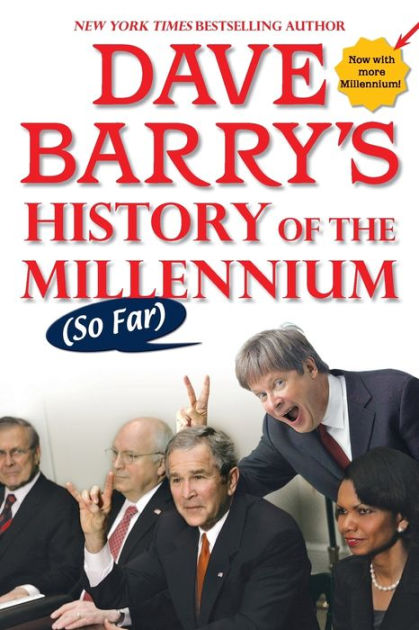 Dave Barry’s History of the Millennium (So Far) by Dave Barry (ISBN: 978-0-399-15437-9) is a compilation of those year-end columns for the first few years of the 2000s. Since those were always multi-page columns, the book is a decent length even though it doesn’t even deal with a full decade. The style of Barry’s columns relies on a couple main devices. One is to make fun of real events, and given the state of American politics, that is easy to do. Often, it seemed like he didn’t have to do a lot of writing; the material was writing itself. Another is to start by reporting a real event and then, suddenly and usually rather abruptly, turn it into something surreal or absurd. The subject of the jokes is wide ranging and includes politics, religion, sports, crime, popular culture (singers, movie stars, and generic celebrities who are famous for now real reason), and some bizarre things that make hometown papers only. As the cover to the book suggests, the Republican Party and President Bush are the subject of many jokes, but politicians at all levels find themselves in Barry’s crosshairs. Another continuing theme throughout the book is that things really are getting worse. Each year’s summary starts out with a comment about how we all hoped the year would be a good one and would improve on the past, but that, as usual, we were all disappointed with just how the latest year turned out. Given the ineptitude around us, why should we keep being so optimistic? It’s never dark humor, but there is a level of sarcasm or cynicism that often gives the jokes an edge.
 Reagan and Gorbachev: How the Cold War Ended by Jack F. Matlock, Jr. (ISBN: 0-679-46323-2) is a very detailed, play-by-play recounting of most (all?) of the diplomatic events leading up to the end of the Cold War. Matlock was a career diplomat that served on the National Security Council. This position and his academic and diplomatic career as a specialist on Russia provided him with an insider’s perspective on the processes that led up to the end of the Cold War. The book chronicles, often in great detail, various meetings, negotiations, summits, and communications that involved leaders of the United States and the Soviet Union. The focus was, of course, on what the two countries’ leaders, Reagan and Gorbachev, did, including their preparations before their meetings, their political efforts in their home countries in order to secure the ability to push their preferred policies forward. Matlock talked about the papers prepared for Reagan and how Reagan studied them. He talked about the negotiation processes. He recounted meetings between secretaries of state and foreign ministers. Those meetings, though, and the preparations were made possible by the leaders’ efforts to put people in place that would assist them. The preparations were made because the leaders desired that, something that was not always the case with the leaders who came before them. While Matlock endeavored to explain that so-called summit meetings weren’t the most important things in the diplomatic arsenal, those are what got headlines and what, ultimately, required the most preparation and resulted in the headline deals that moved the West and the Soviets away from nuclear war and toward peace. He, therefore, spent most of the book talking about these meetings that took place in Moscow, Washington, Geneva, and Reykjavík.
 Assassination: Operation Anthropoid: 1941–1942 by Michal Burian, Aleš Knížek, Jiří Rajlich, and Eduard Stehlík (ISBN: 80-7278-158-8) tells the story of one of the better-known assassinations in World War II, that of Reinhard Heydrich, the commander of the Reich Security Main Office (RSHA), acting governor of the Protectorate of Bohemia and Moravia, and a principal architect of the Holocaust. The operation was conceived by Czechoslovaks in exile in the UK, but carried out by paratroop commandos in occupied Czechoslovakia in concert with local members of the resistance. Like many of the operations in occupied Czechoslovakia, most of the people involved ended up dead. Radio operators, paratroopers and soldiers, resistance members who helped the paratroopers hide, farmers who lent a place to stay or a warm meal, all of them met the same fate once the Nazis discovered that they were in any way associated with the efforts against Germany. Thankfully for the Czechoslovaks, there were enough people that were willing to risk it all, and two of the paratroopers who had undergone intensive and extensive training in the UK, Jozef Gabčík and Jan Kubiš, were able to execute their plan against Heydrich. The plan was to shoot him, but that didn’t initially work, so a bomb was tossed toward his car. The explosion, which happened just outside the back of the car, didn’t kill Heydrich initially, and the attackers had to run away, chased for a short distance by their target. A week later, Heydrich succumbed to his wounds, and in the coming weeks, Nazi reprisals wiped out complete Czechoslovak towns and eventually also wiped out Gabčík and Kubiš.
 The Complete Far Side by Gary Larson (ISBN: 978-1-4494-6004-4) contains every single panel from the comic, which ran from 1979 to 1995. It is not really a book, but three books in a set. The comics are presented more or less in chronological order, so the reader can see how Larson’s style evolved during the early years. There is really not a whole lot to include in an overview of a collection of comics, and that is the case here. There is an eclectic collection of dinosaurs, cows (especially cows), squid, doctors, scientists, space aliens, chickens, dogs, and mailmen, among others. The jokes range from rather macabre stuff to funny plays on words or a surrealist or absurdist take on a famous saying or proverb. Every so often, there are pop culture references that are sometimes hard to get (at least for someone like myself who has never been big on pop culture and always has to look names and titles up when crossword puzzles reference these in clues). The drawing style is unique with the always obese-looking characters and simply drawn animals, scenery, and other settings, but it’s a classic, and having every panel in one place is nice.
 The Czech Black Book, edited by Robert Littell, is a collection of original source documents from the first week of the invasion. There are press releases, official announcements, and news stories that were curated in response to Russian propaganda that claimed Russia and other Warsaw Pact countries came to Czechoslovakia to help and at the request of the Czechoslovaks (the Russians called their collection the White Book, hence the Czech one being black). The documents from the Czechs show a much different picture. The news reports feature interviews of high-level Czechoslovaks as well as from men on the street, and the feeling is that they simply wanted to be left alone and chart their own course through history unhindered by the Russians, whom they had previously considered friends. There was often a feeling expressed that the invasion had done unrepairable damage to that relationship. The government press releases and communiqués showed a government united around the reformers in the Czechoslovak Communist Party and a total disdain for the few leaders who preferred the Russian socialist path. The Czechoslovak leaders weren’t ready to throw communism or socialism away (it reminded me of Gorbachev a little), but they certainly wanted to be able to choose their own way, and the Russians weren’t ready for their satellites to have that level of independence. Trade unions, clubs, and other organizations also called on the citizens of Czechoslovakia to resist the invaders, although not violently, but by the interesting peaceful means of ignoring them. They were to refuse to help the Russians whenever possible, to continue their everyday lives as if nothing was happening around them since strikes and other resistance would simply give the Russians the excuse they needed to escalate the action. Even when a few Czechoslovak citizens lost their lives, were arrested, or otherwise assaulted, the general population kept its cool, and the Czechoslovak leaders attributed the end of the invasion, in large part, to this reaction (or non-reaction, as the case may be) by the people. In the end, negotiations were carried out, and the invaders left, although not under the conditions that the Czechoslovaks would’ve desired.
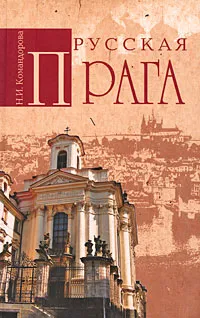 Русская Прага (Russian Prague, my translation) by Natalya Ivanovna Komandorova (ISBN: 978-5-9533-3746-5) presents an overview of some of the common history between Russia and the Czech Republic. It starts in tsarist times and ends with a small section about post-Communist interaction between the two countries. The medieval links between the two countries were focused largely on trade with a little religion thrown in, typical for a time when church and state were intimately intertwined. The many interfamilial marriages and constantly changing alliances during the 1700s and 1800s resulted in some interaction between the two nations, and academic and intellectual interests were added to the subjects of correspondence. These reasons for a Russian presence in what was then Czechoslovakia exploded in the early 1900s as Russia experienced what is nowadays referred to as brain drain when the Bolsheviks came to power. Czechoslovakia, and Prague in particular, proved to be a welcoming place for Russian academics, politicians, and intellectuals who wanted to escape persecution and restrictions on their freedoms in Soviet Russia. There were links between the two countries in the post-World War II era, too, but they tended to be less positive. The Soviets worked to keep tabs on and even control the Russian diaspora. Russian-Czechoslovak relations took a hit they would never really recover from when the Soviets invaded in 1968. Modern relations between the two countries have returned to the medieval focus on trade with a significant level of distrust toward the Russians on the part of many Czechs.
 Iron Curtain: The Crushing of Eastern Europe, 1944–1956 by Anne Applebaum (ISBN: 978-1-4000-9593-3) discusses just how Communist regimes came to power in Europe following World War II. The book chronicles how the Communists came to power in Eastern Europe, focusing on Hungary, Poland, and East Germany, with a fair number of examples from Czechoslovakia and occasionally Romania. The Communists rose to power quickly in post-war Europe through a comprehensive strategy that thoroughly encompassed the lives of the people. This included the police, youth organizations, the media, political organizations, the arts, and the economies of the countries where the Soviet Union was victorious over Germany. In many cases, a combination of factors worked together to make the Communist takeover work. First, it was the Soviet Union that was in control in these areas. Even in places where there was arguable Allied control, it was the Soviets doing the day-to-day administration, so they worked to install people and organizations that were compatible with their ideas of how things should work. Second, there had already been strong support for Communist, socialist, and other Left-leaning ideologies before and during the war. This only continued after the war. Third, the activists were the ones most involved. They were also the ones who were willing to use violence to reach their goals. While most regular people were concerned about getting a job, rebuilding their homes and businesses, and helping their friends and families, activists were getting involved in politics, unions, youth and religious organizations, and the media. This helped them make sure that things were done they way they wanted. In the rare cases when there was some push-back, the activists, often with help from the police or the newly formed secret police organizations, violently quashed any dissent. Applebaum does discuss resistance a little, but this is a short section, which seems to accurately represent the proportions of active and passive support or acquiescence to the regime and resistance.