My first real contact with Armenians was while serving as a missionary for the Church of Jesus Christ of Latter-day Saints in St. Petersburg, Russia. We regularly ran into Armenians in our efforts to preach on the streets. One of the members of the branch in Pskov was an ethnic Armenian. One of the sister missionaries in one of the districts I served in was from Armenia. It was from her that I first learned about the Armenian alphabet, which was like nothing I had ever seen before. Since then, I have had a few chances to get to know more Armenians and learn a little about the history of this small country in the Caucasus that has outsized sway around the world because of its ubiquitous and rather tight-knit diaspora. The diaspora is so large and so widespread, in part, because of the World War I time-frame killings Armenians were subjected to.
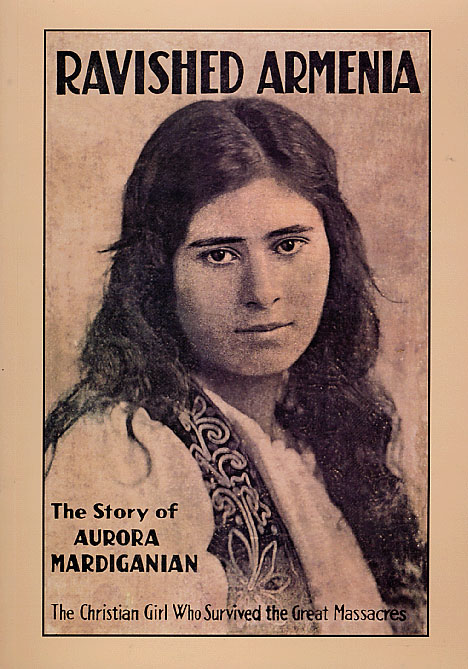 Ravished Armenia: The Story of Aurora Mardiganian, the Christian Girl Who Survived the Great Massacres by Aurora Mardiganian (Arshalyus Mardiganyan) is an autobiographical account of the Turkish oppression of the Armenian people in the Ottoman Empire starting in 1915. The Mardiganian family, relatively wealthy financiers, are warned by their shepherd that he had a dream about the Armenians’ imminent destruction, but his prediction is dismissed. Soon, though, it comes true, as the family is driven from their home, along with all the other Armenians. Occasionally, leniency is shown to those who will renounce their Christian faith and adopt Islam, but even then, the freshly converted Armenians are killed by their Turkish and Kurdish oppressors. Aurora, like most of the women and children, is driven from place to place, guarded by Turkish policemen. Those who are too slow to keep up during forced marches are dispatched quickly and usually cruelly, although Mardiganian’s account does point out a few instances of decency and humanity from guards or locals in the places the Armenians were marched. Her story, like many of those who lived during this time, is made all the more tragic because she was there to see the deaths of her father, mother, a sister, and a brother. She was sold multiple times to be a harem girl. This never worked out for the buyer because Aurora was never willing to accept Islam. It really didn’t work out for her, either, though, because her refusals were usually met with abuse and deprivation. After wandering the Ottoman Empire under the care of the Turkish police or as the property of various rich Turks, having seen so much killing, rape, and pillaging, her old shepherd friend, then working for a Turk trying to get Aurora to submit to Islam before being fully accepted into his harem, helped her escape. She stayed with friendly Kurds before eventually being helped by Americans in the region and then making her way to Russian-controlled territory and under Russian and Armenian military oversight, made her way to Tbilisi, then Russia, and then the United States.
Anyone who has spent more than a few minutes with Armenians will have heard of what they refer to simply as the Genocide. There are some political implications involved in using that term, but that is what the Armenians refer to it as, and it was, undoubtedly, a terrible time for them. There are not many things one can compare their suffering to, although maybe the treatment of the Bosniaks when the former Yugoslavia fell apart is a decent comparison. Aurora’s story was one of suffering and tragedy. As a memoir meant to tell of her people’s travails, there is no larger discussion of world politics at the time or even the regional situation (in short: it’s the Caucasus and the Middle East, so it’s somewhere beyond complicated). The reader just gets a relatively young girl’s take on a horrible situation. On the other hand, despite all the destruction, violence, and despair, there is hope in the book. I found the willingness she had, along with a few others, to not renounce Christ despite the often gruesome consequences extremely brave and inspiring. The will to survive and the resourcefulness displayed by those in a tight spot to do so were admirable, too. There are also lessons in the book about avoiding the totalitarian and authoritarian impulses that so often afflict those in power that lead to so much death and destruction of human life.

|
This work, including all text, photographs, and other original work, is licensed under a Creative Commons Attribution-NonCommercial-NoDerivatives 4.0 International License and is copyrighted © MMXXI John Pruess. |


 In the Turkish extermination of the ethnic Armenian population within Turkey's borders during World War I, German author Franz Werfel thought he saw something the world should learn from. To bring that message to the forefront, he wrote The Forty Days of Musa Dagh (ISBN: 978-1-56792-407-7). The novel is a fictionalized account of a home-grown Armenian resistance movement that succeeded in holding off far superior — numerically and technically — Turkish forces for fifty-three days (Werfel's forty days were a reference to the symbolic Biblical number), at which point French and British warships rescued the survivors. The book chronicles the efforts of (the fictional) Gabriel Bagradian and the villagers as they live off the land, fight valiantly for their freedom, and deal with everyday problems exacerbated by the situation. The story is, of course, an adventure story, what with the battles, mutiny, illicit love, petty jealousies, special missions, and a wide array of characters from mayors, widows, common criminals, and carpenters to German foreign ministry officers, priests, Turkish military leaders, and French admirals. Werfel told their stories in an attempt to warn the German people that they were headed into something eerily similar with the Germans playing the role of the Turks and the Jews the Armenians. Werfel's account ends with one twist of his imagination, leaving Bagradian on his hard-won mountain to face certain death, but death as a free man.