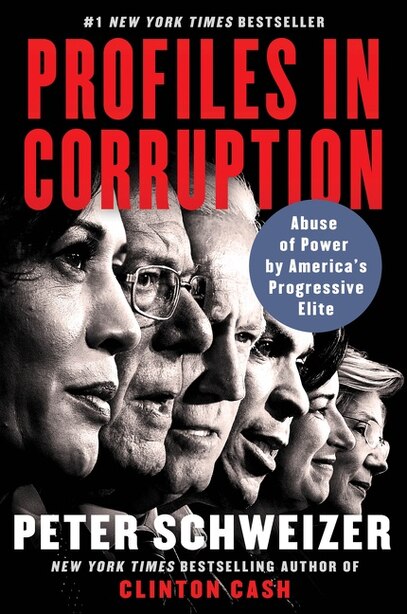
Profiles in Corruption: Abuse of Power by America’s Progressive Elite by Peter Schweizer (ISBN: 978-0-06-289790-9) examines the corruption of some of the American Left’s biggest stars: Vice President Kamala Harris, Senator Bernie Sanders, President Joe Biden, Cory Booker, Amy Klobuchar, Eric Garcetti, and Senator Elizabeth Warren. Schweizer could’ve written a book like this about Republicans, too, but chose not to since Leftists claim they fight against big business and cronyism and are believed by a significant swath of the public. With that hypocrisy as a background, the corruption seems even worse as it’s not just corruption, but also a lot of lying. All of them are long-term public officer holders that have been involved in hardly any business activities, yet have wielded the power that comes with their offices to enrich themselves, their friends, and their families. Schweizer chronicles these politicians’ activities throughout their careers, which includes their time in local and state office as well as on the national stage. As they move up the ladder, their influence grows, and the amount of money they’re able to command in exchange for various favors grows in a corresponding manner. One of the most popular schemes was earmarking federal funding for ones’ friends and families via authority over grants and programs (all of them) or writing laws that benefit a friend’s law firm (Harris, Klobuchar) or a brother’s real estate development project (Biden). The book is full of stories of politicians claiming to be tough on crime, for example, but then not prosecuting their political allies. There are stories of politicians writing laws that make it possible for family and friends to develop property formerly off limits. In every case, the politician in question also comes out ahead. Schweizer ends by claiming that there is a certain level of responsibility for the corruption with the American voter because these politicians keep being re-elected.
The book is a quick read and quite interesting. It’s also depressing on a certain level because these are only a few of the examples of corruption. Like Schweizer claims, everyone knows it’s a bipartisan problem, too. I thought the fact that there were so many examples made the book’s case stronger. These examples of corruption were not some one-off thing. These are embedded habits. While I tend to generally agree with Schweizer’s conclusion that we get what we vote for, one thing that depressed me throughout the book was simply the amount of public money available. A lot of this corruption would not be possible if there was not so much public money available. There are so many things the government has no business being involved in. If it was smaller, the way it should be, there would be a lot fewer opportunities for politicians to be bought. In that way, I disagree with Schweizer’s conclusion. Reduce the size of government and this problem takes care of itself to a certain degree.

|
This work, including all text, photographs, and other original work, is licensed under a Creative Commons Attribution-NonCommercial-NoDerivatives 4.0 International License and is copyrighted © MMXXI John Pruess. |


 Clinton Cash: The Untold Story of How and Why Foreign Governments and Businesses Helped Make Bill and Hillary Rich by Peter Schweizer (ISBN: 978-0-06-265943-9) talks more about Bill and Hillary Clinton after the Clinton presidency than during it, but the story told would not have been possible if it weren’t for Bill Clinton having held America’s highest office first. After leaving office after eight years, the Clintons decided to stay intimately involved in politics. Hillary was elected to the Senate, ran for president, and was secretary of state under Obama. In the book, Schweizer chronicles how the Clintons leveraged their proximity to power to rake in piles and piles of money. The author points out that there is nothing technically wrong about that fact. What was so suspicious was the timing, amount, and source of much of that money. The book carefully points out the machinations that often took place under the radar. When certain shady businessmen wanted to get involved in the Kazakh mining business, big donations were made to the Clintons’ foundation, Bill made a high-profile visit to Kazakhstan, said some stuff that, in some ways, legitimized Kazakhstan’s dictator, and suddenly those same businessmen had a deal. When Russia wanted in on buying American uranium and Hillary sat on a Senate committee that was involved in the approval of that plan, those involved in the deal were donating to the Clintons. Similar actions took place when India wanted to get nuclear technology. The Clintons had shadowy dealings in South America and in Africa. When the Clintons were in a position to possibly affect the outcome of a decision, they and their friends seemed to benefit and America seemed to lose. Schweizer ends his book with an appeal to those who have the legal authority to investigate these suspicious dealings.
 Dave Barry’s Money Secrets: Like: Why Is There a Giant Eyeball on the Dollar? (ISBN: 1-4000-4758-7) is a parody of financial advice books or self-help books and contains a lot of Barry’s goofball humor as well as the kinds of juxtapositions of what people are always saying and what actually happens in real life that have kept comedians in business since the dawn of time. He talks about the need for money, the lack of money, the history of money, investment opportunities, financial gurus, famous rich people (the bit on Donald Trump was surprisingly germane), tipping, and the stock market, among other things. None of it is sound financial advice, but it the vast majority of it hits home, like all good humor, because there’s some truth to it.
 The Oligarchs: Wealth and Power in the New Russia (ISBN: 1-58648-001-4) by David E. Hoffman starts long before the ruble crash and financial crisis, telling the story of how Russia came to that point after the fall of Communism. The story is told in a very personal way, relying heavily on the author’s many personal interviews with the major players in industry and politics, as well as his and other journalists’ first-hand experiences during the “wild ’90s” in Russia. The book provides short biographies of the major players, household names in Russia and sometimes beyond well into the early 2000s: Aleksandr Smolensky, Yuri Luzhkov, Anatoly Chubais, Mikhail Khodorkovsky, Boris Berezovsky, and Vladimir Gusinsky. The book chronicles these men’s rise to power. They were entrepreneurs, opportunists, risk takers, visionaries, and criminals all rolled into one. The book also provides a lot of information on Boris Yeltsin since the story of the oligarchs is inseparably woven into Yeltsin’s story. From the dying throes of Communism to the dawn of