When I was a kid, sports on TV was a big deal. The local colleges played football seasons that were eleven or twelve games long, but less than half of those games were on TV. Only about half the people I knew had cable, so sometimes televised games weren’t even available to everyone. When something was on TV, I made the effort to watch. I liked watching BYU’s football and basketball games as well as Utah Jazz games with the occasional Oakland A’s game when they were featured on national TV. As I got older, there were more things on TV, particularly more Jazz games, and I still tried pretty hard to watch as many of those as I could. Nowadays, with work, family, and other more pressing matters, I hardly ever watch the Jazz games and watch BYU games less frequently than before. I have never been an NBA fan or a college football fan, though, and, in general, couldn’t care less about other teams or what’s happening in various leagues or conferences. I care about my favorite teams and that’s all. Every so often, something happens in the sports world, though, that makes waves and casual fans like me or even non-fans have to take notice.
 Why I Stand by Jonathan Isaac (ISBN: 978-1-956007-06-0) is a book that exists because of one of those moments. After the protests and riots that occurred after George Floyd’s death, many athletes used their position (“platform” being the buzzword everyone liked to use) to advocate for a message they believed in. One of the more controversial ways they did this was to kneel during the national anthem. Jonathan Isaac, a very promising NBA player, chose to buck the trend and stand during the national anthem. He stood out even more because he did not choose to wear the Black Lives Matter apparel that most others did. Like most things, his decisions in that matter were not just sudden, spur-of-the-moment thoughts. They were based on a lifetime of experiences and a large body of personal beliefs. The book recounts Isaac’s childhood, high school and college experiences and rather meteoric rise in the sport of basketball from a no-name kid playing inconsistently in high school to a top-10 NBA draft pick. It also discusses Isaac’s struggles with anxiety and belief in his own worth, which were ultimately helped more than anything by a spiritual journey that led to a firm belief in God. He writes about going to church as a kid, but not really knowing why and not applying what was being taught. Like many people, he had some negative experiences with organized religion along the way, and by the time he was playing in the NBA as a rookie, he was connected to religion in name only. A neighbor who was a church leader and a few setbacks in his basketball career provided opportunities for Isaac to re-evaluate his relationship with God, and his honest approach to that led to a conversion that led to action that ranged from feeding the poor to becoming a pastor in his church. Ultimately, those convictions led him to stand while his teammates knelt during the national anthem, but he believed that incident was just one instance of standing for truth and right and that God asks that of His followers in many other situations, too.
Charles Barkley, another famous basketball player, once said in an advertisement that he was not a role model. It was a controversial advertisement because basketball players and other famous people in the spotlight are role models whether they want to be or not and whether they should be or not. I find that most of them should not be, but a guy like Jonathan Isaac is a role model by virtue of his position and his actions. His account came across and genuine and humble. He was open about his struggles and did not shy away from the fact that he made mistakes in his life and is still far from the perfection that God has commanded us to stive for. However, he has not tried to dodge hard work and responsibility at all and has put forth the effort necessary to effect change in his life for the better. His willingness to stand alone for his beliefs is admirable, no matter where someone comes down on the issues (he notes in his book that many did not agree with him, but that some teammates and others told him they found his courage and determination to be character traits worthy of respect and emulation). I thought he had well-articulated reasons for doing what he did, and I happen to agree with them, but I found the book’s message of finding one’s self-worth in Christ and in knowing that we are beloved children of God to be the main message. The byproduct of knowing those things is that one is then willing to stand for truth and right even when it’s uncomfortable.

|
This work, including all text, photographs, and other original work, is licensed under a Creative Commons Attribution-NonCommercial-NoDerivatives 4.0 International License and is copyrighted © MMXXI John Pruess. |


 Pros and Cons: The Criminals Who Play in the NFL (ISBN: 0-446-60747-9) by Jeff Benedict and Don Yaeger delves into the subject of the behavior of professional athletes (and, in a way, college and high school athletes since the authors not that professional athletes who get a pass on bad behavior have been getting similar passes for years). The book relies heavily on statistics, which everyone knows are open to manipulation, but the authors go into detail about their methodology. The bulk of the book is anecdotes regarding various players and their criminal undertakings, ranging from gambling (probably the least harmful thing discussed) to robbery, burglary, and assault, and then on up to murder. It’s tough reading in some places as this raw, and real people are involved. The authors’ position is that players, team management, NFL management, and fans are at fault, but the bulk of the fault lies with team and league management, since they are the ones that push for light punishments, involve their lawyers in an effort to get players off the hook, and stick up for guys who spend their days off skirting the law in myriad ways. They do proffer some solutions, most of which center around harsh penalties for all encounters with the law, not just convictions and not just for what people normally think of as “serious crimes.”
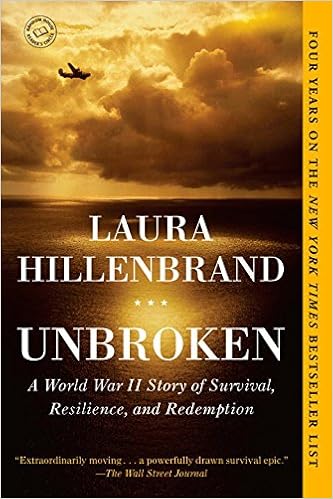 Unbroken: A World War II Story of Survival, Resilience, and Redemption by Laura Hillenbrand (ISBN: 978-0-679-60375-7) is just such a story about overcoming trials. Like so many stories of resilience in the face of overwhelming odds, the story starts with humble origins. Louis Zamperini was the son of Italian immigrants struggling to make ends meet along with most other Depression-era Americans. A caring older brother discovered the track and invited Louie along, later serving as an unofficial coach, and Louie became as star, eventually qualifying for the Olympics, running a race (5,000 meters) he didn’t usually do. He competed admirably in Berlin, finishing eighth against some of the world’s greatest runners. His running career, though, was cut short by the onset of war, and he served as a bombardier. That, too, was cut short because his plane went down during a rescue mission, and he was captured by the Japanese after some time floating in a raft at sea. Floating around for weeks was already an amazing act of survival and resilience, but the worst was yet to come. Zamperini then spent more than two years in various Japanese prison camps undergoing brutal treatment. He and others kept their wits about them by resolving to beat the system and not give in to their captors and abusers. Some made it, some did not. There were some funny stories along the way, but most of it was monotony, drudgery, and pain. Eventually, Zamperini and the others that survived were done with the horrors of the camps because the war ended. Unfortunately, for many, that was not the concrete ending they would’ve preferred. The horrors lived on in many of the former POWs’ minds, causing more than one to turn to alcohol, destructive behaviors, and even suicide to end the pain. Zamperini’s story included a lot of post-war alcoholism, but he eventually quit that thanks to a conversion to evangelical Christianity, in part because of him remembering some promises he made to God while floating aimlessly on the Pacific Ocean in the first few days after his plane went down. Zamperini used this redeeming experience in his life to later inspire and help others as well as come to terms with and even forgive his war-time tormentors.
 The Boys in the Boat: Nine Americans ad Their Epic Quest for Gold at the 1936 Berlin Olympics (ISBN: 978-1-101-62274-2) by Daniel James Brown tells a story in which sports and life worked together to teach just such lessons as young men who made up some of the Greatest Generation strove for excellence in their athletic endeavors and in life, garnering a gold medal along the way. The story follows the life of Joe Rantz the closest, but the reader also gets fairly well acquainted with his rowing teammates, some of his family, his girlfriend, and his coaches along the way. They all were the kind of people that made America great — hard workers who were responsible and self-reliant, expecting nothing from others but the best from themselves. Rantz had an interesting childhood in which his mother died, he spent some time living in a mining camp, his step-mother was the stuff of fairy tales, brutally controlling toward his dad and eventually kicking Rantz out of the house when he was still a young teenager. Joe fended for himself, living in the house the rest of his family abandoned, working his way through high school and college. It bordered, in a way, on a tale of survival during his early years. In college, he tried out for and made the rowing team, showing immense potential as a freshman. Hard work over the next three years eventually landed him and his teammates in the Olympics in Berlin, Germany, where Hitler was in his heyday. Rantz and his fellow oarsman from Washington had overcome a lot throughout their lives, many from similar backgrounds to Joe’s, to make it to the Olympics in a sport historically dominated by elites and other from the moneyed class. In Berlin, they overcame more challenges and the home team to capture gold literally right from underneath Hitler’s nose.
 Dream Team: How Michael, Magic, Larry, Charles, and the Greatest Team of All Time Conquered the World and Changed the Game of Basketball Forever (ISBN: 978-0-345-52050-0) by Jack McCallum takes a pretty in-depth look at that most famous of basketball teams. The book goes into a lot of detail about how it even came about that the pros were allowed in the Olympics. It was a long, drawn-out process that involved FIBA, the USOC, and the NBA. Once all the egos involved in such organizations were sorted to an acceptable degree, the path was open, and the U.S. got to work putting the Dream Team together. McCallum, who was an NBA writer for a long time, chronicles how each member of the team was selected. He profiles them, some briefly, some in great detail. The qualifying tournament and the Olympics themselves are also described, with the Olympics, obviously, getting more attention even though the games had similar outcomes: blowouts. Since there is so much spectacle that attends the Olympics, and the Dream Team only compounded this effect, there was a bit more to cover. The book finishes with a short section on how the Dream Team had a large impact on the the global game of basketball and talks about the mess that were the next to U.S. Olympic teams.
 The Contract: The Journey of Jimmer Fredette from the Playground to the Pros by Pat Forde (ISBN: 978-1-60907-140-0) is essentially the story of how Fredette overcame naysayers like myself throughout his life and achieved one of the lofty goals he has set for himself in his life by making it from a backwater in New York to the NBA. The book draws its name from the highly publicized contract that Fredette signed with his older brother, TJ, pledging that he would do whatever it took to get to the NBA. Fredette had a supportive family, and the book chronicles bouncing balls in the house and a makeshift full court in the back yard that was the place the neighborhood kids wanted to be. Most of all, though, he had TJ there to support him and serve as an unofficial coach and trainer throughout his formative years. The book actually spends a significant number of pages discussing TJ because of his large role in Fredette’s progress both as a basketball player and person. The book chronicles Fredette’s rise through high school and college, where he proved me and about a few million other people wrong by sweeping national player-of-the-year awards his senior year and being the tenth pick in the NBA draft.
 Putin’s Olympics: The Sochi Games and the Evolution of Twenty-First Century Russia (ISBN: 978-1-315-81728-6) is a book by Robert W. Orttung and Sufian N. Zhemukhov that brings both of those interests together. It takes a deeper look than the usual press on the subject at the Sochi Olympics and their greater context in Russia’s domestic and international politics. The book looks at the problems surrounding the hosting of the Olympics in Sochi, which included corruption, a marginalization of civil society, problematic international relations, and the relation of security during the Olympics and its connection to the Russian invasion of Ukraine. The viewpoint of the book was from that of the Olympics being something the authors defined as a “mega-project” and how Russia’s rulers, especially President Putin, tried to use that to their own advantages, both personally and to bring Russia’s standing up on the international stage. The authors come to what I consider mixed conclusions, noting that the Sochi games were secure, did result in much-needed infrastructure upgrades in Sochi, and, from Putin’s standpoint, his position was secured because Russians saw the Olympics as a positive for their country, although, as the Shenderovich quote above notes, this is not necessarily a good thing. On the other hand, the successes came at a great price, both monetarily and in prestige internationally, where Russia was hurt by the scandals surrounding the games.
 Assisted: An Autobiography (ISBN: 978-1-60907-570-5) by John Stockton, if nothing else, proved me right in my assumption. Memoir might be a better description of the book, but those arguments about semantics take nothing away from a rather thorough look at Stockton’s life as a little kid roaming the neighborhood with his friends on long summer days to his time as an NBA star and through his post-retirement activities. He told about his upbringing, his childhood, his high school days, his experiences in college, including various summer jobs, basketball, and dating. He talked about making it in the NBA, being a rookie, changes in the game, some of former Jazz owner Larry Miller’s quirks, and a host of other things that fans and disinterested parties alike might find interesting. He talked about his family, and his parents and wife in particular. He discussed a couple of his coaches, including Jerry Sloan, an NBA great and another hard-nosed, down-to-earth, blue-collar guy. Stockton’s discussion of the Olympics was fascinating because he was very open about his love for his country and the great responsibility he felt putting U.S.A. on his chest. He discussed his life after basketball, except that it hasn’t really been life after basketball as some of his kids of played at a very high level, he’s restored a warehouse and turned it into a community sports center, and he’s still involved in the occasional pickup game. Finally, as part of the proving my assumptions true, his tale is woven throughout with references to family, God, prayer, hard work, and other old-fashioned values.