 Finding God in the Gulag: A History of Christianity in the Soviet Penal System by Jeffrey S. Hardy (ISBN: 978-0-19-775167-1) is a book that gives readers a chance to know more about life in the Gulag. Unlike Solzhenitsyn’s based-on-a-true-story novel, this book is an academic look at Christianity in the Soviet camps from the earliest days under Lenin to the dying days of the Soviet Union under Gorbachev with a little post-script about a few things in the post-Soviet times. It catalogs both attempts by inmates to life and express their religions and attempts by the prison management to suppress religion. It was interesting to note that efforts to extinguish religion in prisoners was not uniform in the Soviet Union. It was more lax in some camps than in others. There wasn’t always a central policy that camp managers could look to, so they did it their own way. Sometimes that meant believers were beaten and spent time in solitary confinement. Sometimes that meant a Christian guard did nothing when a prisoner prayed or sang a hymn or made an icon. There was a short section on faith among thieves and other such common criminals, including a few paragraphs about the fascinating world of Russian prison tattoos. The book also catalogs people losing their faith, which was unsurprising, and one that is not judged neither by the author nor by most prisoners who are cited in the book. They tended to believe the camps were inhumane and that one should not be judged too harshly or even at all for what they did in the camps. There was also a little proselyting that happened in the labor camps. This was especially true of Baptists and Jehovah’s Witnesses, but Orthodox and Catholic priests also preached and even baptized people. Toward the end of the Soviet regime, religion was sometimes encouraged because it generally had a good influence on prisoners and mediated their violent behavior.
The book was an interesting read and would be interesting to people interested in Russian or Soviet history or religion. It only briefly discussed non-Christian religions, which are major players in Russia, but either weren’t the focus of the book or weren’t such a concern in the Gulag. I did think the book was slightly disorganized and it felt like the narrative jumped around a lot, but I am not sure how I would’ve better organized it. I thought the stories about people finding faith and maintaining faith despite great psychological and physical pressure were inspiring. People sacrificed a lot to maintain their belief in God and to live it according to their conscience. It’s worth looking to many of these people as examples of standing up for what’s right no matter the consequences.

|
This work, including all text, photographs, and other original work, is licensed under a Creative Commons Attribution-NonCommercial-NoDerivatives 4.0 International License and is copyrighted © MMXXI John Pruess. |



 Hide Your Children: Exposing the Marxists behind the Attack on America’s Kids by Liz Wheeler (ISBN: 978-1-68451-391-8) provides a look at how the education system has deteriorated further since the 1980s. The book starts with an overview of just who the Marxists the subtitle is talking about and then gives specific examples of how attacks on the nuclear family, endless accusations of racism, critical theory, queer theory, and attacks on homeschool, a proxy for attacks on personal responsibility and liberty, fit into the Marxist program meant to destroy society. Each chapter gives some history of where the modern Marxist threat originated and, using specific examples, how it became more mainstream than it ever should have. The historic sections are followed by a discussion of how it is today and the threat that presents to America, a country built on the idea that it survives only if the people who inhabit it are a moral people. The book ends with a chapter providing some suggestions on how to change the tide and fight back against the Marxist wave that has overpowered our educational system since it’s much easier to change the minds of the impressionable young than older people more set in their ways. The author’s suggestions include fighting the culture war, working to ban critical theory from public institutions, homeschooling whenever possible, fighting for school choice, working against ESG and DEI, remembering that local politics have an outlandishly large impact on our lives, returning to religion, and protecting the innocence of our children. Finally, there were some appendices with the Constitution and papal encyclicals that discussed the dangers of Communism.
 Iron Curtain: The Crushing of Eastern Europe, 1944–1956 by Anne Applebaum (ISBN: 978-1-4000-9593-3) discusses just how Communist regimes came to power in Europe following World War II. The book chronicles how the Communists came to power in Eastern Europe, focusing on Hungary, Poland, and East Germany, with a fair number of examples from Czechoslovakia and occasionally Romania. The Communists rose to power quickly in post-war Europe through a comprehensive strategy that thoroughly encompassed the lives of the people. This included the police, youth organizations, the media, political organizations, the arts, and the economies of the countries where the Soviet Union was victorious over Germany. In many cases, a combination of factors worked together to make the Communist takeover work. First, it was the Soviet Union that was in control in these areas. Even in places where there was arguable Allied control, it was the Soviets doing the day-to-day administration, so they worked to install people and organizations that were compatible with their ideas of how things should work. Second, there had already been strong support for Communist, socialist, and other Left-leaning ideologies before and during the war. This only continued after the war. Third, the activists were the ones most involved. They were also the ones who were willing to use violence to reach their goals. While most regular people were concerned about getting a job, rebuilding their homes and businesses, and helping their friends and families, activists were getting involved in politics, unions, youth and religious organizations, and the media. This helped them make sure that things were done they way they wanted. In the rare cases when there was some push-back, the activists, often with help from the police or the newly formed secret police organizations, violently quashed any dissent. Applebaum does discuss resistance a little, but this is a short section, which seems to accurately represent the proportions of active and passive support or acquiescence to the regime and resistance.
 Red Scarf Girl: A Memoir of the Cultural Revolution by Ji-li Jiang (ISBN: 978-0-06-446208-2) details one of the worst parts of China’s Communist history, the Cultural Revolution. The book, a memoir, is told from the viewpoint of the author as the events unfolded. Her family history included a well-to-do grandfather, a Muslim grandmother, and a father who had joined the Communist Party in its infancy when it was still illegal and then had a falling out with its leaders. This put her at a disadvantage when Mao began the Cultural Revolution to retain his power (power struggles seem to be a fixture of Communist regimes) since her family was not considered “red” enough. Ji-li was a true believer in Mao and the Revolution at the beginning of the book, but as things went along and friends and neighbors were denounced, goals and dreams shattered, lives ruined (or lost), and her own family affected, she came to understand that devotion to a cause or a leader should not trump one’s devotion to the truth and to one’s family. Like many Chinese, she was later disappointed when she found out that the Cultural Revolution and all the damage it had done was not really to advance Communism, but to allow Chairman Mao to hang on to power. Ji-li paints a descriptive picture of what life was like before the chaos, and it actually didn’t seem too bad. When the Cultural Revolution starts, though, things change quickly and they change drastically, as all things old are thrown out. Kids can no longer read comics, neighbors stop talking to each other and some look for ways to harm neighbors and former friends. School is changed, favoring class status instead of merit. Houses are ransacked, people imprisoned, beat, sometimes killed. Hope is lost for many. Some, like Ji-li’s father, resist heroically, never admitting to the accusations leveled falsely against him. Life eventually settles down, but it’s never the same again, and even to a young girl, it’s obvious that there were freedoms and opportunities lost.
 Stasiland: Stories from behind the Berlin Wall by Anna Funder (ISBN: 978-1-84708-355-7) is a book written in a journalistic style that tells a variety of stories from East Germany: former Stasi, dissidents, people who tried to escape, and just regular people. The book, because of its style, also followed the author’s journey through East Germany and dealing with the psychological damage being so close to it dealt her. The people interviewed included a woman who was not political at all, but one day, found herself close to the border, saw a possibility, and went for it. She was caught, imprisoned, and forever scarred by the traumatic experience. She later married a guy who was punished for an escape attempt simply because he swam out toward a boat that was Swedish while at an East German beach. Endless trouble from the state eventually killed him. Another was a neighbor of the author, a rock musician who was famous throughout the country. Eventually, the authorities decided he and his group were just too much, though, and they were informed they no longer existed. The state disbanded the group. One of the most heart-rending stories came thanks to a woman who essentially traded her freedom for that of others. She and her husband had a very sick baby that was being treated in a West German hospital because the East Germans didn’t have the right medicines and abilities. The parents were only allowed a couple visits, and never together, in an effort to prevent defection. Later, the parents prepared to make an escape attempt via a tunnel. The Stasi, East Germany’s brutal secret police, found out about the tunnel, though, and the escape attempt was called off. That didn’t prevent the parents of the sick boy from being persecuted. Eventually, the mother was told she could go to the West and see her son, but there were conditions. One of the conditions would’ve sold out some of the others who had been involved in the escape attempt. In an amazing act of heroism, she didn’t give in. The boy grew up in the West under the care of nurses and doctors. The interviews with the former Stasi were less exciting. Most seemed to lament, in one way or another, the passing of the former East Germany and the power, authority, and privilege many of them had, usually at the expense of others. The reunification wasn’t kind to everyone, resulting, in some cases, in increased crime and poverty for those who struggled to adapt to the new order.
 In Europe’s Shadow: Two Cold Wars and a Thirty-year Journey through Romania and Beyond by Robert D. Kaplan (ISBN: 978-0-8129-8662-4) is a wide-ranging survey of Romanian history, focusing on the post-World War I XX century and the first decade or so of the XXI century. Kaplan has

 Savage Continent: Europe in the Aftermath of World War II by Keith Lowe (ISBN: 978-1-250-03356-7) takes a very raw look at the immediate post-World War II period in European history. The author catalogues the side of post-war Europe that is not usually highlighted in articles and books: genocide, ethnic cleansing, corruption, and violence. The wartime years are famous for those, but they continued, usually on a smaller scale and in a more isolated fashion, for years after the Allies defeated the Axis powers. Lowe examines the post-war conditions and how they created the ideal setting for further violence. While the Allied armies tried to gain control and figure out just what they had on their hands, displaced persons and refugees wandered Europe. There were plenty of instances of vigilante justice and people looking for revenge against the Germans or other people that had truly or only purportedly wronged others. In Poland, Hungary, Czechoslovakia, and a few other places, the German concentration camps were still being used, either has temporary housing or by the Soviets or others for their original purposes, just against a new type of inmate. Ukrainian and Poles fought. Greece went into a civil war. Jews continued to find no quarter. The Allies and international organizations worked hard to remedy the harsh conditions, but given the level of destruction the war had wrought, it was often slow going. Finally, the emerging struggle of the Cold War meant that some of these problems were not given the focus that some would have liked them to have been under.
 A River in Darkness: One Man's Escape from North Korea by Masaji Ishikawa (ISBN: 978-1-5420-4719-7) is just such a tale, although it does have an interesting twist. The author was not born in North Korea; in fact, he was born in Japan and was ethnically half Japanese. His dad, who was not native to Japan, moved his family to North Korea under pressure from ethnic compatriots and the pressure of being an ethnic minority in re-building, post-war Japan, where such minorities weren’t always welcome. The promises of the Communist utopia were very quickly discovered to be a total sham by the author and his family. However, there was no real opportunity to get out. The author's family had nothing to offer the Communist Party, so they lived as peasants, eventually finding that living under the radar of the authorities was easier than trying to conform to the system in North Korea. Eventually, Ishikawa tires of the poverty, starvation, racism, hypocritical inequality, and lack of freedom. He heads toward the border with China, fearful, but determined to make a break for it since, although that would mean an uncertain future, it was better than the future he could easily predict inside North Korea. He made it to China, eventually linking up with the Japanese embassy there, which, with great difficulty, helped exfiltrate him to Japan. Once back, Japan had jumped forward forty or so years, while North Korea had steadily gone backward. Ishikawa struggled to adjust and felt abandoned by Japan.
 KGB: The Secret Work of Soviet Secret Agents by John Barron tells some of the stories of the main Soviet agency of oppression and secrecy, the KGB. It provides an overview of all the Soviet intelligence agencies, but focuses on the KGB, which the author assessed to be the brains behind all of them. After the more academic portion of the book, it recounts a few fantastic stories. Most of the stories, a few which I had read elsewhere previously, had to do with the stuff of movies. The book contains the stories of Americans who betrayed their country and of Russians who betrayed theirs. They are fascinating accounts full of sneaking around big cities, breaking into vaults, offers of money, international intrigue, “seductresses” (as promised by the paperback version’s typically sensationalist cover art), and, of course, spies. It was interesting to read of a disgruntled U.S. Army soldier, his former prostitute wife, and his giving the Russians access to something they likely figured was impossible to access. I was also really intrigued by the stories of Russians and other eastern Europeans who risked it all to do what they figured was their part in the battle against authoritarianism and for liberty. One interesting story was that of a Czech who was sent to Canada by the Russians, but who ultimately decided that all he had been taught in years of intense training was not true now that he’d been in the West and seen how things really worked.
 In When Character Was King: A Story of Ronald Reagan by Peggy Noonan (ISBN: 978-0-14-200168-4), the former Reagan staffer (speechwriter), journalist, and columnist gives her take on the fortieth president. The story starts when Reagan was a kid and ends as he succumbs to the Alzheimer's and the ailments of time. One learns where he got his worldview from and how his early life influenced where he got. Reagan's father, I learned, was an alcoholic, but he still imbued his son with principles that served him well in seeing the greatness in all people and in upholding America's tradition of equality. Reagan's mother was a strongly and actively Christian woman, which also became a major part of his character. He believed in God and believed God wanted to be part of people's lives. One reads about Reagan's involvement in Hollywood. He was arguably an up-and-coming star, but never went big time because he got involved in the actors' union and the more political side of things. His political career was dogged by accusations of being just an actor, and acting likely helped him as he campaigned, but his real talent was likely in speechmaking to begin with. The book recounts Reagan's entry into politics. He was not, it seems, overly ambitious, but saw his involvement as a chance to help people, and that's where character came in. Reagan had standards and stuck to them, providing for people a stable and strong standard behind which they could rally. He was unabashedly religious, had no tolerance for racism, and knew that there was a distinct difference between democratic forms of government with capitalistic and those of the "
 Rise and Fall by Milovan Djilas (ISBN: 0-15-177572-9) provides one man’s (Djilas (Đilas) himself) view of the Communist rise to power in Yugoslavia. Since he was one of Tito’s closest aides and advisors, he provides an inside perspective that is largely unrivaled. He also chronicles what he considers the falling away of the Yugoslav Communists from their revolutionary ideals. As he comes to realize that Communism, as implemented in Yugoslavia, isn’t what was promised, he becomes disillusioned with it, enough so that he published material critical of Tito and the Communists, leading to nine years as a political prisoner. Djilas covers a lot of ground in a little over 400 pages. He gives a short account of the wartime Communists, but mostly focuses on life under Tito after the war. He talks about foreign relations, internal politics, bizarre Communist Party perks like special stores for the elite party members, the cult of personality surrounding Tito, and the oppressive nature of a totalitarian or dictatorial political system. Interestingly, Djilas’s falling out was not with Communism; it was with what Communism had developed into in Yugoslavia. The reader even gets a small glimpse into Djilas’s personal life as he discusses his marriages. Finally, the totalitarian oppression claims the once high-ranking government official and he spends almost a decade as a prisoner because of his ideas, not necessarily even that radical.
 To the Rescue: The Biography of Thomas S. Monson by Heidi S. Swinton (ISBN: 978-1-60641-898-7) chronicles the amazing life of service that President Monson has led from an early age through the present day. The timeline for the biography is straight forward, starting with his early childhood and ending with his time as the leader of the Church. He learned from parents and family around him in what was, at the time, a typical childhood. It follows him through high school, a mission, early marriage, employment, and a variety of Church callings. Along the way, there are many familiar stories, but there are sometimes some additional details that weren’t always part of the many sermons President Monson has given. There were also some additional stories. It was interesting to read about President Monson’s family a little bit and about his professional experienes. There was a lot of time spent on President Monson’s service as an apostle in what was then East Germany. The Church history aspect was interesting, as it was with some of the other episodes from his life, but they often seemed more like pioneer stories because of the great faith shown and the hardships endured. What was consistent no matter what part of his life was being discussed was the dedication he showed to serving others, whether that be in his family or those around him. President Monson was never too busy to help someone out, talk to them, visit them, give them a blessing, or share time and possessions with them. It becomes abundantly clear as the life of this man is chronicled that he understands very well that Heavenly Father is serious when He says that the worth of souls is great in His sight. President Monson has cultivated that genuine love and concern that is a trait of our divine Father and made it a part of his own personality.
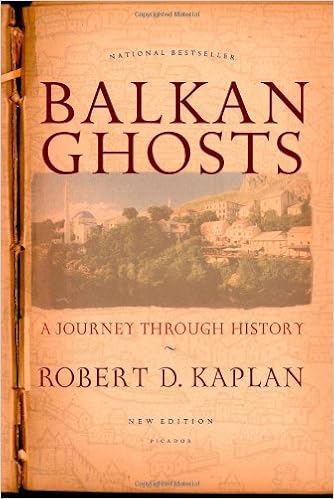 Balkan Ghosts by Robert D. Kaplan (ISBN: 978-0-312-42493-0), is self-styled as a travelogue, but is more akin to a feature story in a national magazine on current affairs. Kaplan weaves his extensive travels and living experience in the region and the accompanying interviews and everyday events with historical perspective and the relevant biographical information pertaining to the important figures in the Balkans’ history, his “ghosts.” Kaplan’s definition of the Balkans is a bit wider than most Americans’, so not only the former Yugoslavia, but Romania, Bulgaria, and Greece, too, are included in the discussion of this fascinating geographical region. Each country and each nation (ethnic group) has a few figures in its past who lived in such a way and made decisions in such a way as to continue to influence the way things are done and the way people think. With the exception of Greece, the Balkans also deal with a specter of a different type, the continued need to deal with the harsh consequences of communist dictatorships that broke people and destroyed countries immediately after the Nazis and fascism gave the same thing a whirl. It’s worth noting that the Nazis followed right on the heels of the Hapsburgs, who were, in most people’s estimation, better rulers than the succeeding ones, but on occasion no less ruthless. The great figures and great histories of the various peoples are presented with all the raw emotion that is associated with Balkanization, and Kaplan points out that since the histories are great, the people pick those moments when their histories were at an apex and claim that cultural, linguistic, and territorial summit as the way things should be now before any other discussions can be had. It puts them all in a hard place, but Kaplan argues that considering all the things these groups of people and these countries have been through, there’s really no way but up, although, as his reference to Shakespeare alludes to, it might be a painful process.