Showing posts with label religion. Show all posts

Friday, September 25, 2026

Restoring the Ancient Church

One of the unique things about the Church of Jesus Christ of Latter-day Saints is that its members, myself included, believe that it is headed by a prophet.  Most people are familiar with the idea of a prophet through names like Moses, Isaiah, and Noah. Those prophets received revelation — information — from God and then passed it along to others. Joseph Smith did the same. Part of his job was to be the means on Earth used by God to restore the ancient Church.  The concept of a prophet lives on today, with the head of the Church being a prophet who also communes with God and then passes the knowledge acquired on to us to help us navigate the stormy seas of our time and the questions unique to our situations.
 
Book cover.Restoring the Ancient Church: Joseph Smith and Early Christianity by Barry Robert Bickmore (ISBN: 978-1-893036-16-1) explores the idea that the church founded by Joseph Smith was not made up, but actually follows the ancient church as set up by Christ while on the earth.  It starts with a discussion of the apostasy and if a restoration was even necessary.  Once that was established, the author delves into topics such as the nature of God, the organization and structure of the church, the afterlife, and even a little bit about baptism and the temple ordinances.  There are extensive and thorough excerpts from ancient writings, some apocryphal, some simply scholarly and philosophical explanations from the first four centuries after Christ that show that the ancient Christian church believed and practiced many things that align with the modern teachings of the church founded by Joseph Smith.  The idea of a non-trinitarian, non-creedal God consisting of three separate beings united in purpose was quite normal.  An afterlife consisting of more than simple understandings of heaven and hell, but of degrees of inheritance and the possibility for progression was extant.  The ancient church had sacred ordinances not shared with outsiders that focused on the creation and man’s mortal journey as a stepping stone to return to his Heavenly Father.  A case is made that even baptism was regarded as a sacred thing, not necessarily to be shared with everyone, and was more closely guarded than it is today.  The organizational structure of the ancient church, at least as presented, had many similarities.  The overarching point was that Joseph Smith had no possible access to most of the sources provided, and even if theoretical access existed to others, it wasn’t something a hard-working but poor farmer had the time the nor means to deal with.  The evidence points to two things: Joseph Smith had access to revelation and the restored Church is the same Church as the one Christ Himself established.

I found the book to be fascinating, although dry in places.   I found the explanation of the apostasy and the need for a restoration to be kind of bland, although necessary.  The evidence was all very interesting.  Some bits of evidence were strong than others, and some of the more difficult-to-understand passages from ancient theologians sometimes seemed to miss the mark.  It seemed all very thorough, though.  The evidence presented is convincing, but in no way replaces the real way to know if something is true or not, which is to follow Joseph Smith’s example and ask of God.  One final note: The book was clearly published on a budget, and there were enough typos and formatting errors for me to be distracted at times.  Like all modern books, what should be footnotes are endnotes, causing a lot of wasted time flipping between where one is reading and the endnotes (even with a bookmark in the endnotes).
 
Creative Commons License
This work, including all text, photographs, and other original work, is licensed under a Creative Commons Attribution-NonCommercial-NoDerivatives 4.0 International License and is copyrighted © MMXXI John Pruess.

Tuesday, February 03, 2026

Finding God in the Gulag

In college, I borrowed a copy of Solzhenitsyn’s famous work, One Day in the Life of Ivan Denisovich, from the BYU library, and read it.  This was remarkable on two counts.  First, this was not assigned reading for a class; it was of my own free will and choice.  Second, it was fascinating!  It was an engrossing story that pulled the reader in.  I could easily imagine myself right there alongside the title character freezing to death in a work brigade and dealing with the guards and fellow inmates in the barracks.  It brought to life the horrid conditions of Soviet labor camps, something that the world hasn’t entirely gotten away from yet.  It was something I found interesting enough to want to know more about.

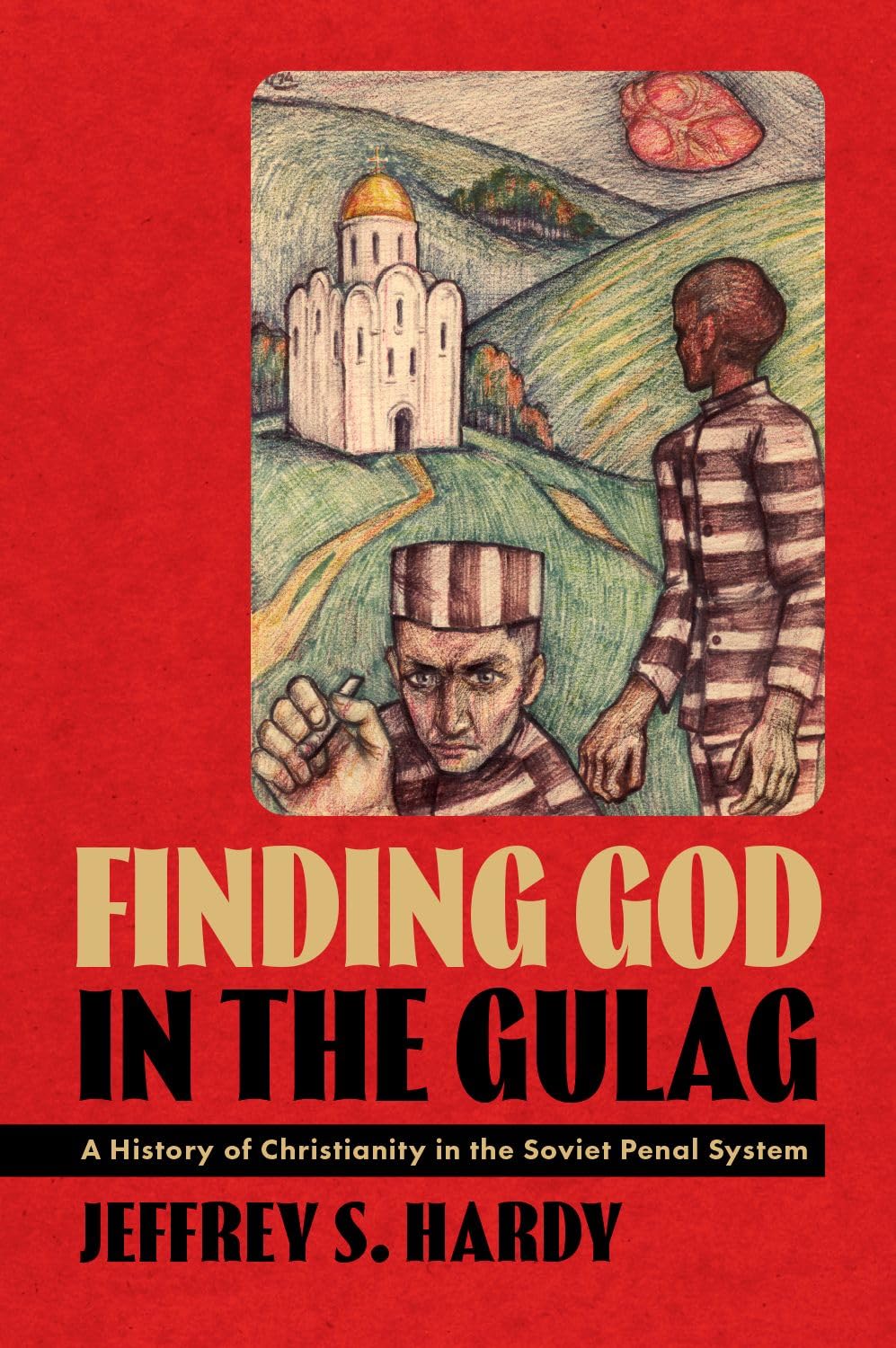
Book cover.Finding God in the Gulag: A History of Christianity in the Soviet Penal System by Jeffrey S. Hardy (ISBN: 978-0-19-775167-1) is a book that gives readers a chance to know more about life in the Gulag.  Unlike Solzhenitsyn’s based-on-a-true-story novel, this book is an academic look at Christianity in the Soviet camps from the earliest days under Lenin to the dying days of the Soviet Union under Gorbachev with a little post-script about a few things in the post-Soviet times.  It catalogs both attempts by inmates to life and express their religions and attempts by the prison management to suppress religion.  It was interesting to note that efforts to extinguish religion in prisoners was not uniform in the Soviet Union.  It was more lax in some camps than in others.  There wasn’t always a central policy that camp managers could look to, so they did it their own way.  Sometimes that meant believers were beaten and spent time in solitary confinement.  Sometimes that meant a Christian guard did nothing when a prisoner prayed or sang a hymn or made an icon.  There was a short section on faith among thieves and other such common criminals, including a few paragraphs about the fascinating world of Russian prison tattoos.  The book also catalogs people losing their faith, which was unsurprising, and one that is not judged neither by the author nor by most prisoners who are cited in the book.  They tended to believe the camps were inhumane and that one should not be judged too harshly or even at all for what they did in the camps.  There was also a little proselyting that happened in the labor camps.  This was especially true of Baptists and Jehovah’s Witnesses, but Orthodox and Catholic priests also preached and even baptized people.  Toward the end of the Soviet regime, religion was sometimes encouraged because it generally had a good influence on prisoners and mediated their violent behavior.
The book was an interesting read and would be interesting to people interested in Russian or Soviet history or religion.  It only briefly discussed non-Christian religions, which are major players in Russia, but either weren’t the focus of the book or weren’t such a concern in the Gulag.  I did think the book was slightly disorganized and it felt like the narrative jumped around a lot, but I am not sure how I would’ve better organized it.  I thought the stories about people finding faith and maintaining faith despite great psychological and physical pressure were inspiring.  People sacrificed a lot to maintain their belief in God and to live it according to their conscience.  It’s worth looking to many of these people as examples of standing up for what’s right no matter the consequences.
   
Creative Commons License
This work, including all text, photographs, and other original work, is licensed under a Creative Commons Attribution-NonCommercial-NoDerivatives 4.0 International License and is copyrighted © MMXXI John Pruess.

Friday, January 02, 2026

He Walked the Americas

I remember hearing a story from my grandpa as a young kid about some Indian tribe that believed their ancestors had contact with a great white god and how some people in the Church of Jesus Christ of Latter-day Saints believed that could easily be explained by Jesus’s visit to the Nephites after His resurrection.  Later, I learned that such legends were likely more widespread and that the natives at the time of the Spanish Conquest may have been influenced by these beliefs to think that the arrival of the white conquerors was a second coming of Christ, the great Queztalcoatl.  I was reminded of those old stories more recently when a Native American man who was also a member of the Church made the rounds on Church-related podcasts and said that when he went through the temple, he found a lot of similarities to his lodge ceremonies.  I don’t know how much these various stories have been convoluted with Mormon culture, but they always seemed interesting to me, and it seemed like there could be at least some truth to them.  

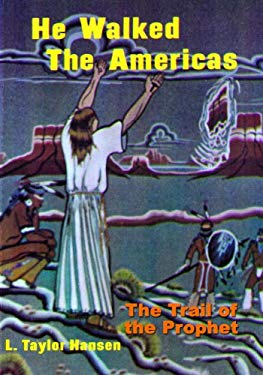
Book cover.He Walked the Americas: The Trail of the Prophet by L. Taylor Hansen (ISBN: 978-1-939149-19-0) is a compilation of stories from North and South American Indians that relate to a so-called white or pale prophet.  The stories tell about the arrival of the prophet, his activities, and then his departure.  The legends describe the man, usually as wearing white garments (most often with small crosses on the hem), having brown hair, usually a beard, wearing sandals, and usually with cross-shaped marks in his hands.  Sometimes he was accompanied by other white men.  Other times he organized churches, established temples, and called people to continue his teachings after his departure.  The arrival is usually on a ship in the legends, but one of the stories recorded by the author noted that the mysterious white prophet’s ministry started with his appearance at the temple.  The man’s activities while visiting the ancient Indians included preaching peace, ending human sacrifice, healing sick and otherwise afflicted people, and controlling the wind and water.  The last two were kind of important in the legends because this god was often referred to as the feathered serpent.  Wind was often represented by feathers and the water by the snake.  The organization of churches, usually with twelve men called to be leaders and teachers, and the establishing of temples was the other main activity of this white prophet in the legends.  The stories then tell of his departure, usually with the people mourning his leaving and eventually forgetting his teachings and reverting to war and human sacrifice.

I thought the book was very interesting.  Hansen simply compiled the stories and lets the reader judge for himself what to think.  If someone is well acquainted with Mormon theology, the most likely candidate for the great white prophet is Jesus after His resurrection.  The legends allow for a few other Book of Mormon-related possibilities, too.  Many of the legends involve the white prophet’s arrival via boat.  Both the Jaredites and the Nephites arrived by sea and brought with them seeds, which was also in the legends.  Some have claimed the legends, especially in North America are the result of Moroni’s travels before finally depositing the plates in the Hill Cumorah.  There’s no real way to know since the stories are clouded by time (admitted by the compiler and by some of the Indians relating the legends), but the similarities are fascinating and with so many from such a disparate set of sources, there is also no real reason to discount them all.  Knowing the Book of Mormon is true comes through study and prayer, but anthropological evidence for it like this is always nice to have once the spiritual testimony has been gained.
   
Creative Commons License
This work, including all text, photographs, and other original work, is licensed under a Creative Commons Attribution-NonCommercial-NoDerivatives 4.0 International License and is copyrighted © MMXXI John Pruess.

Thursday, March 07, 2024

Hide Your Children

In the 1980s in America, homeschooling was not popular.  For three of my elementary school years, I got to be homeschooled.  I thought it was great.  I got to learn at my pace, which was wonderful for subjects like math, science, and English.  I loved that I was usually done with my school day two to three hours earlier than the rest of the kids in the neighborhood.  At home, I only had to do actual schoolwork and none of the fluff or other, non-academic stuff.  I remember hearing from many people that kids who were homeschooled would not be socialized.  No one ever really defined that word, but between city sports leagues, church activities, and playing friends in the neighborhood, I had plenty of chances to be with other kids, not to mention the fact that the overwhelming majority of inappropriate things I learned I had learned at school.

Book cover.Hide Your Children: Exposing the Marxists behind the Attack on America’s Kids by Liz Wheeler (ISBN: 978-1-68451-391-8) provides a look at how the education system has deteriorated further since the 1980s.  The book starts with an overview of just who the Marxists the subtitle is talking about and then gives specific examples of how attacks on the nuclear family, endless accusations of racism, critical theory, queer theory, and attacks on homeschool, a proxy for attacks on personal responsibility and liberty, fit into the Marxist program meant to destroy society.  Each chapter gives some history of where the modern Marxist threat originated and, using specific examples, how it became more mainstream than it ever should have.  The historic sections are followed by a discussion of how it is today and the threat that presents to America, a country built on the idea that it survives only if the people who inhabit it are a moral people.  The book ends with a chapter providing some suggestions on how to change the tide and fight back against the Marxist wave that has overpowered our educational system since it’s much easier to change the minds of the impressionable young than older people more set in their ways.  The author’s suggestions include fighting the culture war, working to ban critical theory from public institutions, homeschooling whenever possible, fighting for school choice, working against ESG and DEI, remembering that local politics have an outlandishly large impact on our lives, returning to religion, and protecting the innocence of our children.  Finally, there were some appendices with the Constitution and papal encyclicals that discussed the dangers of Communism.

Looking back on my time in school, I can see some of the early beginnings of what was discussed in the book.  I remember having lessons on self-esteem in fifth grade.  The discussions about just what constitutes a put-down are exactly the kind of thing that gets rolled into social-emotional learning in the mid-2020s.  Homeschooling was a great experience for me that taught a lot about personal responsibility and putting forth the effort to better one’s own life.  That was the ultimate message of the book, but it also presented a good picture of what some of the problems with the modern American education system and how much of what is taught is at odds with the liberty needed to be self-sufficient.  One interesting undercurrent of the book was Wheeler’s belief that while religion was key to containing Marxism, Catholicism was the preferred route.  The appendices included two very long papal encyclicals, both of which accurately described Communism as a problem, but were also inclined to support organized labor as a rather fuzzy concept of how to deal with poverty.  The descriptive portion of the book was its strongest and make it worth reading.  The prescriptive part was fine, with ideas that were good, but left me wanting more specifics (something that would improve many books about politics).  
 
Creative Commons License
This work, including all text, photographs, and other original work, is licensed under a Creative Commons Attribution-NonCommercial-NoDerivatives 4.0 International License and is copyrighted © MMXXI John Pruess.

Saturday, July 15, 2023

Why I Stand

When I was a kid, sports on TV was a big deal.  The local colleges played football seasons that were eleven or twelve games long, but less than half of those games were on TV.  Only about half the people I knew had cable, so sometimes televised games weren’t even available to everyone.  When something was on TV, I made the effort to watch.  I liked watching BYU’s football and basketball games as well as Utah Jazz games with the occasional Oakland A’s game when they were featured on national TV.  As I got older, there were more things on TV, particularly more Jazz games, and I still tried pretty hard to watch as many of those as I could.  Nowadays, with work, family, and other more pressing matters, I hardly ever watch the Jazz games and watch BYU games less frequently than before.  I have never been an NBA fan or a college football fan, though, and, in general, couldn’t care less about other teams or what’s happening in various leagues or conferences.  I care about my favorite teams and that’s all.  Every so often, something happens in the sports world, though, that makes waves and casual fans like me or even non-fans have to take notice.

Book cover.Why I Stand by Jonathan Isaac (ISBN: 978-1-956007-06-0) is a book that exists because of one of those moments.  After the protests and riots that occurred after George Floyd’s death, many athletes used their position (“platform” being the buzzword everyone liked to use) to advocate for a message they believed in.  One of the more controversial ways they did this was to kneel during the national anthem.  Jonathan Isaac, a very promising NBA player, chose to buck the trend and stand during the national anthem.  He stood out even more because he did not choose to wear the Black Lives Matter apparel that most others did.  Like most things, his decisions in that matter were not just sudden, spur-of-the-moment thoughts.  They were based on a lifetime of experiences and a large body of personal beliefs.  The book recounts Isaac’s childhood, high school and college experiences and rather meteoric rise in the sport of basketball from a no-name kid playing inconsistently in high school to a top-10 NBA draft pick.  It also discusses Isaac’s struggles with anxiety and belief in his own worth, which were ultimately helped more than anything by a spiritual journey that led to a firm belief in God.  He writes about going to church as a kid, but not really knowing why and not applying what was being taught.  Like many people, he had some negative experiences with organized religion along the way, and by the time he was playing in the NBA as a rookie, he was connected to religion in name only.  A neighbor who was a church leader and a few setbacks in his basketball career provided opportunities for Isaac to re-evaluate his relationship with God, and his honest approach to that led to a conversion that led to action that ranged from feeding the poor to becoming a pastor in his church.  Ultimately, those convictions led him to stand while his teammates knelt during the national anthem, but he believed that incident was just one instance of standing for truth and right and that God asks that of His followers in many other situations, too.

Charles Barkley, another famous basketball player, once said in an advertisement that he was not a role model.  It was a controversial advertisement because basketball players and other famous people in the spotlight are role models whether they want to be or not and whether they should be or not.  I find that most of them should not be, but a guy like Jonathan Isaac is a role model by virtue of his position and his actions.  His account came across and genuine and humble.  He was open about his struggles and did not shy away from the fact that he made mistakes in his life and is still far from the perfection that God has commanded us to stive for.  However, he has not tried to dodge hard work and responsibility at all and has put forth the effort necessary to effect change in his life for the better.  His willingness to stand alone for his beliefs is admirable, no matter where someone comes down on the issues (he notes in his book that many did not agree with him, but that some teammates and others told him they found his courage and determination to be character traits worthy of respect and emulation).  I thought he had well-articulated reasons for doing what he did, and I happen to agree with them, but I found the book’s message of finding one’s self-worth in Christ and in knowing that we are beloved children of God to be the main message.  The byproduct of knowing those things is that one is then willing to stand for truth and right even when it’s uncomfortable.  
 
Creative Commons License
This work, including all text, photographs, and other original work, is licensed under a Creative Commons Attribution-NonCommercial-NoDerivatives 4.0 International License and is copyrighted © MMXXI John Pruess.

Sunday, August 08, 2021

Saints: No Unhallowed Hand

Salt Lake City, Utah, is home to an interesting state park that is currently called This Is the Place Heritage Park.  I remember it as This Is the Place State Park.  It is home to a grand monument to Brigham Young, the Mormon pioneers, and other explorers of the early American West.  The rest of the park is a number of reconstructed early pioneer homes, outbuildings, and buildings such as a blacksmith’s shop, a general store, and other buildings typical of frontier towns.  As a kid, the thing that attracted me most to the park was that they sold candy in the general store, there were farm animals to see, and there were a few things that kids could do, such as give combing wool a try (it was much more difficult than it looked).  I had little appreciation for the pioneers that the park and monument were originally meant to honor (“originally” is a key word because now it’s billed as a “living history museum” and they’ve even added that old, traditional pioneer facility, the splash pad).

Book cover.Saints: No Unhallowed Hand (ISBN: 978-1-62972-648-9) is the second volume of a multi-volume history published by the Church itself.  This volume follows the Church’s exodus from Nauvoo to the Salt Lake Valley.  It tells the story of the wagon trains and hand cart companies that forged the Mormon Trail.  The Church was forging into new territory as well, as Brigham Young became the second president of the Church and the second prophet of this era.  In addition to trekking across the North American plains, the Church was expanding internationally, with missionaries taking the message of the restored gospel to Europe, South Africa, and the islands of the Pacific.  Missionary work didn’t always go so well, and there were plenty of other locations, like Southeast Asia, where missions resulted in extremely few converts.  The book also chronicles the early Church’s struggles with the American government.  After the lack of concern the federal government showed the Church when Missouri’s official position was persecution, most Church members were wary of the U.S. government.  Brigham Young and his successors were wary, but also saw the wisdom of working toward a reconciled position.  This led to things like the Mormon Battalion and helped influence Church members’ thinking as some later struggled to accept the end of polygamy.  A major theme in the book was the construction of temples.  They required great sacrifice, but also resulted in great blessings.  
The book is written in the same way as the first volume in the series, so there were no surprises this time with formatting, style, or anything like that.  I probably enjoyed reading this volume a little more than the first one because I am less familiar with the early missionary efforts and the stories of Church members across Europe and the Pacific.  I thought most of the stories were good: interesting and something one can learn from.  The book dealt in depth with polygamy, which was never something I struggled with, but I know it’s a question that many, both inside and outside the Church have.  The book touched on the Mountain Meadow massacre in a way that I thought presented a good level of detail and the level to which Church members were involved.  The stories of faith and sacrifice were what made the book a worthwhile read, though, teaching of their importance and the attendant blessings they bring to our lives.

Creative Commons License
This work, including all text, photographs, and other original work, is licensed under a Creative Commons Attribution-NonCommercial-NoDerivatives 4.0 International License and is copyrighted © MMXXI John Pruess.

Tuesday, December 22, 2020

Книга Мормона

This year, the Church of Jesus Christ of Latter-day Saints used the Book of Mormon as the text, in conjunction with the relatively new Come, Follow Me manual, for Sunday school lessons.  The Book of Mormon has always been a part of my life since I’m a life-long member of the Church, and I have come to know that it never hurts to re-read this book, which is aptly described by its subtitle, “Another Testament of Jesus Christ.”  Since it’s been almost twenty years since I finished by mission, which I served in St. Petersburg, Russia, I thought it would be fitting to read the Russian translation of the book.  It’s gone through a few updates since I read it as a missionary, so there would be a little bit of a new feel to it for me (my version was dated March 24th, 2015).
 
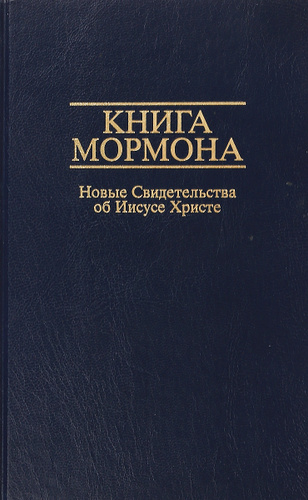
Book cover.While I normally try to summarize the book or provide highlights and some of the author’s main points, that seemed a little less useful for a book of scripture, but since part of the impetus behind reading it in Russian was to help maintain (re-gain?) at least a semblance of Russian-language skills, I thought I would hearken back to my mission days and try to give the same type of overview of the Книга Мормона that we gave as missionaries when doing what we called street contacting, simply walking up to people, asking if they’d give us a few minutes of their time, and then explaining who we were and what, in generic terms, our message was.  If people were willing to listen for a few minutes, we usually had a chance to talk about the Book of Mormon, which was new and unique for upwards of 90% of the people with whom we spoke.  Most missionaries, myself included, liked to use the illustrations included at the front of the book.  We typically told people we met that the Book of Mormon was a book of scripture, the same as the Bible is a book of scripture, that testified of Jesus Christ.  It was written by ancient prophets, starting with a man named Lehi, who left Jerusalem and moved to the American continent.  The book recorded the history and prophecies of Lehi’s descendants, culminating in a visit to these people by the resurrected Savior, where He taught His gospel and performed miracles just as He had done in Jerusalem.  This record was compiled by another ancient prophet, named Mormon, and buried, later to come forth, with God’s help, through a modern-day prophet named Joseph Smith.  The book ends with a promise that if we ask God about its truthfulness, He will answer us.

I will first note that I am a huge fan of how this edition of the Book of Mormon in Russian uses the Russian letter Ё (yo).  While most literate Russians don’t need it printed, and there’s some debate among linguists about its status, learners of Russian are helped immensely by the letter.  I would’ve loved having it in the Book of Mormon as a missionary (as it was, I always added the two dots over the E when it was required by hand in my copy as a missionary).  The new translation, though, didn’t always leave me as satisfied.  I found that they strayed from some Biblical phrasings or other more staid expressions in favor of more literal translations (which has been done with other languages, too), likely in an attempt to make the scriptures more accessible to the modern, younger reader.  Finally, there were a few translations, as usual, where having a native English speaker who knows Russian well as a proofreader would’ve helped.  None of those imperfections reduce the truth of the book, of course.  As stated above, it’s never bad to re-read the Book of Mormon.  Even though I know very well how the stories go and what the main lessons are, the book is inspiring almost every time I pick it up.  Like the Bible, the Book of Mormon is full of eternal truths and principles that apply to our lives even though the situations we encounter are continually changing and the world around us is always fluid.  At the end of the book, Moroni’s promise continues to deliver.  Moroni notes that we can know the truth of all things through the Holy Ghost, and I have put that to the test repeatedly, both about the Book of Mormon and about other Church- and doctrine-related questions.  My belief in God, in the scriptures, and in the Church have repeatedly been strengthened, often as a result of my questions, and I can state, just as I did twenty years ago at the end of the quick overview given to so many people on the streets of St. Petersburg, I know the Book of Mormon is the word of God!
   
Creative Commons License
This work, including all text, photographs, and other original work, is licensed under a Creative Commons Attribution Non-Commercial No Derivatives 3.0 License and is copyrighted © MMXIV John Pruess.

Saturday, August 15, 2020

Church of Cowards

I grew up in a religious family with parents and grandparents who were examples of hard work, service, dedication, and faith.  A lot of what they did was within the framework of the Church of Jesus Christ of Latter-day Saints.  As a young teenager, I remember when my dad gave a talk in church (almost every Sunday, two or three people from the congregation give talks — sermons, essentially — that they have prepared ahead of time, by invitation).  I don’t remember the particular subject, but it involved God’s command to love and serve our fellowmen.  As people were milling about after church, I overheard one person commenting on how my dad was certainly entitled to give a talk on that subject because he walked the walk, as they say.  I don’t know if I was meant to hear that comment, and I’ll never know, but I did, and it taught me a lesson.  In later life, I have spent a lot of time and effort trying to convince both myself and others that the message of the gospel of Jesus Christ is one of action.  He expects us to be active instruments in His hands, seeking out others and lifting them up.

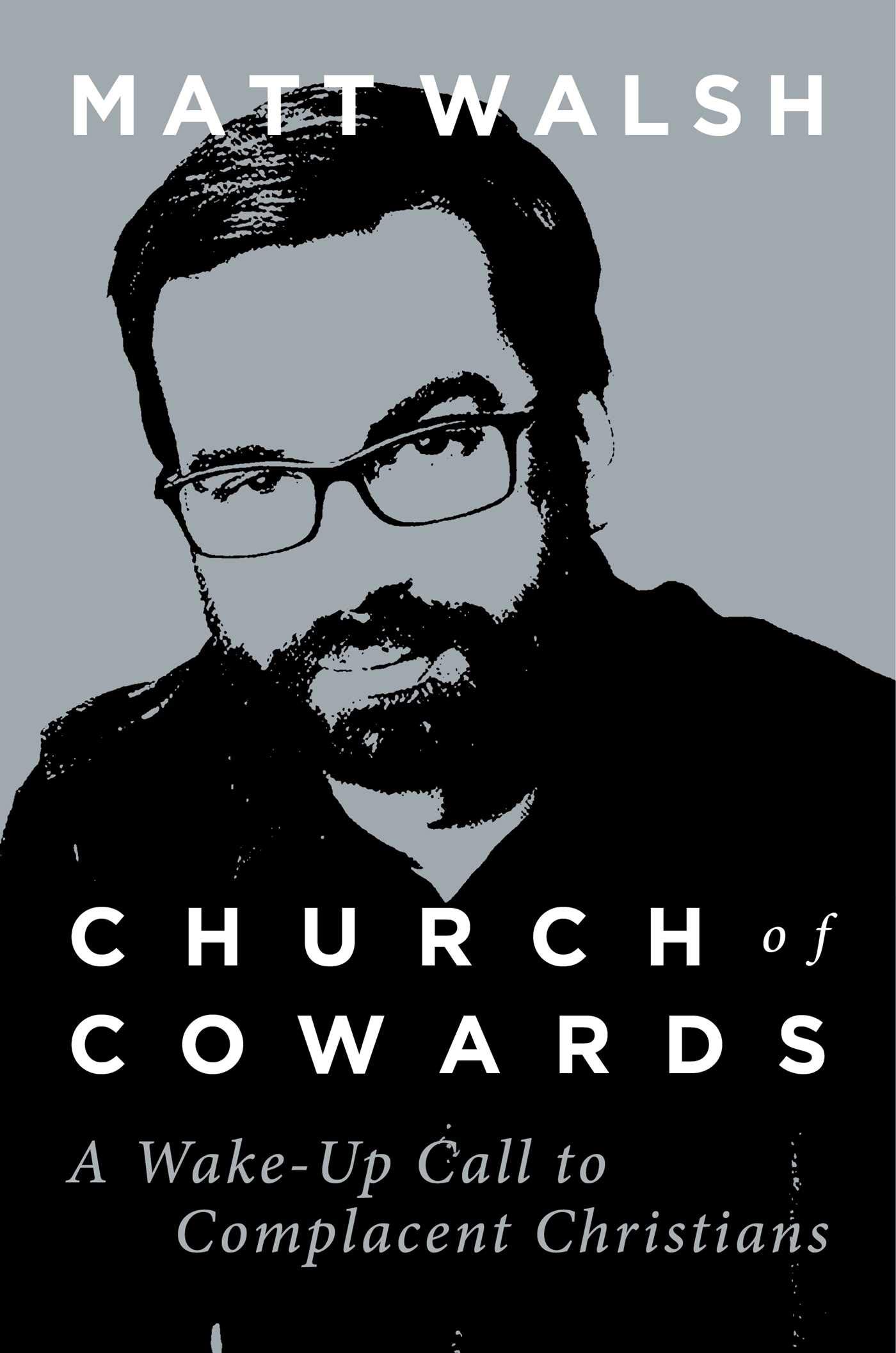
Book cover.Church of Cowards: A Wake-up Call to Complacent Christians by Matt Walsh (ISBN: 978-1-62157-920-5) is a book about that very call to action.  In the book, Walsh discusses some of what he perceives to be problems in America and then talks about how they are largely, if not completely, overcome by Christians getting up and putting their religious beliefs into action.  While he is Catholic (not discussed in the book, but a known fact), the book is not directed at any specific denomination; the things he says are meant to be applicable by all believers.  He notes that polls generally find America to be about 70% Christian, but that America does not function like a country that is 70% Christian.  The opening chapter presents a fictionalized situation where barbarians come to America to slaughter Christians, something like ancient Rome, but can’t find anyone that will stand up for what the barbarians believe to be Christianity.  The people they find are wishy-washy and non-committal about anything other than their openness and tolerance.  The rest of the book that looks deeper into those watered-down values and how far they are from what Walsh believes is taught in the Bible.  Modern man’s disdain for organized religion, the commitment many show to entertainment instead of God, and a brand of religion that doesn’t require any sacrifice from its adherents are a few of the topics that draw Walsh’s ire in a, typical for his Internet-based daily show, scathing take-down of modern American Christianity.  The book asks those who call themselves Christian to start taking their religion more seriously, which, for most, will mean making effort to change and become more active.

I wasn’t sure what to expect from this book.  Podcasting doesn’t always equate to writing, so even though the author has a successful show, that doesn’t mean he’ll write a book successfully.  It probably helps that he also writes a regular column that tackles similar subject matter.  American culture is always in Walsh’s crosshairs, and the writing was not a disappointment.  I was also interested to see how religious writing from a conservative Catholic would square with the theology of my own church.  In general, it did, and the doctrinal differences expressed in the book were not central to his arguments, so I didn’t think they detracted from the points made and believe that would be true for most any denomination.  As with anything that touches touchy subjects, I didn’t agree with every word (he brilliantly took on Christian entertainment in a section with which I couldn’t agree more, though), but there was much where I was nodding in agreement and there was no arguing on the main point: America would be a vastly different country today were we who profess Christianity to actually live by its precepts in all facets of our lives.  The book is a call to action; it’s action that usually starts with ourselves.  Are we living our lives in accordance with God’s will or are we seeking our own?  The book serves, as its subtitle claims, as a great wake-up call.

Creative Commons License
This work, including all text, photographs, and other original work, is licensed under a Creative Commons Attribution Non-Commercial No Derivatives 3.0 License and is copyrighted © MMXIV John Pruess.

Saturday, October 19, 2019

Saints: The Standard of Truth

“The Lord has led this people all the while in this way,”
Brigham declared, “by giving them here a little and there a little.
Thus He increases their wisdom, and he that receives a little and is thankful for that
shall receive more and more and more.”

I grew up in Utah, was born and raised in the Church of Jesus Christ of Latter-day Saints, and there are Mormon pioneers among my ancestors on my Mom’s side of the family.  During my childhood and early teen years, I felt as if I couldn’t go half an hour without hearing about the pioneers.  My belief in Jesus Christ and in the Church itself never wavered (in fact, the result of every question I’ve ever asked has been a confirmation of my beliefs), but I couldn’t always see the connection between Church history and what I was experiencing.  I often found the constant discussion of Church history and the pioneers to often be too much.  Even as I got older, matured, and came to understand history (in general) better and its strong connection to our current lives, I warmed up to Church history slowly.  I still don’t know that I’m all the way there as there are other aspects of history that interest me more, but I am certainly no longer antagonistic toward it.

Saints: The Standard of Truth (ISBN: 978-1-62972-492-8) is the first volume of a multi-volume history published by the Church itself.  It basically covers the time period that corresponds to Joseph Smith’s life.  It presents information about the Smith family, Joseph’s early years, his growing interest in religion as a teenager, the First Vision, the long path to Joseph acquiring the golden plates, the translation and publication of the Book of Mormon, and the founding of the Church.  As the story goes along, the cast of characters grows rapidly to include the others who played key roles in the restoration of God’s Church on the earth, such as Joseph’s wife, Emma, Martin Harris, Oliver Cowdery, the Whitmer family, and others.  Once the Church is founded, the book traces the history of the Church, focusing a little bit less on Joseph Smith, although never really getting away from him since he was so incredibly central to the story.  One reads about the Church’s westward progression through Kirtland, Ohio, onto Missouri, and then to Nauvoo.  Along the way, stories famous to anyone who has been in the Church long, such as two sisters rescuing the pages of what would become the Doctrine and Covenants or the early Saints praying for the ice on the river to break so their boat could get through, are presented.  There were also a few lesser-known stories.  The book ends with Brigham Young being called as the second president of the Church and his vision of moving the members of the Church even farther West in a quest for safety and freedom.
I honestly did not know what to expect from the book.  I had a feeling it would be too fluffy and not serious enough (the 7-volume Church history that is common in many homes of members of the Church long had a prominent place in my parents’ home, and has always come across as a serious work to me).  There were times when I felt that, but I also thought there were serious moments and some of the sometimes contentious and controversial aspects of Church history (polygamy, the Kirtland Safety Society, for example) and Joseph Smith’s story (treasure hunting being one example) were explored in what I thought was an open and candid manner.  I was appreciative of the inclusion of some stories that I was not familiar with.  I thought the writing was quite fair, never disparaging those who did not join the Church, those that fell away, or even those who fought against it.  Overall, I thought it was a decent read.  One of my bigger complaints is about the physical book itself.  It’s huge.  There’s tons of whitespace on each page that doesn’t need to be there, the font is too big, and the spacing is too much.  This book is simply inconvenient to hold and read, but doesn’t need to be since it could honestly be half the size and half the thickness.

Creative Commons License
This work, including all text, photographs, and other original work, is licensed under a Creative Commons Attribution Non-Commercial No Derivatives 3.0 License and is copyrighted © MMXIV John Pruess.

Sunday, April 07, 2019

The Days of the Consuls

In fact, this was a continuation of last year’s disturbance
which had never altogether ceased, but smoldered on in muffled silence,
waiting for a convenient excuse to erupt again.

As soon as one learns anything about the ex-Yugoslavia (commonly, but rather incorrectly referred to in the West as “the Balkans”), one hears about the Yugoslav writer Ivo Andrić.  Andrić was born in Bosnia and Herzegovina while it was under Austro-Hungarian rule.  He later published a number of works, the most famous being The Bridge on the Drina, for which he was awarded the Nobel Prize in Literature.  That book is usually thought of as part of a trilogy of books that tells all about the clash of civilizations that was a big part of Andrić’s life in Bosnia, home to four distinct ethnic groups who adhere to four different religious traditions, all under the reign of various foreign conquerors throughout history.

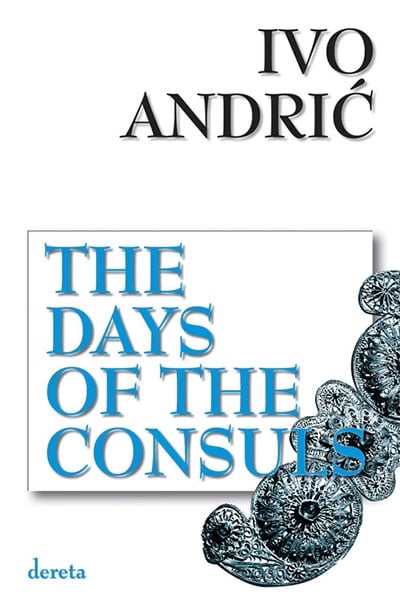
Book cover.The Days of the Consuls by Ivo Andrić (ISBN: 978-86-6457-018-3), which has been published in English under the alternative titles of Travnik Chronicle and Bosnian Chronicle, fits right into Andrić's main motif, telling the story of the city of Travnik, which is medium-sized for Bosnia today, but was historically much more important as the seat of the Ottoman Empire in Bosnia, during a few short years while the Austro-Hungarian Empire and Napoleon’s France kept consuls in the town.  The story is told from an omniscient narrator point of view, but focuses largely on French consul, his entourage, and his interactions with the others in Travnik, be they local or outsider.  The French consul deals with being an outsider himself, shunned by the local Muslims and never really understood by the Ottoman representative, although their relationship was cordial.  He remains the enemy of the Austro-Hungarian consul, although he sees many similarities between the two men and carries on professional, if not friendly, relations with him.  The members of the consuls’ families and entourages are met with varying degrees of acceptance or disgust by those around them, including those from the local clergy.  The Muslim population seems to be the most vocal in their distaste for the outsiders, but the Orthodox, Catholic, and Jewish populations also steer clear and are distrustful of the changes the presence of the consuls seems to be ushering into their otherwise simple lives.  When Napoleon is finally defeated, the French no longer see the need for a consul in Travnik, and the French consul is recalled.  The Austrians also remove from Bosnia.  With all that has changed, all has remained the same.
I had always intended on reading Andrić’s so-called trilogy in the order they were published, but it didn’t happen thanks to the vagaries of translation.  I bought this book not being aware that it was the same book as the Travnik Chronicle.  All the same, I enjoyed it and still look forward to someday really pushing my brain to its limit by reading it in its original language.  More than once, while reading, I thought of Tolstoy and his sweeping historical epic, War and Peace.  This does not attain those heights, but I found the style to be very similar.  I enjoyed the thorough descriptions of people and place achieved through masterful use of language instead of relying, like so many modern authors, on cliché and overly vulgar and expressive language.  It might mean more to me because of my own extensive travel in the country and the familiarity inherent to reading about something one knows relatively well.  Andrić believed that Yugoslavia had a unique and uniquely turbulent past that presented many opportunities for learning, learning that would help people avoid the ethnic and religious conflict that has seemingly always plagued the region.  In the book, which is, in a way, plotless, as it simply chronicles the day-to-day lives of Travnik’s citizens, one can see this theme, but I would argue it is meshed with one that emphasizes similarities over differences, and that is the lesson, one that is, unfortunately, unheeded in modern-day Bosnia and Herzegovina, and unheeded elsewhere.  Slightly different approaches to the same fears, concerns, and goals hindered all parties in the book from a more mutually beneficial co-existence.

Creative Commons License
This work, including all text, photographs, and other original work, is licensed under a Creative Commons Attribution Non-Commercial No Derivatives 3.0 License and is copyrighted © MMXIV John Pruess.

Sunday, February 18, 2018

Unbroken

World War II has always fascinated me.  This is likely related to two things.  One is familial involvement.  One grandpa was a soldier in the war.  The other set of grandparents were children in Germany.  The other thing is that I loved drawing aircraft as a kid, and the bombers of World War II figured prominently in my usual repertoire.  What I didn’t necessarily understand as a kid is the large part that prison camps played in the war.  From the little reading that I have done and the little that I know, there are atrocious things that happened in the war’s prison camps, but I have heard more than a few stories of people rising above the horror and rising above the temptation to give up or to forever hate those who have treated them so evilly.  These stories are an interesting and often inspiring piece of history.

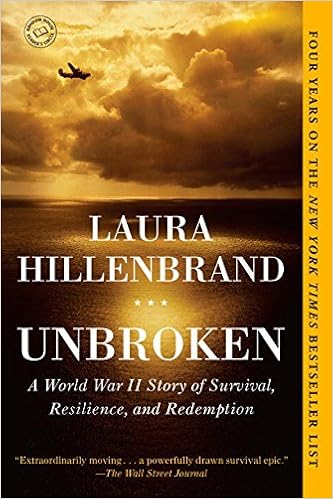
Book cover.Unbroken: A World War II Story of Survival, Resilience, and Redemption by Laura Hillenbrand (ISBN: 978-0-679-60375-7) is just such a story about overcoming trials.  Like so many stories of resilience in the face of overwhelming odds, the story starts with humble origins.  Louis Zamperini was the son of Italian immigrants struggling to make ends meet along with most other Depression-era Americans.  A caring older brother discovered the track and invited Louie along, later serving as an unofficial coach, and Louie became as star, eventually qualifying for the Olympics, running a race (5,000 meters) he didn’t usually do.  He competed admirably in Berlin, finishing eighth against some of the world’s greatest runners.  His running career, though, was cut short by the onset of war, and he served as a bombardier.  That, too, was cut short because his plane went down during a rescue mission, and he was captured by the Japanese after some time floating in a raft at sea.  Floating around for weeks was already an amazing act of survival and resilience, but the worst was yet to come.  Zamperini then spent more than two years in various Japanese prison camps undergoing brutal treatment.  He and others kept their wits about them by resolving to beat the system and not give in to their captors and abusers.  Some made it, some did not.  There were some funny stories along the way, but most of it was monotony, drudgery, and pain.  Eventually, Zamperini and the others that survived were done with the horrors of the camps because the war ended.  Unfortunately, for many, that was not the concrete ending they would’ve preferred.  The horrors lived on in many of the former POWs’ minds, causing more than one to turn to alcohol, destructive behaviors, and even suicide to end the pain.  Zamperini’s story included a lot of post-war alcoholism, but he eventually quit that thanks to a conversion to evangelical Christianity, in part because of him remembering some promises he made to God while floating aimlessly on the Pacific Ocean in the first few days after his plane went down.  Zamperini used this redeeming experience in his life to later inspire and help others as well as come to terms with and even forgive his war-time tormentors.

I thought the book was good.  It was an inspiring story and it included some interesting information on the war.  It is best classified as a biography of Zamperini, not a history book.  There are many aspects of the book that were worth remembering, including the hard work and dedication the subject put into his running, his service in the military, and then his life after the war.  There were so many times he could’ve given up and probably justifiably so, but he didn’t.  He used the overwhelmingly negative experiences to make himself better, which is something worth emulation.  As noted above, this was a trait that was fairly common in his generation and one that is definitely missing in many today.  I was intrigued to read that faith and religion played such a large role in his post-war healing.  Such an aspect to story was not surprising, though, since a trust in the atonement of Christ is the surest way to redemption.  Finally, I would be lying if I didn’t note that I liked the stories about the running, which included some thoughts about Zamperini being one of the contenders for breaking the 4-minute mile barrier, and the Olympics in pre-war Germany, which are a subject of interest in and of themselves.

Creative Commons License
This work, including all text, photographs, and other original work, is licensed under a Creative Commons Attribution Non-Commercial No Derivatives 3.0 License and is copyrighted © MMXIV John Pruess.

Wednesday, August 16, 2017

Visions of Freedom

Growing up as a Mormon in Utah, especially back before the advent of what are often called in Mormon culture “small temples,” the Salt Lake Temple reigns supreme.  It is photographed endlessly.  It is the crown jewel of Temple Square even though most visitors cannot enter it.  It is the subject of both the state’s and the Church’s history and the stories that involve the Salt Lake Temple intertwine the two.  As a result of that situation, some of the state’s other temples are a bit lesser known to the general populace, myself included.  The fact that I always have to stop and think and remind myself that the St. George Temple was the Church’s third temple, not the Salt Lake Temple, proves that point.  I first heard, from my parents during a visit to Southern Utah as a kid, that the Founding Fathers appeared to President Wilford Woodruff in the St. George Temple.  The story was amazing and one I always remembered.

Book cover.Visions of Freedom: Wilford Woodruff and the Signers of the Declaration of Independence by Michael de Groote and Ronald L. Fox (ISBN: 978-1-60861-227-7) is a book about Wilford Woodruff’s visions (he had two of them on this subject) and the men that appeared to him.  The first part of the book discusses the history behind modern vicarious ordinances in the Church of Jesus Christ of Latter-day Saints (anciently, the Bible contains one passage discussing baptism for the dead, and scholarly literature discusses a few others).  The next major theme of the book is how Wilford Woodruff’s preaching about his visions and the work he did in the St. George Temple for the men who appeared to him, as well as for some other famous people throughout history, changed, to a significant degree, the Mormon outlook on work for the dead in the temple.  Before President Woodruff’s visions, the vast majority of temple work was done only for ancestors or very close friends.  What that meant was that once a person had traced his genealogy as far as he could, he didn’t have much of a reason to attend the temple.  President Woodruff’s work for the Founding Fathers and others taught that temple work was necessary for all who had ever lived, which also gave faithful saints a reason to come to the temple again and again.  The majority of the book, though, consists of short biographies of the signers of the Declaration of Independence.  Each signer gets at least one page, although most have more than that.  There are some appendices that discuss the actual temple work and various accounts of President Woodruff’s visions.
I am not normally attracted to reading about Church history.  The history of the United States fascinates me.  I’m sure this overlap helped this book be of interest, but I think it had more to do with the fact that the story was one that was of interest to me as a kid.  I found the discussion of baptisms for the dead in the early Church quite intriguing.  What I missed in the discussion of Wilford Woodruff’s dream was the actual sermons in which he talked about it.  I found them, later, in the appendices.  I thought that was an unnatural place for them.  They should’ve been front and center.  Finally, the biographies were interesting.  They were just snippets and, usually, not very long, providing highlights of government service and the thoughts of other Founding Fathers on the person in question.  I enjoyed learning about how they came to be involved in the signing of the Declaration of Independence.  Many of them were what would be called “flip-floppers” in today’s toxic political environment (although maybe not necessarily since that term, at its purest, refers to those who change positions for political expediency, not because of any deeply held personal belief).  Many were British supporters until things just got too out of hand (it was almost always taxes that bothered them, but property rights and religion played a role, too).  The wide cross section of society was interesting, too.  Most of the signers were from the upper or upper middle class.  Not all, though.  There were guys who had worked their way up from being the apprentices of tradesmen to being judges.  There were merchants, clergymen, lawyers, and others.  What they had in common was a desire for themselves and their fellow countrymen to be free.  The book typically pointed out when one of the signers owned slaves or not.  This is a fascination that modern history has, but I thought it was dealt with admirably by the authors, who noted, at the end, that, unfortunately, many of our Founding Fathers were slave owners, but that was a burning issue then, and most of those who owned slaves struggled with it, later freeing some or all of their slaves or helping to write laws that hampered the slave trade in the U.S., but the important thing was that the founding documents (many signed not just the Declaration, but the Constitution as well) made it possible to later eliminate slavery in America.  Ultimately, that’s why they came to President Woodruff: they wanted to be free, free from spiritual prison in the afterlife.  It was an interesting historical and theological read that made me think about my amazing national heritage as well as my testimony in a loving God that has provided a way for all men to return to him and experience salvation.

Creative Commons License
This work, including all text, photographs, and other original work, is licensed under a Creative Commons Attribution Non-Commercial No Derivatives 3.0 License and is copyrighted © MMXIV John Pruess.

Friday, April 07, 2017

Hero of Hacksaw Ridge

I didn’t know much about “conscientious objectors” before hearing about this book (and the related movie).  I think the term was abused during the Vietnam era when many people did all they could to not serve in the military, but I honestly know very little.  That's what made reading this book so interesting — a way to learn more about this, especially what it originally meant and how someone made it work for them and ultimately was of great service to his fellow countrymen.  As someone who is active in one's church, the religious aspect of the story was also compelling, as such things seem to make the stories seem more relevant.

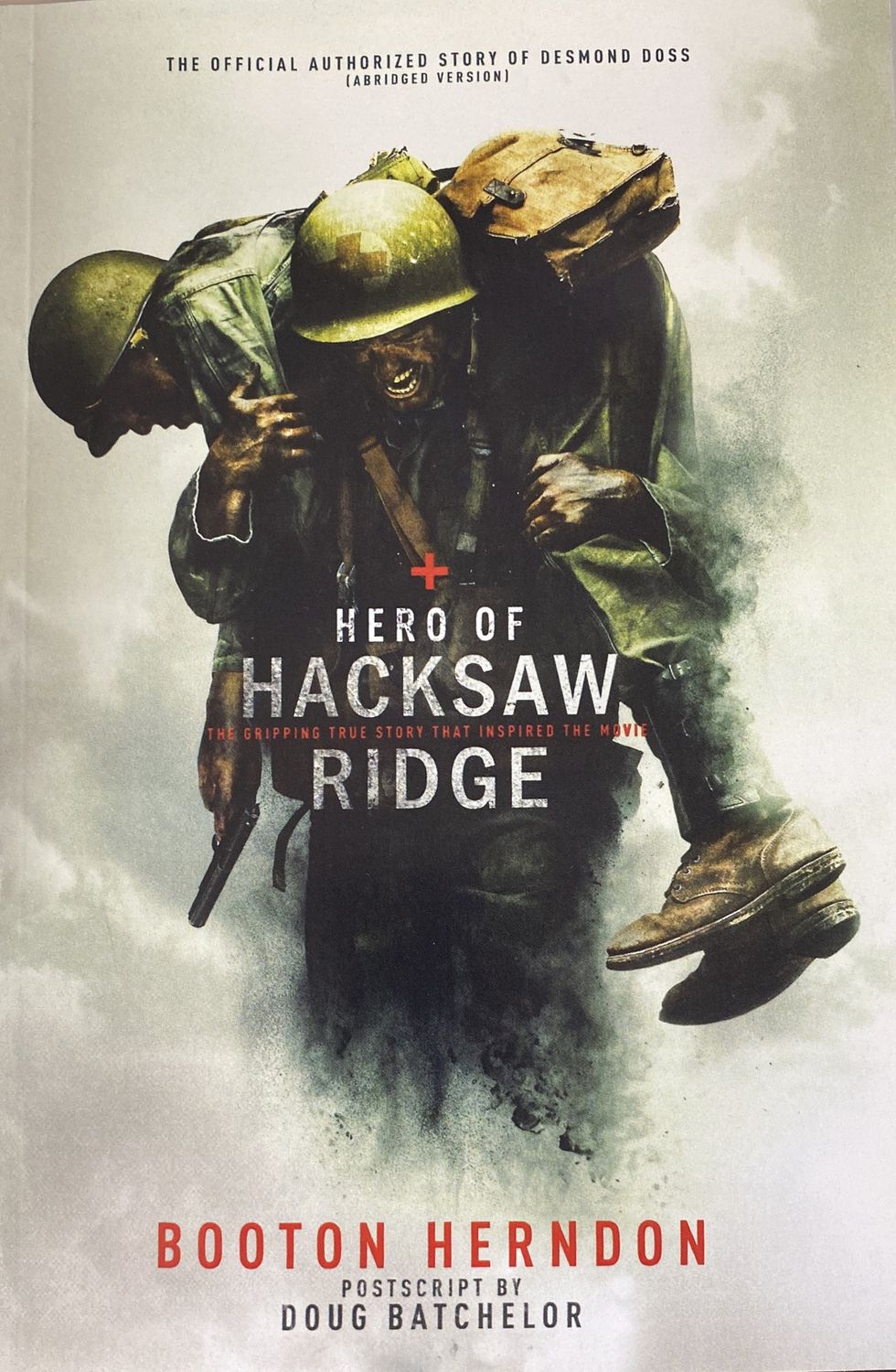
Book cover.Hero of Hacksaw Ridge: The Gripping True Story That Inspired the Movie (ISBN: 978-1-629131-54-2) by Booton Herndon is an abridged version of the story of Desmond Doss, a medic who served in the U.S. Army during World War II and saw action in the Pacific theater as the army advanced on various Japanese positions.  What makes the story unusual is that he was awarded the Congressional Medal of Honor and not once during his training or active duty did he use arms since he was a Seventh-day Adventist and believed it was wrong to bear arms.  The story chronicles his time in the military from his joining to his discharge after being wounded in action in Japan.  Doss is unwaveringly strong in his religious convictions, including an extremely temperate and patient attitude with those around him.  He displays great faith in standing up for his beliefs when those around him threaten him and ridicule him at every opportunity.  He doesn't hold a grudge when it comes time to perform his duty, and more than once wile fighting in the Pacific, he helps and saves the lives of others, usually at great risk to himself.  The story ends with what truly are “gripping” details of battles on Okinawa where he saved likely around 100 lives while himself being injured.  He is then awarded the much-deserved medal and is able to return to civilian life.  The book also includes a post-script with information about Adventist beliefs (many are similar to those held by members of the Church of Jesus Christ of Latter-day Saints).
I found the short book to be extremely interesting and often an exciting read.  The persecution he experienced, especially during training was disheartening, and I consider myself lucky to have never experienced anything like that.  I always envision myself being strong like he was, and pray for that to be true.  The combat scenes were intense, but well-written and not too graphic.  There was also a lesson to be learned in the combat scenes because by then, his fellow soldiers knew Doss and respected him, in part because he was uncompromising his his duty, both to God and his country.  He was no longer ridiculed, but respected.  As is usually the case, sticking to one’s beliefs results in respect in the long run.  It was also refreshing to see a person who was able to understand how he could serve the country without compromising his beliefs.  One has a clear duty to one's nation, and it's too bad that so many peoople don't understand that today.

Creative Commons License
This work, including all text, photographs, and other original work, is licensed under a Creative Commons Attribution Non-Commercial No Derivatives 3.0 License and is copyrighted © MMXIV John Pruess.

The Qur’an

I had never thought of Islam in any serious way before the infamous attacks of September 11th.  After that, I had a short unit on Islam in a comparative religion class at BYU (to this day, it remains my favorite religion class at BYU).  It wasn't until living in Sarajevo, though, that I had any substantial contact with Muslims.  Bosnia's brand of Islam is, in the mainstream, moderate, and there's a standard joke among many of the Americans that Ramadan for Bosnians is the detox month.  My interpretation of Bosnian Islam is that Muslims in Bosnia are like a lot of Christians in Europe.  Christians in Europe and Easter-and-Christmas Christians; Muslims in Bosnia are Ramadan Muslims.  In the meantime, the more extremist flavor dominates the American headlines.  I figured it would be interesting to make my own, somewhat more informed, opinion about the religion that claims well over 1 billion adherents.

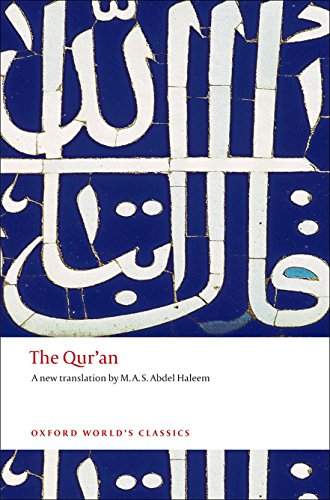
Book cover.To do that, I read the Qur’an (ISBN: 978-0-19-953595-8), translated by Abdel Haleem.  The Koran (there are lots of possible spellings for this) is Islam's holy book, purported to be a recording of revelation given to the prophet Mohammed (lots of spellings for his name, too).  It focuses on the nature of God as the only God, as opposed to idols, pantheons of pagan gods, or even God as Christians know him, the Father of Jesus Christ.  The Koran talks about Mary and Jesus, but Jesus is not God’s Son.  It talks about Muslims’ duties to the poor and orphans.  It discusses the afterlife and the resurrection.  It warns evildoers against their course of action.  There are some details about domestic life, finances, and there is the well-known injunction to prayer, which results in the call to prayer that happens five times a day wherever there is a functioning mosque.  There are some instructions regarding Muslims’ dealings with non-believers, or infidels.

I was very interested in reading the Koran and am glad I did.  However, it was often slow going.  I found the book to be extremely repetitive.  The discussion of God as the only god and the lack of any other gods and the renunciatin of the false practice of worshipping idols was repeated ad naseum.  I read the book looking for two things.  The first was some of the more controversial passages about women, jihad, and relations with the infidel.  The second thing I looked for were doctrinal differences or similarities with the doctrines of the Church of Jesus Christ of Latter-day Saints.  The doctrinal aspect of the read was interesting.  As I already knew from discussions with Muslims, there were some similarities.  God’s existence being the most basic and fundamental.  It was interesting to read about the resurrection and various injunctions to help the poor, be fair to orphans, and in general help others.  The prohibition against alcohol and pork remind one of the Word of Wisdom.  There were discussions of the afterlife that included seven degrees of heaven that seemed awful similar to the Mormon three degrees of glory with a celestial kindgom divided into three of its own degrees.  There were other similarities, too.  The biggest difference has to be the denial of Jesus as the Christ.  I found it odd because the Koran repeatedly says the prophets of the Old Testament, such as Moses and Abraham, were true prophets, so since those men all testified of Christ’s coming, it seems there was some misunderstanding of the Old Testament.  As for the controversial passages, I found them to not be too inflammatory, although it was easy to see where the more extreme interpretation comes from, but I was reminded of Glenn Beck’s analysis in his book about Islam in which he explains that ultimately it doesn’t matter what we think the Koran says and it doesn’t matter what Islamic scholars say the Koran says; what matters is what the extremists think it says because their interpretation is the one that drives them.  Finally, a note on the book I read.  I was disappointed in the translation.  It was meant to be accessible to a modern reader.  There were many instances of my reading it and translating what I was reading in a more King James style, which I thought read a lot better.  I think I would’ve appreciated a more traditional translation.  There were many passages that included Arabic metaphors that the translator often tried to explain, but with which I struggled.  I tried to be fair to the Koran and admitted my unfamiliarity with it, but in the end, I realized that one of the big reasons there were struggles to understand it were not translation problems, but the simple fact that the book is not inspired scripture in the way the Bible and the Book of Mormon are.  Those books contain similar Old World metaphors, but I usually get them.  Part of that is familiarity and a lifetime of study; part of it is the fact that when you read inspired scripture, your understanding is influenced by the Holy Ghost.  The Koran was well worth a read, especially if one is trying to understand those around oneself, and also provides Christians a chance to look inside themselves, explore their own beliefs, and come away stronger.

Creative Commons License
This work, including all text, photographs, and other original work, is licensed under a Creative Commons Attribution Non-Commercial No Derivatives 3.0 License and is copyrighted © MMXIV John Pruess.

The Power of Positive Parenting

When I was a kid, my mom, like most of my friends' moms, would threaten me by wishing upon me a kid just like me.  I never considered that much of a threat.  If the kid was just like me, I’d know how to deal with him.  Now, a kid like my mom or one of my sisters, that scared me.  Now, as a parent, I sometimes see myself in my kids, but mostly not, and parenting is a huge responsibility with a lot of good moments, fun times with kids, but also a few moments of fear as one realizes that one doesn't have the answers to all that life seems to throwing at us.

Book cover.The Power of Positive Parenting by Glenn I. Latham (ISBN: 1-56713-175-1) doesn't have all the answers either, but after reading it together with my wife, we decided that it has many of the answers, and even where it doesn't it tends to point the reader in the right direction.  The book is full of guidance on how to deal with all kinds of different behaviors that children (and adults) engage in.  There are sections for younger kids, for teenagers, for small problems, for sibling rivalry, and for larger, more destructive behaviors.  There are a couple over-arching themes in the book that course through the suggestions for each kind of problem.  One is to ignore things that doen't really cause any harm since most people just want attention and will take it however they can get it.  Igoring kids’ whining, for example, is the most effective way to get them to stop.  The other thing that was presented over and over was the need to positively reinforce good behavior.  Default parent settings seem to be set to find negative behavior and call it out.  What about the good?  Fidning and reinforcing good behavior gives kids the attention they need and teaches them that good behavior will be rewarded.
I recognize that God has all the answers when it comes to parenting, but I also believe that God helps those who help themselves, so I have to do all I can first.  This book is one of those things.  My wife and I have tried to implement many of the strategies taught in this book and plan on reading through it again.  As always, some days are more successful than others, but when we catch ourselves implementing the strategies we liked from the book, things really do go smoother around the house.  We have found so many behaviors that are eligible for ignoring instead of attention.  We also find ourselves trying harder to be patient, react to things calmly, and provide positive feedback on all the things that the kids do right.  The book was written in the late 1980s, and you can feel that in the language used, but the science behind it is strong, and would recommend it to anyone involved in the sacred role of parent.

Creative Commons License
This work, including all text, photographs, and other original work, is licensed under a Creative Commons Attribution Non-Commercial No Derivatives 3.0 License and is copyrighted © MMXIV John Pruess.

Saturday, July 23, 2016

Love Thy Neighbor

People often say that man’s cruelty to his fellow man never ceases to amaze them.  I think it ceased to amaze me long ago.  What could arguably never cease to amaze me is that the solution is right there, right in front of our eyes.  In the Bible, a man named Naaman, a Syrian army commander, came to Elisha, a prophet to be healed of leprosy.  He was told to simply wash himself in the Jordan River.  He was reluctant to do so because it sounded so easy.  Eventually, he did it, and, as promised, was healed.  Today, we look pretty much everywhere for solutions to problems like war and genocide.  They are big problems so they demand big solutions goes the thinking.  In reality, Christ’s injunction to “love thy neighbor” would solve them much quicker and much more effectively.

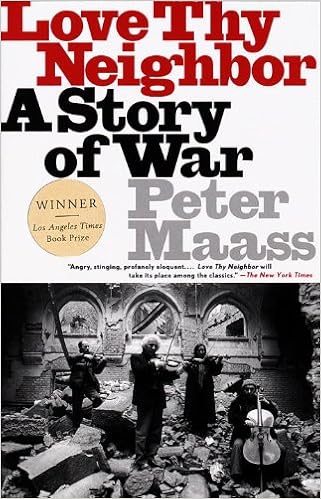
Love Thy Neighbor: A Story of War (ISBN: 978-0-679-76389-5) by Peter Maass is a collection of notes from the author’s time in Bosnia & Herzegovina as a journalist during the Bosnian War, but since the stories are all told from his point of view, it reads like a memoir.  There isn’t a lot of continuity, and it just jumps from one story to another, but roughly follows the timeline of the war.  The bit of continuity that is there is Maass wondering how people can forget so easily the need to respect those around them.  The stories are very real and personal, as Maass interacts with fellow jouranlists, soldiers on both sides, government officials, and what would normally be called everyday people, but can’t be in this situation because there was no such thing as normalcy in the Bosnian War.  Maass interviewed a Serb sniper, Bosnian soldiers, dealt with a Serb checkpoint — ultimately unsuccessfully, had Christmas dinner with a Croat family in Sarajevo, experienced what it was like to be under attack while in a gas station, and was, like most who dealt with the Bosnian War, flabbergasted by the impotence of the so-called world superpowers to get anything accomplished in Bosnia.  His account holds nothing back and it presents the war in all of grizzly horror that is war. 

The book was a fascinating overview of the war that could realistically be categorized as an overview of the atrocities of the war.  It presented both the best and worst of people, and it’s the good that ultimately captured my attention.  No matter how low things go, there’s someone out there trying to do good.  The story of the Catholic man and his wife who had Maass over for Christmas dinner was one of those.  It was, ultimately, a small gesture, but one that showed the goodness of the man and his family.  At times, the accounts of the violence seemed rather too much, even considering other books on the Bosnian War I’ve read.  On the other hand, it is reality and it is a reality with which our virtual-reality society really should be better acquainted because the idea that actions have consequences is one from which people seem far removed.  I am not sure if Maass, a Jew who was not overly religious, meant to lead his readers to any certain conclusions, but I think so, and the conclusion I drew from the book was that were we to love our neighbors, the ridiculous idea of ethnic conflict, and all kinds of other conflict, too, would not be something we would have to deal with.

Creative Commons License
This work, including all text, photographs, and other original work, is licensed under a Creative Commons Attribution Non-Commercial No Derivatives 3.0 License and is copyrighted © MMXIV John Pruess.

Wednesday, November 04, 2015

To the Rescue

I have always looked up to Church leaders as good examples, and the prophets in particular.  Since President Kimball died when I was only 5 years old, I only vaguely remember him.  I remember President Benson better, in large part because of his lifelong commitment to Scouting, and he was the prophet while I was heavily involved in Scouts.  I remember President Hunter mostly because the Bountiful Temple was dedicated while he was the prophet, and I participated in that temple’s open house and dedication.  President Hinckley is probably the first prophet I remember because of the things he taught.  He is also the first one that I looked to as a role model.  He was a very positive person and chose to see the bright side of life, no matter the situation.  Before President Monson was even the president of the Church, I saw him as a role model.  His many stories, most of them based on his personal experiences, showed that he had developed many of the character traits that truly good people possess.  Over and over again, I found myself listening and thinking that I should, somehow, implement what he was talking about in my own life.

Book cover image.To the Rescue: The Biography of Thomas S. Monson by Heidi S. Swinton (ISBN: 978-1-60641-898-7) chronicles the amazing life of service that President Monson has led from an early age through the present day.  The timeline for the biography is straight forward, starting with his early childhood and ending with his time as the leader of the Church.  He learned from parents and family around him in what was, at the time, a typical childhood.  It follows him through high school, a mission, early marriage, employment, and a variety of Church callings.  Along the way, there are many familiar stories, but there are sometimes some additional details that weren’t always part of the many sermons President Monson has given.  There were also some additional stories.  It was interesting to read about President Monson’s family a little bit and about his professional experienes.  There was a lot of time spent on President Monson’s service as an apostle in what was then East Germany.  The Church history aspect was interesting, as it was with some of the other episodes from his life, but they often seemed more like pioneer stories because of the great faith shown and the hardships endured.  What was consistent no matter what part of his life was being discussed was the dedication he showed to serving others, whether that be in his family or those around him.  President Monson was never too busy to help someone out, talk to them, visit them, give them a blessing, or share time and possessions with them.  It becomes abundantly clear as the life of this man is chronicled that he understands very well that Heavenly Father is serious when He says that the worth of souls is great in His sight.  President Monson has cultivated that genuine love and concern that is a trait of our divine Father and made it a part of his own personality. 

I never really doubted I would find the book interesting, but I think that I underestimated the power behind the stories.  There is sense of warmth and comfort in the stories from home, whether they be from his childhood or when he was a father.  The stories of service, love, and compassion are often familiar, but never dull.  In fact, they’re just the opposite.  They are inspiring and teach true principles.  I don’t necesssarily remember the details of who, when, or how, but a desire to be more in tune with the Spirit and more ready to help others is clearly left in your mind and heart after reading even a few pages.  Really, you can’t ask much more out of a book.  Thomas S. Monson has led and continues to lead an extraordinary life of service.  It is one worthy of emulation and one about which reading is well worth one’s time.

Creative Commons License
This work, including all text, photographs, and other original work, is licensed under a Creative Commons Attribution Non-Commercial No Derivatives 3.0 License and is copyrighted © MMXIV John Pruess.

Tuesday, October 20, 2015

Surviving Hitler

World War II has always been fascinating to me.  As a kid, it was simply the aircraft and other military hardware that intrigued me.  Outside of the big bombers, I especially found half-tracks to be interesting.  Another thing that is interesting about World War II is that the Axis and Allies alliances were clear and were fighting for a clear right and wrong.  It makes it easy to read about the bold heroes that risked their lives, often losing them, fighting for what was right.  The resistance fighters, brave soldiers, everyday people joining the underground, and those who had the physical and mental stamina to survive the truly horrid death camps were heroes to be admired.  Their steadfastness in selflessly choosing the right is to be copied.  I have no question of that today, but sensed it even as a young child.

Book cover.Surviving Hitler: The Unlikely True Story of an SS Soldier and a Jewish Woman by O. Håkan Palm (ISBN: 978-1-60907-847-8) tells the story of two of the everyday people that made it through the horrors of war.  A memoir- or journal-style narrative takes the reader through the lives of the young woman, Agnes Erdös, a Hungarian ethnic Jew, and Gustav Palm, a Norwegian, as World War II placed its heavy imprint on their lives.  The Germans invaded Norway and Gustav joined the German army.  He was a good soldier who had luck on his side a couple times.  Agnes was raised in a well-to-do family, but as Hungary fell to the occupying forces, her life abruptly changed, and she ended up as one of the many in the Nazi concentration camps.  Sheer determination, coupled with a strength fortified by faith in God, got her through that most awful experience.  Through a series of events, both of them found themselves in Scandinavia after the war, trying to put their lives back together.  They met each other, fell in love, and were married.  Part of the healing process was a search for ultimate truth, and they found the Church of Jesus Christ of Latter-day Saints.  There are some reminiscences from the author, the couple’s son that makes it seem that the healing process was a slow and often painful one, but these good people, who had endured much, forged on, helping others throughout the rest of their lives, ultimately conquering the scars of war.
Overall, the book was an enjoyable read, which is probably a little more of an endorsement than I thought I would be giving when I first opened it.  The reason I didn’t think I’d like it when I started is because of the journal-like format where you read a chapter from one person’s point of view, then a chapter from the others, and then back again.  It makes it seem a bit fluffier and not the kind of solid history book I would normally want to read.  I found it an interesting story, though, and maybe a first-hand account isn’t so bad since more thorough and scholarly histories have already been written.  This gives a unique voice to one of the many different aspects of the terrible war.  Notwithstanding my enjoyment of the book, I still think the title is a little sensationalist.  Gustav, the SS soldier in the story, was not a German Nazi bent on the extermination of the Jews or some other hateful ideology.  He was a young man who made what turned out to be an ill-fated decision.  At the time, he made the best decision he could based on what he knew.  It just so happened that he fought for the Germans.  In some notes to the book, someone explained that President Thomas S. Monson had met the couple and encouraged them to turn their story into a book.  I am not sure what he saw in the story, but my guess is that it was something similar to me — a story that makes the power of the atonement and the miracle of forgiveness that much more real.  For a different look at the war and bit of a human interest angle, the book is an interesting and quick read.

Creative Commons License
This work, including all text, photographs, and other original work, is licensed under a Creative Commons Attribution Non-Commercial No Derivatives 3.0 License and is copyrighted © MMXIV John Pruess.

Sunday, September 20, 2015

It Is about Islam

Ever since September 11th, 2001, Islam has been a big part of what America thinks about.  As with most things in modern American culture, the general American has been content to let a few blabbermouths on his favorite 24-hour news channel serve as his source of information regarding a religion that claims nearly 1.6 billion adherents.  I am not fully free from this sin.  Having lived for some time in Bosnia & Herzegovina and having spent a couple months in Azerbaijan, I like to think I’m not as clueless as the next guy.  What I do know tells me that there are certain people who believe that Islam teaches them to do horrible and disgusting things to people.  I see that line of thought as a threat to America, to the West, and to liberty in general.  Overall, the religion, schools of thought based on the religion, and the culture, like all things foreign, are intriguing, especially since they have a real influence on the world today, and I enjoy the chance to take in something new that touches on many areas of interest at once.

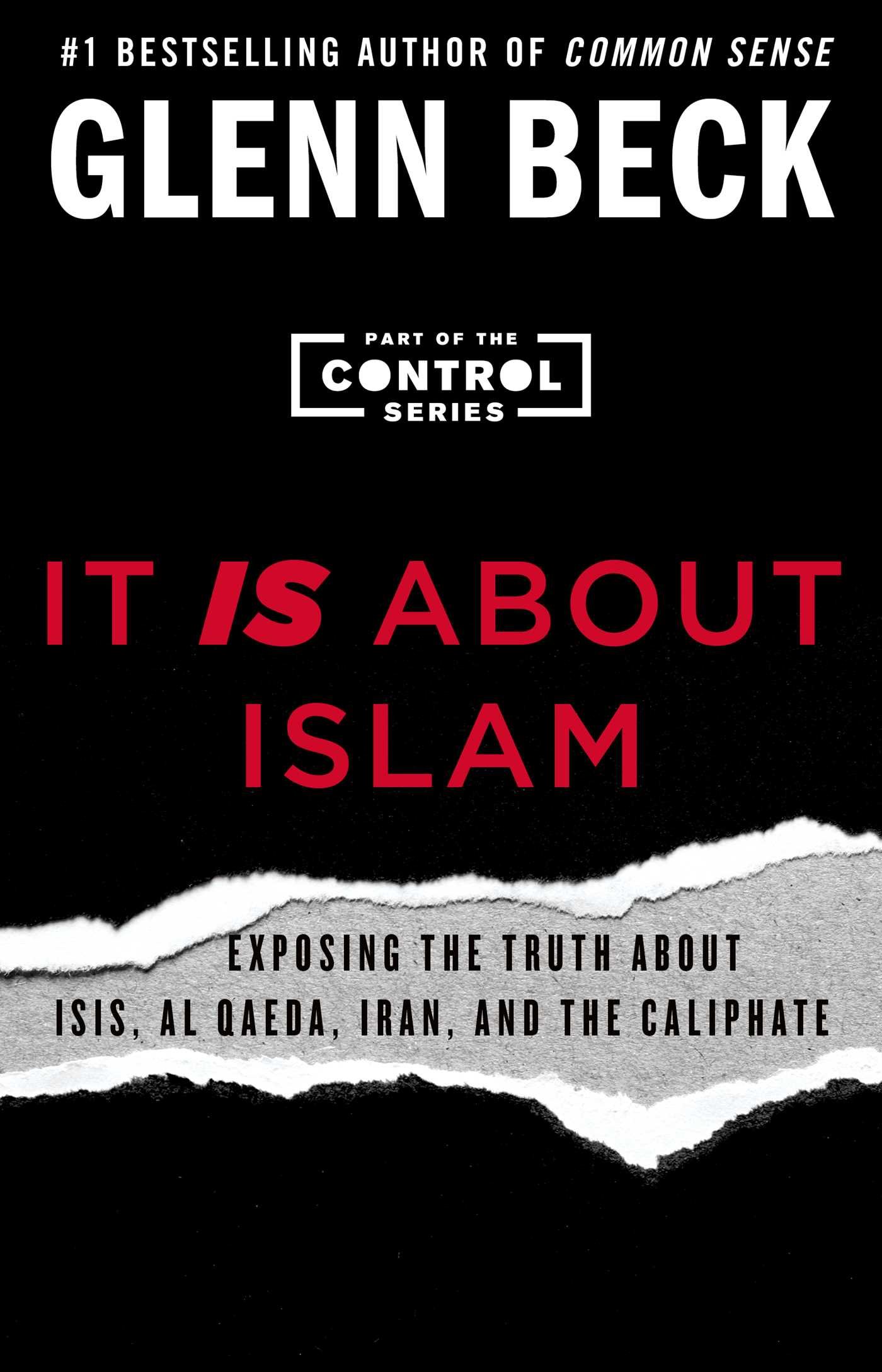
In It Is about Islam (ISBN: 978-1-5011-2612-3) by Glenn Beck, part of Beck’s “Control” series (although I’m not entirely sure because it doesn’t fit the government overstep discussion that is so central to the other two books in the series), the reader is given a crash course in Islam, then typical media and government lies about Islamic extremism (Beck uses the word “Islamism” for this) are discusses and exposed, and then Beck gives a couple basic suggestions on how to move forward.  Based on my own understanding, the background information was solid.  I was intrigued to learn about the contact early Americans had with Islam and the process they went through to properly educate themselves about it.  The “Lies” section was good.  It was likely easy for the research team to gather the material.  There was no need to go into statistics or anything like that.  Simply gathering material from the Koran, the Hadith, and the words of the extremists themselves, did it and showed just how the extremists come up with what they believe.  Finally, there were a couple suggestions on how people should arm themselves with real information and not be willing to be stuck with what the media and politicians try to feed the American public.

I really wasn’t sure how I’d feel about this book.  I know a lot of Muslims, largely because I have spent (at the time of this writing) nearly two years in a country that has a majority Muslim population (~51%, but still a majority).  Bosnia & Herzegovina, though, is famous for being a Muslim lite country, although that has changed a bit since ISIL came on the scene.  I know that the nuts believe they are carrying out the will of God according to the Koran.  I also know some really solid people who are Muslims and don’t live anything like the extremists.  In the end, I ended up agreeing with Beck’s argument that while there are many Muslims that don’t agree with the extremists, it doesn’t really matter because we’re not worried about them; we’re worried about the extremists because they themselves believe they’re engaged in a holy war and that they themselves are carrying out God’s will according to the Koran.  It doesn’t matter what regular Americans think or what elites think or what non-extremist Muslims think.  What matters is what the extremists think, and it would behoove us to call it what it is so we can actually move forward against what is a real threat.  I was probably most disappointed by the section at the end of the book because it lacked any real, concrete suggestions.  The other book in the series have, but this was a bit fuzzier and just asked readers to be educated (one thing I hope to do is read the Koran even though Beck quoted from the Saudi-approved English translation).  I agree that’s important, but in our very literal world today, I think that most people need to be given the step-by-step guide.  My advice would be to not swallow the lines the politicians are always giving us along with doubting just about anything one hears in the media.  Once one figures out the real story, wield the truth and demand justice and common sense by getting vocally and actively involved in local politics.  The book gives the example of some city in Texas having a local sharia court.  If more people who believed in the Constitution stood up, that wouldn’t be happening.

Creative Commons License
This work, including all text, photographs, and other original work, is licensed under a Creative Commons Attribution Non-Commercial No Derivatives 3.0 License and is copyrighted © MMXIV John Pruess.

Wednesday, August 19, 2015

The Possessed

While in college at BYU, I took a Russian literature in translation course.  We read a number of books, most of which I thought were pretty good, a few of which I didn’t much care for.  One that I thought was a good book was Dostoyevsky’s Crime and Punishment.  I remembered that book to have dark, brooding, often just outright insane characters, yet it was a good read. A while back, one of my aunts was cleaning out some old junk and came across some books she read in college.  Some of them were Russian classics.  I took up her offer to become the owner of these books that cost under $1.00 back when they were published in the 1970s.

Small picture of the book cover.Fyodor Dostoyevsky’s the Possessed (often called Demons in more modern English translations), translated by Andrew MacAndrew, was one of those books.  The book is the story of a provincial town in late tsarist Russia that undergoes a short period of chaos when some sons of the town’s prominent citizens return from abroad, university studies, or time in Russia’s crown-jewel cities of Moscow and St. Petersburg.  The young men come back with anarchist, atheist, and nihilist views and what seems like a role in an overarching plan to bring down the established government.  The young men play off the fears of the older members of the town’s citizenry, which aren’t really fears of government or the future, but more about their place in society and other more mundane fears.  Doing this, they wreak havoc messing with romances and balls, get involved with the town’s convicted felons, and even murder someone.  What was probably the saddest part of the novel was how after the murder, the victim’s wife and newborn son died.  All of it was caused by the anarchists working to spread their ideas and being willing to eliminate their opponents if necessary.  After the murder, the anarchists were mostly dealt with by the authorities and things fell back into their routine in the town after a shake-up in the government.  Other than the misery they caused, the atheist anarchists accomplished nothing, and that was probably Dostoyevsky’s point in writing the novel: atheism, anarchism, and nihilism are sure ways to bring about one’s destruction and the destruction of those around us.  He also noted, as another of the novel’s characters died, that a firm belief in God and Jesus Christ was a sure antidote to those negative philosophies.

As predicted, the novel had dark, brooding, misguided, and certifiably insane characters.  It was honestly kind of hard to get through at times.  It’s not the kind of book that you pick up one afternoon and finish later that evening because you just couldn’t put it down.  On the other hand, it’s very well written, and easy to follow the story, if not always the philosophy of some of the characters, which is probably just because the ideas of nihilism and anarchy are such fringe ideas in our current society.  By the end of the book, even with all of the death and destruction that many people consider to be hallmarks of Russian literature, I was a fan.  It showed very clearly the depths to which the philosophies of nihilism, atheism, and anarchism can lead people.  They lead to destruction on a personal and societal level.  They lead to spiritual and physical destruction.  While Dostoyevsky didn’t focus on the Christian message very much, he made the point clearly that to redeem oneself and to redeem the human condition, one must accept God and live by the standards that acceptance demands.  That is a message worth reading any time.

Creative Commons License
This work, including all text, photographs, and other original work, is licensed under a Creative Commons Attribution Non-Commercial No Derivatives 3.0 License and is copyrighted © MMXIV John Pruess.