Showing posts with label Revolutionary War. Show all posts

Thursday, August 20, 2026

Paul Revere’s Ride

Paul Revere's famous ride as learned by most elementary school kids in the U.S. is exciting, breathtaking stuff.  He rides his horse frantically through the town, alerting Bostonians to the imminent arrival of “the British” (ignoring the fact that most colonists thought of themselves as British).  The lanterns are hung in the Old North Church and the day is saved.  I loved the story as a kid.  I loved visiting the old church when I had a chance to take a trip to Boston.  The story was one that helped bring history to life and wasn’t hard for a kid to imagine and to wish to emulate.
 
Book cover.Paul Revere’s Ride by David Hackett Fischer (ISBN: 0-19-509831-5) is an in-depth biography of the man whose famous horse ride and plan to warn the colonists of impending danger has largely withstood the test of time and has been passed down to the present day through prose, poetry, and visual art.  Paul Revere’s father was a poor French boy when he arrived in the New World, but hard work allowed him to establish himself and provide a solid foundation for his family.  Revere followed in his father’s footsteps by learning to silversmith.  He added engraving to his repertoire along with being unafraid to try his hand at other things, including dentistry (not exactly the science we know today).  He was also a master networker and communicator who felt and filled a large civic duty.  He was a part of multiple civic organizations and participated fully in various local boards and commissions.  People up and down the Massachusetts coast knew and trusted him.  He did undertake his famous nighttime ride, but he was not alone, and it didn’t involve only the Old North Church.  Revere rode one route while two other men took a different route.  Revere’s was arguably more successful, as he made contact with more people than the other riders, but both played an important role.  As they made contact in the towns and villages near Boston, other riders then carried the warning farther inland or farther north.  Wildly, Revere was actually apprehended briefly by a British patrol, but they let him go after questioning.  Ultimately, the other Massachusetts towns were warned in time to prepare for the coming of the British army.  After the famous ride, Revere went on to continue his involvement in American politics, including making engravings that told the colonists’ side of the story and helped organize them around the revolutionary cause.  Revere made many contributions above and beyond his famous ride to the revolutionary effort.
 
I thought the book was really good.  I was a little worried when, at the beginning, the author noted that he would tell a bit about British General Thomas Gage as well, but it turned out that didn’t distract from Revere’s story.  Given the role Gage played in British efforts, it probably helped to know some of this background.  There were a number of illustrations throughout the book, which I thought were interesting.  The true story of Paul Revere’s ride, of course, doesn’t exactly match the famous poem; it’s likely better and doesn’t change at all the inspiration that the story provides us, encouraging us to sacrifice for a good cause.  Revere provides an excellent example of what an involved citizen should be.  He participated in local formal and informal bodies, contributing time, effort, skill, and means to the cause of freedom.  He was willing to contribute himself to liberty’s cause.
 
Creative Commons License
This work, including all text, photographs, and other original work, is licensed under a Creative Commons Attribution-NonCommercial-NoDerivatives 4.0 International License and is copyrighted © MMXXI John Pruess.

Sunday, August 16, 2026

John Adams

“To be good, and to do good,
is all we have to do.” — John Adams

I’ve always looked at the American Founding Fathers with a lot of respect, but I also have often fallen into the common trap of thinking of them as George Washington, Tomas Jefferson, and Benjamin Franklin.  There were fifty-six signers of the Declaration of Independence.  There were thirty-nine signers of the U.S. Constitution.  Both of those documents were inspired documents, and there was a lot of inspiration and many miracles that went into them both, contributing to and guiding the creation of the United States of America, which has thenceforth been a blessing for so many people.  I figured 2026, the 250th anniversary of America’s birth, would be great time to get to know some of the other Founding Fathers a little better.
 
John Adams by David McCullough (ISBN: 0-684-81363-7) provides a deep and broad look at the second president and a man who is often credited as being the voice of independence.  The book starts just a little before John Adams was born, telling the reader about his parents and lineage before getting into the details of the future president’s life.  McCullough tells the Founder’s life story in great detail, in part because Adams left extensive diaries and letters to draw from.  One learns about his schooling, his law practice, his family life, his farm in Massachusetts, and his ascendency onto the national stage, where he flourished.  One learns about his shortcomings as well, including a propensity to get down on himself, a willingness to let others’ opinions of him matter (vanity), and a sometimes quick temper.  Once Adams makes to Philadelphia to advocate for independence, the book goes into great detail, explaining his thinking and his actions and then follows his career.  He was a diplomat, helping Benjamin Franklin in France and forging his own path in the Netherlands, where he, on his own, secured loans to help the American cause as the Revolutionary War dragged on.  He was the new country’s first ambassador to England and then the country’s first vice president.  In all of his positions, he advocated for what he thought was right.  He didn’t back down and wasn’t afraid to take a little heat sometimes.  The book paints him as a man of strong moral convictions based on a faith in God.  During his time as president, he successfully kept America out of a war with France, which greatly helped America, a weak and fledgling nation, find its wings.

I thought the book was masterfully written, which is not a surprise, considering it’s written by the author of another great work, 1776.  I got to know John Adams quite well over the course of the book.  His letters and diaries are woven tightly into explanatory prose.  The book was well balanced, noting where Adams had personal and professional shortcomings or hiccoughs.  Like most of us, life tended to knock off a few of the rough edges, and he grew and improved throughout his life.  I was impressed by his strong sense of morality and how that guided him in all that he did.  His role in America’s early years was grand, and he liked to think of himself as grand, but also realized that he was happiest when surrounded by a few good books and the daily labor of running a farm.  He made the most of the opportunities presented to him, sacrificed time, money, and even his family for the callings he had, and left the world a better place.

Creative Commons License
This work, including all text, photographs, and other original work, is licensed under a Creative Commons Attribution-NonCommercial-NoDerivatives 4.0 International License and is copyrighted © MMXXI John Pruess.

Thursday, May 28, 2026

Founding Father

There’s never been a time when the Revolutionary War hasn’t been interesting to me.  The concept of people standing up for what they believe to be right and being willing to sacrifice everything for that is always inspiring.  The Americans who fought in the Revolutionary War had a set of beliefs and rights that they believed were given by God and being infringed upon by the English government.  They sacrificed intangible things like their names and reputations as well as treasure and the proverbial blood, sweat, and tears.  Their sacrifices resulted in a country that has provided incredible opportunity like nowhere else for generations and generations.  Whether it was regular soldiers suffering on cold battlefields or commanders trying to inspire their men against what was the world’s premier fighting force at the time, there were many sacrifices being made, inspiring both the people of that time and people like me hundreds of years later.

Book cover.Founding Father: Rediscovering George Washington by Richard Brookhiser (ISBN: 0-684-82291-1) provides a short overview of the original father of the country, George Washington.  The book starts with an interesting discussion of modern history, which is history that often looks to break down the heroes of the past, find fault with them, and discount the stories that have been handed down for generations.  Brookhiser claims he’s not looking to disparage Washington like other modern historians while being willing to set aside legend (“I cannot tell a lie,” for example) in order to give a clearer picture of the first president.  The book then provides a basic overview of the major parts of Washington’s life, war, overseeing the writing of the Constitution, and his time as President, plus a review of the ideals and morals that drove Washington or that Washington chose to drive himself to achieve, as the case may be.  A rather significant amount of time was spent relating Washington’s largely successful attempts at controlling his temper, other emotions, and tongue.  The book finished with an interesting and very modern, despite the book being published in 1996, review of Washington’s patriarchal role.  Brookhiser notes that fathers are not the rocks in people’s lives that they once were, and calling someone the father of a nation or a founding father may not really inspire anyone in modern America like it may have previously.  Washington’s role as the father of his country and the strong, guiding presence behind many early American events is examined before the book ends with his death.

Overall, I thought the book was fine.  I think I didn’t find it as amazing as many reviewers did is because I didn’t need to rediscover Washington.  I didn’t need to be disabused of any notions of Washington being a failure or some insufferable hypocrite who didn’t live up to lofty ideals he professed.  The Founding Fathers were mortal and had shortcomings.  That is why they are so inspiring.  Like Washington, who spent his life striving to be better by controlling himself, many of the Founders strove to live on a higher plane and provide that for others.  Washington, despite many efforts, has survived deconstruction rather well.  For those who may be questioning the greatness of the heroes of the Revolutionary War, Brookhiser’s work is a worthy addition to that of the more based authors finding the good in the men and women who were willing to put it all on the line and sacrifice for a better life for themselves and their posterity.  I was appreciative of the chance to re-acquaint myself, even if just briefly (the book barely makes it to page 200), with this great man and the great example he provides for us.
   
Creative Commons License
This work, including all text, photographs, and other original work, is licensed under a Creative Commons Attribution-NonCommercial-NoDerivatives 4.0 International License and is copyrighted © MMXXI John Pruess.

Tuesday, August 22, 2023

The Forgotten Founding Father

I don’t know that I can say that I’ve always been interested in languages, but ever since I served a mission in Russia for the Church of Jesus Christ of Latter-day Saints and learned Russian, I’ve had an interest in languages.  I took German in junior and high school, but never made any real progress.  In high school, when they started teaching us about accusative and dative cases, my brain lost it.  I remember doing a homework assignment dealing with those and asking my native German-speaking grandmother and my German-speaking father for help and still just having brain cramps.  Learning Russian was also very difficult, but I was able to overcome my problem with cases, and it’s been fun to attempt to keep some of these language skills from earlier in my life up since then.  Learning foreign languages like German and Russian also helped me understand things like English grammar and the etymology of English words a little better.  As a really young kid, I remember a copy of the Merriam-Webster dictionary on our shelf and sometimes asking my mom why we never read “the big, red book.”

Book cover.The Forgotten Founding Father: Noah Webster’s Obsession and the Creation of an American Culture by Joshua Kendall (ISBN: 978-0425-24545-3) tells about how that “big, red book” came to be thanks to another person who was very interested in words and language.  The book chronicles Webster’s life from boyhood to death, taking a very detailed look at the parts of his life that led to his creation of the famous dictionary, part of Webster’s desire to make America its own unique country.  Somewhat unusual for his day, Webster went to college even though he came from a farmer’s family.  He then pursued a career tied to literature.  He wrote extensively, including many essays, letters, and pamphlets in support of American independence and then in support of a federal republic.  While his writings are not as well known today as those of others like Hamilton, at the time, there were many leading Americans who believed Webster’s efforts were essential parts of swaying public opinion.  Webster initially made his name by publishing a speller, a book that helped schoolchildren learn to read and write.  This book provided him with a foundational income throughout his life.  He also worked as a lawyer, editor, and publisher.  What he realized he loved doing, though, was more similar to the speller: compiling, organizing, and ordering information.  This led to his interest in dictionaries.  He found flaws in extant dictionaries and decided to improve on them by publishing his own.  One motivation he had for this was that he believed a uniquely American language would help create and uphold a uniquely American culture, one that was needed to help the nascent nation maintain its distance from its former imperial overlords and move forward.  While his ideas on government changed over the course of his life, his belief in America did not.  The dictionary took much more time and money than he thought it would, but it was eventually published and created a new standard as well as codifying much of what was then a unique American language with new words expressing the new ideas embodied by the new nation.

Overall, I enjoyed reading the book and found it interesting and informational.  Reading of the American Founding and those who played integral roles in those events is always interesting.  I found some of the discussion of early American literature and the academic scene to be less intriguing, but understand that it helped set the stage for Webster’s work and may be a necessary part of telling his story.  It seemed the author wanted to diagnose Webster with some kind of mental disorder (OCD, autism, etc.), but never really came out and said it, just approached it tangentially.  That constant repetition of that theme was a little distracting.  The dictionary itself is only the last quarter of the book, so there’s a lot of other material to get through, but I thought the case for Webster’s role in America becoming its own entity, separate from Great Britain, was made convincingly.  Those interested in the Revolution and the Founding, not just nerdy linguistic things will find the book of interest.
 
Creative Commons License
This work, including all text, photographs, and other original work, is licensed under a Creative Commons Attribution-NonCommercial-NoDerivatives 4.0 International License and is copyrighted © MMXXI John Pruess.

Thursday, March 23, 2023

Franklin & Washington

The Founders (I’m old enough that it was the Founding Fathers) of America were some amazing people.  Stories of Benjamin Franklin, inventor, diplomat, statesman, and printer were a staple of what was taught as history when I was a kid.  It was great stuff and inspired me to read his Autobiography as a teenager, and that was a great read, too.  Franklin embodied much about the nascent country: innovation, progress, a desire for liberty, and the ability to chart one’s own course.  Washington’s life was also the stuff of legend.  Surveying sounds boring as a career, but in the Revolutionary era, it was outdoorsmanship at its finest, supplemented by frontier action.  Washington added to his status by being a competent military leader, fearless under fire.  Finally, he was the country’s first and probably greatest president, in large part because he was a reluctant leader (those are typically the best kind).

Franklin & Washington: The Founding Partnership by Edward J. Larson (ISBN: 978-0-06-288016-1) takes an often detailed look at how Benjamin Franklin and George Washington worked toward common goals during the Revolutionary era, often working in concert to attain the desired outcome of a free United States.  Larson provides an overview of each man’s life, which establishes that even before they knew each other, they had much in common.  They were colonists, their early fortunes were tied to the western frontiers of their respective colonies, and they were involved in military and political matters.  While their person routes to success were different, with Franklin rising to wealth and fame via hard work, ingenuity, and learning and exploiting the political scene, Washington had a slightly easier route that involved coming into land and marrying into a wealthy family.  Ultimately, though, he, too, was a self-made man, parlaying his surveying and military skills into productive aspects of management and leadership, letting him be a successful estate owner and businessman with a strong ability to find workable compromises in otherwise explosive situations.  Once both were convinced that British rule was not the way to go for the colonies, they poured their hearts and souls into independence.  They believed strongly in liberty, and put their money where their mouths were, sacrificing time, money, and more to the cause of liberty.  Franklin spent years abroad; Washington spent years leading the Continental Army.  Once independence had been secured, both turned their attention to helping the thirteen colonies unify, something both strongly believed in.  This was more time and sacrifice.  They were leaders at the Constitutional Convention.  Their styles there sometimes differed, but they worked toward a common goal of a unified country with a federal government strong enough to keep the states in check at times.  Larson also spends a significant amount of time talking about one of the biggest differences between the two, which was their outlook on slavery.  While they started life someone on the same footing there, Franklin slowly evolved to eventually come to an abolitionist viewpoint.  Washington never moved from his position as a slave holder, although he was willing to go along with the anti-slavery clauses in the Constitution.
The book was mostly interesting, and I found the comparison between the two storied leaders to be an interesting approach to studying the Revolutionary era.  Even though their stories are well known, the biographical section was good and had some details that were at least new to me.  The author claimed Franklin to be a deist, which is the popular thing to do, and while the first Franklin quote he used to prove that could possibly support that assumption, I thought the next three God-related quotes from Franklin were much more supportive of his believing in God.  The author didn’t really touch on Washington’s religiosity (a good thing, too, considering that George Washington’s Sacred Fire thoroughly destroys any argument to the contrary on that score), which I found a little disappointing.  If they really thought so differently about God, it could’ve been a good point about how  men of differing fundamental beliefs still found common ground and worked together, a very appropriate lesson for today.  If their beliefs were closer in nature, it could’ve been another point where these great men saw eye to eye.  The slavery discussion had its interesting moments, but was too much. The point was made early in the book that these two didn’t see eye to eye on this issue, but then the reader had to read fifty pages about it.  There was also a rather accusatory approach to Washington’s views (“views” being a stretch as one really only reads about his actions and not what he said about it, which, as I have read in other places, were conflicted), seemingly pointing out that Franklin came to the abolitionist side, so automatically Washington should’ve, too.  In any case, the historian is not supposed to judge the actions of yesteryear’s figures by today’s standards.  All modern readers know slavery is wrong, and the Constitution they helped create set up a system that allowed for the abolition of slavery to happen much faster than many would’ve preferred, so the focus should’ve been, again, on how the two managed to work together and have strong respect for each other until their dying days despite this.  Both of these problems seemed like missed opportunities by the author in what was otherwise a good book about two great men.
   
Creative Commons License
This work, including all text, photographs, and other original work, is licensed under a Creative Commons Attribution-NonCommercial-NoDerivatives 4.0 International License and is copyrighted © MMXXI John Pruess.

Saturday, December 18, 2021

Seven Miracles That Saved America

Although the 1980s brought about the fall of the Soviet Union and its empire in Eastern Europe, as well as the decline of many of its proxies elsewhere in the world), that was not until the tail end of that wild decade.  The first nine years had a world very clearly defined by the West, led by the United States of America, and the Communists, led by the Soviet Union.  America’s special role in the world was well understood by almost everyone in the world.  Later, this came to be called “American exceptionalism,” but at the time, it was simply known as “America.”  This America was built on a firm foundation of inspired men from Columbus to the great president of the 1980s, Ronald Reagan.  In between, there were the Founding Fathers, Abraham Lincoln, and the Greatest Generation.

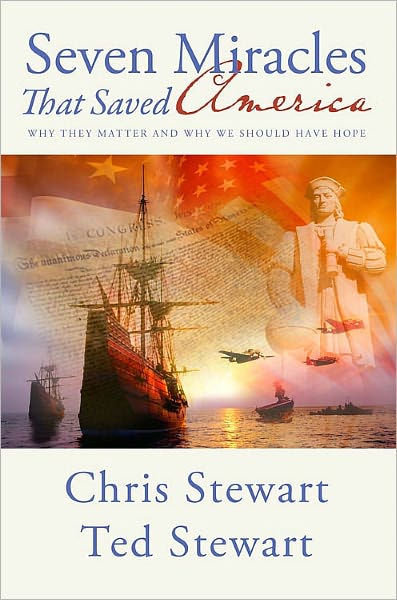
Book cover.Seven Miracles That Saved America: Why They Matter and Why We Should Have Hope (ISBN: 978-1-60641-144-5) by Chris and Ted Stewart explores singular events and unique people in American history that, had things unfolded even slightly differently, could have resulted in a vastly different America.  All of these events and people hinge on such a fine line that it is easy to see that they were influenced by God.  The miracles that the authors review in detail are the following: Columbus and Columbus’s discoveries, Jamestown, a summer fog during the Revolutionary War, the advent of the American Constitution, Abraham Lincoln and the battle of Gettysburg, the battle of Midway, and Ronald Reagan and how the assassination attempt against him failed by less than one inch (just a little bit more and the bullet kills him).  Each one of the miracles is reviewed in detail by the authors and the scene is set through some historical fiction.  At the end of each section, the authors ask some questions that invite the reader to think about what would have happened in each of these situations had things — and usually it’s quite an exhaustive list of things — turned out even slightly different.  For example, with the foggy morning during the Revolutionary War that allowed American troops to withdraw and regroup without suffering losses, it really was a question of a few hours and things could have been vastly different.  The same could be said about the battle of Midway.  There, it really was more like minutes since one of the pilots flying and trying to locate Japanese fleet only had minutes before needing to return to base without running out of fuel.  At the last possible minute, though, he spotted the Japanese ships, and that allowed the Americans to attack first, which proved critical in the battle, along with other decisions and rare direct hits during the bombing runs.  The point being made is that there were just too many decisions at so many different points along the way that for those who recognize that God has a role in human existence, these events were miraculous and they resulted in an exceptional country that has long been a light on a hill.

The book was an interesting read and presented some things that I was either not very familiar with or, in the case of the foggy day during the Revolutionary War, had not heard of at all.  I liked the detailed reviews of the events and people, which helped make the case that the events really were miraculous.  I think the case was presented effectively.  I found the concluding chapter, where the authors proposed that God’s intervention in the past likely meant God would intervene in the future to also be sound analysis, especially as it was paired with God’s discussion with Abraham about preserving the ancient cities of Sodom and Gomorra as long as even a few righteous remained there.  What I found to be less interesting was the historical fiction (not one of my favorite genres to begin with, admittedly) that was used as a scene setter.  It seemed to me that it was there simply to make this more of a book-length affair, and I think it would have been possible to find solid, historical material to fill in a lot of the space taken by the fictionalized accounts.  A shorter book would have also been acceptable as I believe the points were adequately made.  In any case, it was a great reminder of America’s exceptionalism and of our individual responsibilities to help keep it that way by being part of the righteous that God is willing to preserve.
 
Creative Commons License
This work, including all text, photographs, and other original work, is licensed under a Creative Commons Attribution-NonCommercial-NoDerivatives 4.0 International License and is copyrighted © MMXXI John Pruess.

Sunday, January 06, 2019

Washington’s Spies

After reading George Washington’s Secret Six, I wanted to know more about this ring of spies that did so much for my country.  I didn’t know the story of these early Americans, which was almost unheard of outside of their individual families until the 1920s, when a guy with the interesting last name of Pennypacker recognized that the handwriting in some documents in his Long Island, New York, collection and in some letters in the George Washington collection were the same.  That led him to figuring out just who Samuel Culper was.  He wrote a book, but the story went back into relative obscurity until cable channel AMC decided to make it into a TV series.  As a mostly non-TV watcher, I’d much rather pick up the book.

Book cover.Washington’s Spies: The Story of America’s First Spy Ring by Alexander Rose (ISBN: 978-0-307-41870-8) delves deep into the history of the Culper Ring.  It starts well before the two main Culper spies came onto the scene by giving the reader the full story of America’s first spy, Nathan Hale, who likely said, “I only regret that I have but one life to lose for my country,” before being hung, condemned as a traitor to the king.  Hale was friends in college with the first spymaster of the United States, Benjamin Tallmadge, and Hale’s untimely demise served as a very real warning to Tallmadge and others who were contemplating ways to undermine the British in America.  In similar, extremely detailed fashion, Rose takes the reader through the history of the ring from its very beginning to its disbanding as the Revolutionary War wound down.  He talks of its triumphs in warning Washington of various British plans ranging from diversionary marches to producing counterfeit money.  He discusses the struggles the ring had, which ranged from finding someone to shuttle messages back and forth to figuring out ways to encipher writing, all the while avoiding the heavy hand of military justice.  The book also provides a lot of detail on Benedict Arnold’s defection, the effects of which the Culper Ring diminished, and on the British spymaster, John André, who was involved in that unfortunate event, and therefore, hung by the Americans.

This was a book that I really enjoyed reading.  While more academic in nature than the first book I read on the subject (I even had to look up a few words in the dictionary), it was no less engrossing, and it easily captures one’s imagination, transporting the reader back in time and into the shops, taverns, and marshes of colonial New York.  It’s really no surprise this book and its author were relied on heavily by AMC’s producers.  I liked the high level of detail that gave a very complete picture of all the spies, the couriers, and the American and British officers involved in attempts to gather intelligence and to thwart such operations.  There were also detailed explanations of XVIII-century spy tradecraft such as invisible inks and codes and how to break them.  It made me think of some school and Cub Scout activities that I fondly recalled.  The book is a very solid piece of history that relied solely on well-researched history, including a large number of primary sources (The author also spends a few pages discussing some of the more popular theories about the Culper Ring, such as “Agent 355.”  The author jumps on no bandwagons and intelligently discusses the matter, noting that the somewhat popular theory of a woman intimately involved in the ring is unlikely.), on a thoroughly interesting chapter of Revolutionary War history and one that helped me appreciate those who sacrificed to make the United States of America.

Creative Commons License
This work, including all text, photographs, and other original work, is licensed under a Creative Commons Attribution Non-Commercial No Derivatives 3.0 License and is copyrighted © MMXIV John Pruess.

George Washington's Secret Six

I have always appreciated the Revolutionary War, knowing that it was a critical and major part of the process of America becoming America.  There is a very real chance that I would not be who I am today if it were not for the revolution.  It then goes without saying that I am indebted to the great leaders of nascent America.  Sadly, it’s not a big stretch to say that I don’t know enough about them and about the war they fought to secure both their freedom and my freedom.  The subject has always captured my imagination, though, and I am always excited to learn more about how the United States miraculously overcame Great Britain.

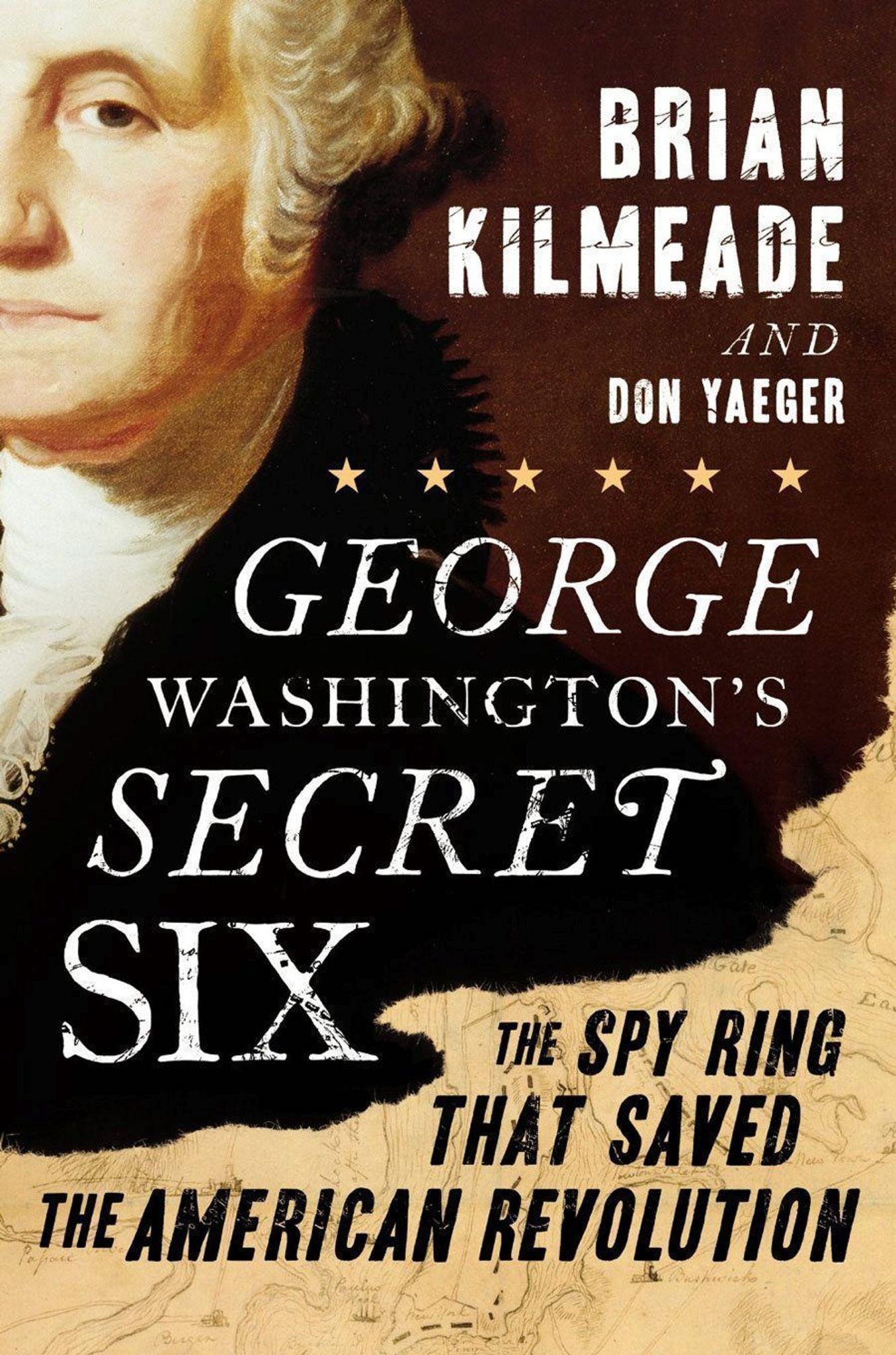
Book cover.George Washington's Secret Six: The Spy Ring That Saved the American Revolution by Brian Kilmeade and Don Yaeger (ISBN: 978-1-59523-103-1) tells a very interesting story and gives some important insights into just how Washington and the other rebels upset one of the greatest empires in the world.  Washington was not opposed at all to spying, and the methods he was willing to employ were rather cutting edge for his time.  Importantly, the American forces were first to plunge into the spy game, so the British, who eventually put off the old ways of thinking about spying and the old ways of spying itself, had to play catch up.  Since New York was of such great importance to the warring armies, getting solid intelligence out of the Tory-held area was critical to the American cause.  Washington’s chief of intelligence, Benjamin Tallmadge, was able to recruit six agents in New York, known as the Culper Ring, after the pseudonyms of the main agents, who then provided the Continental Army with key information throughout the war.  They were able to help thwart a British attack on French forces friendly to the American rebels, they helped capture traitor extraordinaire Benedict Arnold, they helped Washington avoid defeat by warning him not to chase after what was a British diversion, and they helped the Continental government fight against British attempts to infuse America with counterfeit money.  Kilmeade and Yaeger provide a number of details about those involved in the spy ring, the officers on both sides, and the various events they were involved in from the ring’s inception to the end of the war.

I enjoyed the book and was pleased to learn a number of new things.  The book was relatively light reading, though, which was slightly disappointing, but expected considering the author with top billing used to be a cable news morning show host.  I liked getting a look at a part of the Revolutionary War that I was unaware of before, especially considering its relative importance.  This book spent a bit of time on each of the main characters in the spy ring, including one the authors (and some others, it turns out) refer to as “Agent 355.”  There are various theories as to who this person is, but the authors of this book leaned heavily toward the idea that this person was a woman involved in the spy trade.  It very well could have been, but I remained unconvinced and thought that this was more of a ploy to appeal to today’s reader.  Overall, I would’ve liked a more academic treatment of the subject, but found the book to be a great introduction to a fascinating piece of American history.

Creative Commons License
This work, including all text, photographs, and other original work, is licensed under a Creative Commons Attribution Non-Commercial No Derivatives 3.0 License and is copyrighted © MMXIV John Pruess.

Wednesday, August 16, 2017

Visions of Freedom

Growing up as a Mormon in Utah, especially back before the advent of what are often called in Mormon culture “small temples,” the Salt Lake Temple reigns supreme.  It is photographed endlessly.  It is the crown jewel of Temple Square even though most visitors cannot enter it.  It is the subject of both the state’s and the Church’s history and the stories that involve the Salt Lake Temple intertwine the two.  As a result of that situation, some of the state’s other temples are a bit lesser known to the general populace, myself included.  The fact that I always have to stop and think and remind myself that the St. George Temple was the Church’s third temple, not the Salt Lake Temple, proves that point.  I first heard, from my parents during a visit to Southern Utah as a kid, that the Founding Fathers appeared to President Wilford Woodruff in the St. George Temple.  The story was amazing and one I always remembered.

Book cover.Visions of Freedom: Wilford Woodruff and the Signers of the Declaration of Independence by Michael de Groote and Ronald L. Fox (ISBN: 978-1-60861-227-7) is a book about Wilford Woodruff’s visions (he had two of them on this subject) and the men that appeared to him.  The first part of the book discusses the history behind modern vicarious ordinances in the Church of Jesus Christ of Latter-day Saints (anciently, the Bible contains one passage discussing baptism for the dead, and scholarly literature discusses a few others).  The next major theme of the book is how Wilford Woodruff’s preaching about his visions and the work he did in the St. George Temple for the men who appeared to him, as well as for some other famous people throughout history, changed, to a significant degree, the Mormon outlook on work for the dead in the temple.  Before President Woodruff’s visions, the vast majority of temple work was done only for ancestors or very close friends.  What that meant was that once a person had traced his genealogy as far as he could, he didn’t have much of a reason to attend the temple.  President Woodruff’s work for the Founding Fathers and others taught that temple work was necessary for all who had ever lived, which also gave faithful saints a reason to come to the temple again and again.  The majority of the book, though, consists of short biographies of the signers of the Declaration of Independence.  Each signer gets at least one page, although most have more than that.  There are some appendices that discuss the actual temple work and various accounts of President Woodruff’s visions.
I am not normally attracted to reading about Church history.  The history of the United States fascinates me.  I’m sure this overlap helped this book be of interest, but I think it had more to do with the fact that the story was one that was of interest to me as a kid.  I found the discussion of baptisms for the dead in the early Church quite intriguing.  What I missed in the discussion of Wilford Woodruff’s dream was the actual sermons in which he talked about it.  I found them, later, in the appendices.  I thought that was an unnatural place for them.  They should’ve been front and center.  Finally, the biographies were interesting.  They were just snippets and, usually, not very long, providing highlights of government service and the thoughts of other Founding Fathers on the person in question.  I enjoyed learning about how they came to be involved in the signing of the Declaration of Independence.  Many of them were what would be called “flip-floppers” in today’s toxic political environment (although maybe not necessarily since that term, at its purest, refers to those who change positions for political expediency, not because of any deeply held personal belief).  Many were British supporters until things just got too out of hand (it was almost always taxes that bothered them, but property rights and religion played a role, too).  The wide cross section of society was interesting, too.  Most of the signers were from the upper or upper middle class.  Not all, though.  There were guys who had worked their way up from being the apprentices of tradesmen to being judges.  There were merchants, clergymen, lawyers, and others.  What they had in common was a desire for themselves and their fellow countrymen to be free.  The book typically pointed out when one of the signers owned slaves or not.  This is a fascination that modern history has, but I thought it was dealt with admirably by the authors, who noted, at the end, that, unfortunately, many of our Founding Fathers were slave owners, but that was a burning issue then, and most of those who owned slaves struggled with it, later freeing some or all of their slaves or helping to write laws that hampered the slave trade in the U.S., but the important thing was that the founding documents (many signed not just the Declaration, but the Constitution as well) made it possible to later eliminate slavery in America.  Ultimately, that’s why they came to President Woodruff: they wanted to be free, free from spiritual prison in the afterlife.  It was an interesting historical and theological read that made me think about my amazing national heritage as well as my testimony in a loving God that has provided a way for all men to return to him and experience salvation.

Creative Commons License
This work, including all text, photographs, and other original work, is licensed under a Creative Commons Attribution Non-Commercial No Derivatives 3.0 License and is copyrighted © MMXIV John Pruess.

Sunday, November 25, 2012

1776: The Illustrated Edition

I always enjoyed learning about the Revolutionary War.  The bravery of the American rebels was admirable to me, even as a little kid.  I never tired of the stories of Paul Revere, the Boston Tea Party, and the important battles.  Men of incredible intellect such as Thomas Jefferson, Benjamin Franklin, and John Adams impressed me because of their brilliant writings and inspired philosophy.  Men of action, those leaders and infantrymen in the Continental Army who far and away exceeded expectations, and General George Washington, in particular, had story after story worth telling.  I was also probably influenced by epic artwork such as Arnold Friberg's The Prayer at Valley Forge, which portrayed the deep faith that many of our Founding Fathers displayed and was worthy emulating.

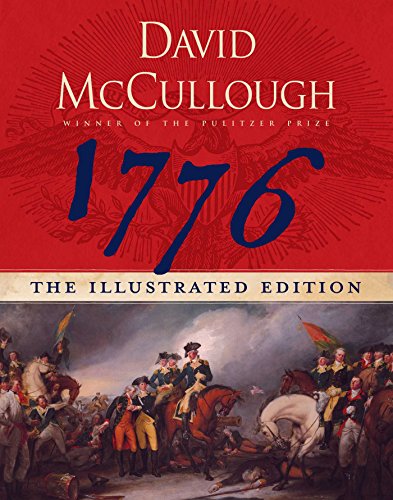
Book cover.In 1776: The Illustrated Edition (ISBN: 978-1-4165-4210-0) by David McCullough, the award-winning writer and historian added a little bit of a twist to his seminal 1776: paintings, maps, copies of original documents, and other visual aids that help bring the drama America's first year as an independent nation to life.  The book chronicles the activities of the colonists and the British throughout the year.  Since the Revolutionary War lasted another six years, there is actually not a whole lot of Revolutionary War coverage in the book, but the set-up is there, and the key battles of the year, such as Washington's crossing of the Delaware to defeat formidable and intimidating Hessian forces, are there in great detail.  McCullough explains the significance of the actions of Congress, Parliament, and the two belligerent armies.  As the year comes to a close, the stage is set for the next few years of war, but one could easily predict the eventual outcome given the improbable patriot successes and the momentum they, regarded as simple "rabble" by the elite British forces, had gained in such a short time.
The book was an enjoyable read, and its coffee table-style format was neat.  Every twenty pages or so, there was a sleeve with reproductions of letters, documents, and maps.  Almost every page had an illustration, painting, or other visual.  It did help bring it alive.  The illustrated edition, of course, does not contain all of the text of McCullough's original work, but there is enough to follow the stories, get details, and be amazed and inspired.  In the end, the book served as a very visual reminder of how amazing and miraculous the foundation of America was.  We are sometimes not as appreciative of what the Founding Fathers sacrificed everything for as we should be, and it's always good to be reminded.  It's even better to not just express our gratitude, but to do something about it.  Like those who sacrificed so much during 1776, our liberties are also not free.

Creative Commons License
This work, including all text, photographs, and other original work, is licensed under a Creative Commons Attribution Non-Commercial No Derivatives 3.0 License and is copyrighted © MMXI John Pruess.

Saturday, May 19, 2012

George Washington's Sacred Fire

In about first grade or so, every kid in America learns that George Washington was the first president of the United States of America, is on the $1.00 bill and the quarter, and "could never tell a lie."  Later, by about fifth grade or so, most American kids are being told by the same schools that George Washington was a backwards slave owning white man that was something or other called a deist, which is typically presented to mean something akin to atheist, and that the cherry tree story was a lie.  I guess it is always somewhat inconsistent to make broad generalizations, but for the 90–100 kids in fifth grade at the same school I was in for fifth grade, the above story is true, and I can't help but assume it holds for many, many others.  That early attempt at indoctrination didn't totally grab hold of me, and I always thought George Washington most definitely deserved his place on Mt. Rushmore as one of the greatest presidents in American history.  For me, he was a man most daring and intrepid as he led the troops across the Delaware River to surprise the British-allied Hessian forces in New Jersey.  He was also an incredibly humble and grounded man who should figure larger in our modern-day politicians' worldviews: he refused to become king and wanted nothing more than to return to his family and estate at Mt. Vernon.  Finally, Washington was a great spiritual leader.  His prayer at Valley Forge was always truly inspiring and reminded me of great leaders in ancient times such as Helaman and Captain Moroni.

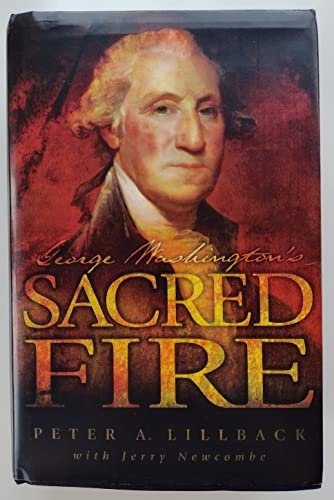
Book cover.In his very thoroughly researched work, George Washington's Sacred Fire (ISBN: 978-0-9786052-6-8), Peter A. Lillback (with Jerry Newcombe), attacks the revisionist history of my fifth grade class.  The book is a very careful examination of the case that has been made and widely accepted regarding Washington's deism.  Lillback explains the arguments that writers, including a Paul Boller that seems to have written the standard in Washington religion-related books up to this point, have used to cast our founding father as a deist.  He then picks those arguments apart one by one.  He does this largely based on Washington's own words.  He claims that this concept has received the short end of the stick throughout time.  One prominent example is that it is often claimed Washington never or almost never used the name of Deity.  Lillback found, after carefully combing through everything Washington ever wrote, that he not only used the name of Jesus Christ, he used hundreds upon hundreds of other names and titles for God, the Son, and the Holy Ghost.  Similar research and proof were conducted and presented regarding other arguments against Washington being a Christian including topics as varied as communion, service attendance, other religiously-motivated behavior, knowledge of the Bible, and library holdings (Washington collected, signed, and sometimes commented on religious books, including compendiums of sermons).  Lillback carefully establishes that Washington communed, attended services and participated in his church community, knew the Bible inside and out, owned many Christian books (and no deist ones), and, arguably most importantly, lived a Christian life.  That final bit is important, because even though Lillback amply proves through Washington's own words (the main text of the book is over 700 pages; the appendices, including hundreds of excerpts from Washington's written prayers or communications where he indicates he is praying, are a couple hundred more), one must always remember with Washington, it was "deeds, not words."

I enjoyed the book immensely.  (As a short aside before explaining that in a little more detail, the book didn't always flow as easily as I might've liked, there were a distracting number of typos, and there were a couple sections that seemed slightly redundant.)  I think I would've enjoyed even if it had not satisfied me with regard to Washington's Christianity.  First, truly understanding the beliefs and positions of the founding fathers helps us think about and understand the way we should look at government today.  Government based on Christian principles and executed to encourage not just a Christian lifestyle, but a fully Christian life and faith, is quite a bit different from what many claim the founders wanted and what the government should be doing.  Second, the man was simply amazing!  He was one of the rare men who practice what they preach, and of said preaching do very little.  While Lillback admits that the cherry tree story is hard to verify (he, though, does not discount it completely), Washington did not lie.  Washington was the humble man I learned about in kindergarten.  He was a great general, a wonderful statesman, and a moral giant.  I found myself over and over noting how important it was to be more like Washington in my everyday life.  He was known to have a terrible temper, but very few people knew that because of his incredible self-control.  That talent was present in other aspects of his personality, too.  Washington understood morality and its bearing on the kind of people and the kind of society we create.  Washington always strove to forgive and to improve himself so he, too, could be forgiven.  Most often, he succeeded.  He was thrifty and abhorred debt.  He was fair, positive, and worked hard to bring others up.  He was a man of prayer who knew where to look for answers he couldn't find on his own.  He knew Whom to thank for any and all answers.  While the book set out to explain Washington's Christianity and succeeded, it also ended up inspiring.

Creative Commons License
This work, including all text, photographs, and other original work, is licensed under a Creative Commons Attribution Non-Commercial No Derivatives 3.0 License and is copyrighted © MMXI John Pruess.