Showing posts with label criminal justice. Show all posts

Sunday, October 02, 2022

Gangs of Russia

The 1990s are known as wild times in post-Communist Russia.  I was lucky enough to be a missionary in Russia at the end of the 1990s (starting in 1999).  I missed some of the craziest times, including a financial crash in 1998 that decimated the meager finances of most every-day Russians, but still got to experience some of the hallmarks of the wild 1990s.  The preferred clothes of the Russian street gang member, track suit pants, a leather jacket, and a black knit hat, were still very ubiquitous, especially in the markets, where the low-level racketeering probably made many of the bootleg CD sales that young people enjoyed possible.  Missionaries sometimes had run-ins with street thugs, although it’s hard to say if they were part of organized groups or not.  Some missionaries who served in Pskov before I did told of having their apartment besieged by a group of young Russian thugs, and one of the missionaries hung a couple sheets tied into an impromptu rope ladder off the balcony and shimmied down in order to get down on the street and warn the sister missionaries from going to the apartment, where a missionary meeting was scheduled.  Later, in the same city, a missionary companion and I had a run-in with thugs who beat us up in our own apartment building’s elevator, taking the small bit of money we had on us as their prize.  Such stories were common in 1990s Russia.

Book cover.
Gangs of Russia: From the Streets to the Corridors of Power by Svetlana Stephenson (ISBN: 978-1-5017-0024-8) delves into street gangs in the post-Soviet Russia.  Published in 2015, it relies on data gathered mostly during the first decade of the 2000s, but also talks about the 1990s.  The books focuses on traditional Russian street gangs, and doesn’t worry much about independent criminals or the famed thieves in law (vory v zakone).  The street gangs, the author reports, are like the thieves in law in that their roots go back to pre-revolutionary Russia, where the social fabric of the village commoners was often knit in part by groups of young men who spent their free time roaming the village streets, often picking fights with neighboring villages.  Much like soccer hooligans, these fights weren’t always territorial in nature, but sometimes just as an outlet for steam and the kind of dangerous, on-the-edge entertainment that young men often look for.  Soviet urbanization quashed much of this behavior, but glorification of anti-Soviet criminals in the 1970s and 1980s led to a comeback.  Once the Soveit Union fell, there were plenty of opportunities for street gangs to make money, not just fight each other, and they rapidly moved into sectors where the state was often unable to provide security or other services that government is usually expected to provide.  Markets, kiosks, street parking, prostitution, and extortion were prime territory for street gangs.  As these opportunities proved lucrative, the fights returned, but now for territory and power.  A few of these new criminals moved up the chain and became career criminals, commanding the guys on the streets below them, which were the types we missionaries ran into.  As the 1990s have faded into the past, street gangs have had to adapt to the state becoming more powerful and things like private security firms (usually started by former gang leaders) edging into the gangs’ territories.  Traditions have also changed or are threatened by the ever-increasing drug trade.  Finally, a major thesis in the book is that Russian  street gang members, unlike those in some other places, are able to combine the street life with regular life, including college, careers, and families.  Russia has a unique culture that allows for one pursuing both angles in life as needed, which has, in a few ways, allowed for the preservation of the street gang.  There was a passing of an era described, though, since the gang wars of the 1990s are done and upward mobility in gangs largely a thing of the past, so the future of Russia street gangs is one of waning and increased reliance on the drug trade, something they have traditionally eschewed.

Given my personal experience with this, I found it interesting to read about.  If it wasn’t for my fascination with Russia, though, I think I would’ve found this a little too dry, even if the underworld and crime were a topic of one’s interest.  The book tried to draw on both statistics for Russia as a whole and some more concentrated studies in Kazan and Moscow (especially Kazan), and I thought that the Kazan focus was overwhelming.  I think it could’ve left out some aspects of the organized crime situation in Russia because of Kazan’s large non-ethnic Russian population and proximity to Daghestan, where the crime situation and corruption are an entire level up from a lot of the rest of Russia.  Some of the personal stories the author gathered in discussions with criminals were interesting, and I liked learning about the ability of many street gang members to live what most would call a double life, but that seemed entirely normal to them, involved in low-level crime with their friends from the street, but going to college, getting married, even holding down jobs at the same time.

Creative Commons License
This work, including all text, photographs, and other original work, is licensed under a Creative Commons Attribution-NonCommercial-NoDerivatives 4.0 International License and is copyrighted © MMXXI John Pruess.

Wednesday, December 09, 2020

Just Mercy

I don’t remember when I first heard about modern executions, but at some point as a kid, probably around ten years old, I remember a prisoner on death row in Utah being executed.  It was all over the news because, as I recall, there were protests against the death penalty.  I remember seeing crowds lined up around the fence of the prison with signs and everything.  The death penalty has been around since the beginning of time, so I have always been interested in the arguments some people make against it.  Easily the most compelling is that of wrongful conviction.  Widely accepted studies claim that between 1 and 5% of all trials result in wrongful conviction, which seems unfair, especially if one of those wrongful convictions leads to the death penalty.

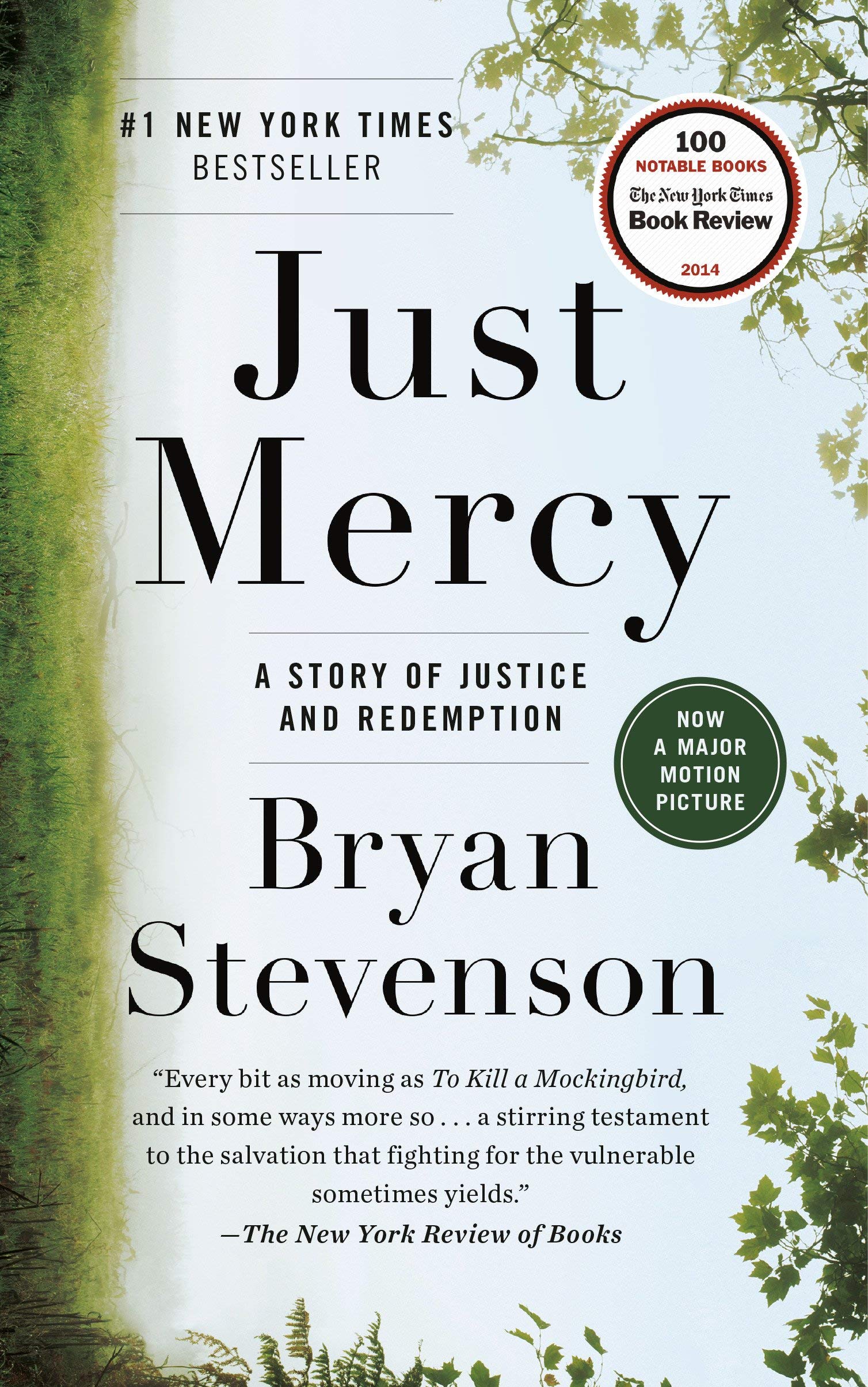
Book cover.
Just Mercy: A Story of Justice and Redemption by Bryan Stevenson (ISBN: 978-0-8129-8496-5) tells the story of the author’s lifelong crusade to provide justice for people whom he believes were treated unfairly by the courts in America.  The reader gets a brief history of Stevenson’s life before founding his non-profit law project, the Equal Justice Initiative (EJI), and then a detailed look at the case of Walter McMillian, a man who was wrongfully accused (let along wrongfully convicted).  Along the way, Stevenson provides a few details of other cases he and his project was working on.  Like the McMillian case, most of the cases involve people who were possibly wrongfully accused or convicted, those who were mentally disabled, and those whose defense had been ineffective (for various reasons, but usually, per Stevenson, because the defendant did not have enough money to pay for effective counsel).  He also spends a solid chapter discussing his efforts to prevent juveniles from being sentenced to life in prison (“death in prison” as he calls it) and from being dealt with by the adult criminal justice system.  The McMillian case also had a racial element to it, which is likely unsurprising since it happened in Alabama in the early 1980s.  After a girl was murdered and the local police couldn’t identify a culprit, they found a convenient suspect in McMillian, a black man who was known in some circles to have had an affair with a white woman.  For most whites in the South in the early 1980s, that was still culturally unacceptable.  Eventually, McMillian was convicted on very shaky testimony and put on death row.  When Stevenson got around to working his case (“got around” since Stevenson took it upon himself to look into just about every death row case), he found many legal holes and worked tirelessly to overturn the conviction.  It took years, but he eventually succeeded, overcoming general police incompetence, racist feelings, and legal precedent, something that is always hard to deal with in the American justice system.  Stevenson notes, in his conclusion to the book, that as he’s worked these cases, he’s learned about justice and mercy.  It’s not just the people in prisons (there rightfully or wrongfully) that are, in some way, “broken,” but that we all are, and that when we recognize that, we are more prepared to show mercy to the broken around us.

The book is informative and really makes the reader think (two important qualities in books).  Crime and the criminal justice system are an interesting topic to learn about, even if one has never really been involved (the closest I’ve ever been is explaining to a judge that the 90 m.p.h. I was accused of driving was patently false, although I would freely admit to driving 75 m.p.h. in a 65-m.p.h. zone; he believed me, thankfully, and the fine I had to pay was quartered).  McMillian’s story is quite gripping, and the book is well worth a read.  Some of the other stories Stevenson brings up are also interesting, but given the lack of detail and attention paid to them, they waver between being a decent supporting cast and being a distraction.  The points made in the supporting stories about the struggles those with mental incapacities have in getting a fair trial are well worth exploring, but need a more extensive treatment.  Arguably the largest point made by the book is that poor people are often hung out to dry when it comes to adequate representation in court.  Stevenson’s book does not make public defenders look good at all.  They are repeatedly shown to be petty and lazy.  My guess is that is an unfair characterization of all of them, although there is no reason to doubt his description in the specific cases he mentions.  Another subject brought up is rehabilitation for those who get out of prison, which seems like a pretty universal thing people should be able to rally around.  In discussing legal questions, it’s always worth hearing the other side, and this book doesn’t do that.  There is no discussion of how, in cases with mentally competent adults, by simply not committing crimes (or, in cases where things aren’t legal crimes, but are against God’s commandments), the majority of these situations could be avoided.  I also found it somewhat disingenuous to have a lawyer talking about applying the law fairly since it is unscrupulous lawyers (Stevenson seems to be an honest one) who use legal tricks and loopholes to keep those who are actually guilty out of prison or free from other consequences.  The justice system, like anything done by the government, is a one-size-fits-all thing, so when too many people are seen getting off the hook, the pendulum swings the other way with minimal sentencing requirements and other harsh penalties.  Finally, racism is also brought up a couple times in the book, and in a few cases mentioned, it seems to have played a negative role, and there is no reason to not believe Stevenson’s account.  I am old enough to remember some people saying interracial relationships were to be avoided (by the time I was a teenager, this sentiment had either died out or was not something people chose to talk about, but in circles I ran in, I believe it to be the former and, certainly, those of my generation did not hold those views), so the McMillian story has a very real air about it.  At the very end of the book, Stevenson strayed into the world of social justice, but it seemed to be a small part of the message, and one I hope stays in the background because it pales in comparison to the message Stevenson, maybe unwittingly, presents, which is that individuals who are free to make their own decisions and who are willing to love their neighbor and sacrifice their time and efforts provide the greatest good.  There was a powerful story in the book where Stevenson helped a black guy who had a troubled childhood and then committed a violent crime.  During prison visits, Stevenson met a prison officer who was quite antagonistic toward Stevenson and, based on some of his tattoos and bumper stickers, harbored at least some racist beliefs.  Stevenson didn’t openly confront this man, and once the warden had to escort the prisoner to trial and heard about his troubled childhood in the foster care system, mellowed greatly, even getting the prisoner a favorite treat, likely against prison rules because the guard found something in common with the prisoner: a troubled childhood in dysfunctional foster homes (dysfunctional homes are a constant in the book, but not an issue that gets discussed).  I thought the story fit Stevenson’s message about all of us being broken in one way or another and our cognizance of that opening us to being more merciful toward others as powerful as anything in the book.  
   
Creative Commons License
This work, including all text, photographs, and other original work, is licensed under a Creative Commons Attribution Non-Commercial No Derivatives 3.0 License and is copyrighted © MMXIV John Pruess.