 Up from Slavery by Booker T. Washington (ISBN: 978-0-9997797-3-6) tells of the famous educator’s life from his early boyhood as a slave to his rise as a professor and principal (these days we’d probably say president) of the Tuskegee Institute. The book was short on the childhood section, understandably so, since he was so quite young when slavery ended and had spent his days like all the other slaves: working. Once freed, he and his family struggled like many to find work that would pay the bills, but they succeeded, and his mom encouraged an innate love for learning that eventually led to Washington’s heading off to the Hampton School. A popular place with newly freed blacks trying to improve their lot, the school didn’t have a lot of room, but Booker so impressed the lady in charge of admissions when he was asked to clean some of the school rooms, that he made it in. He didn’t squander a single opportunity, graduated, and then set about to provide opportunities for others. What that led to was his founding the Tuskegee Institute. The greater section of the book is spent chronicling how the school came about, its struggles and successes, and its growth and Washington’s efforts to promote the school and secure the funding needed to keep it on its own two feet. He worked hard no matter what he was involved in, whether teaching, overseeing the school, working in his own home with animals and in his garden, or fundraising. He was also a well-known and in-demand orator, invited to speak at functions, fairs, and other public events. Throughout the book, he spends significant time noting that service, hard work, fulfilling one’s duties, giving things one’s best shot, and honesty are the keys to success and happiness in life. He also touches on the question of race and racism, but only as a reality that is in the background and that mostly stays there when one develops the abovementioned qualities and masters skills that others require, such as the brickmaking, animal husbandry, sewing, architecture, dairy farming, and others that his school taught in addition to academic subjects.
While very much aware of Booker T. Washington and his accomplishments because I don’t remember a class or unit on American history in school that didn’t include him (as he said, if one works hard and does something that others find useful, one will have earned respect and likely at least some recognition), the book was interesting to read because there was more to his life’s philosophy than the education that he is most famous for. Washington was a hard worker who believed in taking the bull by the horns and not allowing life, fate, other people (including other people’s choices), or whatever other thing people blame their failures on control him. He believed others had a better chance to be successful if they were educated both academically and in life skills and professional knowledge. He dedicated his life to making that happen, noting along the way that he was most fulfilled when helping and serving others. I enjoyed reading his take on race and racism — he largely ignored it. He was a former slave, but had no time for holding grudges and found that a straightforward approach that did not insult Southerners, but found a way to lift them up, helped the most. The relations between the blacks and whites in Tuskegee were good in his opinion, so the proof is in the pudding as far as his approach is concerned. Finally, Washington continually gave credit for his success to God, which is always refreshing. Both historically and morally, the book was great and well worth the time.

|
This work, including all text, photographs, and other original work, is licensed under a Creative Commons Attribution-NonCommercial-NoDerivatives 4.0 International License and is copyrighted © MMXXI John Pruess. |


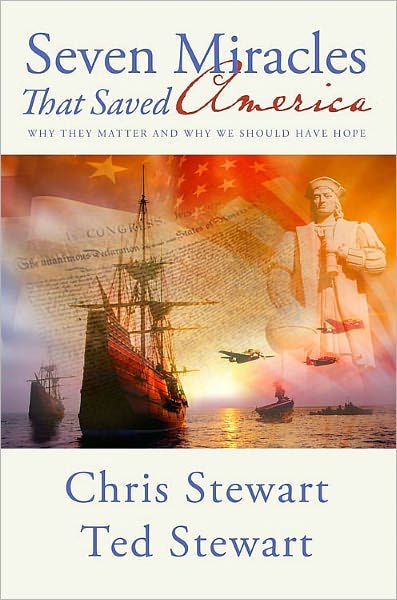 Seven Miracles That Saved America: Why They Matter and Why We Should Have Hope (ISBN: 978-1-60641-144-5) by Chris and Ted Stewart explores singular events and unique people in American history that, had things unfolded even slightly differently, could have resulted in a vastly different America. All of these events and people hinge on such a fine line that it is easy to see that they were influenced by God. The miracles that the authors review in detail are the following: Columbus and Columbus’s discoveries, Jamestown, a summer fog during the Revolutionary War, the advent of the American Constitution, Abraham Lincoln and the battle of Gettysburg, the battle of Midway, and Ronald Reagan and how the assassination attempt against him failed by less than one inch (just a little bit more and the bullet kills him). Each one of the miracles is reviewed in detail by the authors and the scene is set through some historical fiction. At the end of each section, the authors ask some questions that invite the reader to think about what would have happened in each of these situations had things — and usually it’s quite an exhaustive list of things — turned out even slightly different. For example, with the foggy morning during the Revolutionary War that allowed American troops to withdraw and regroup without suffering losses, it really was a question of a few hours and things could have been vastly different. The same could be said about the battle of Midway. There, it really was more like minutes since one of the pilots flying and trying to locate Japanese fleet only had minutes before needing to return to base without running out of fuel. At the last possible minute, though, he spotted the Japanese ships, and that allowed the Americans to attack first, which proved critical in the battle, along with other decisions and rare direct hits during the bombing runs. The point being made is that there were just too many decisions at so many different points along the way that for those who recognize that God has a role in human existence, these events were miraculous and they resulted in an exceptional country that has long been a light on a hill.