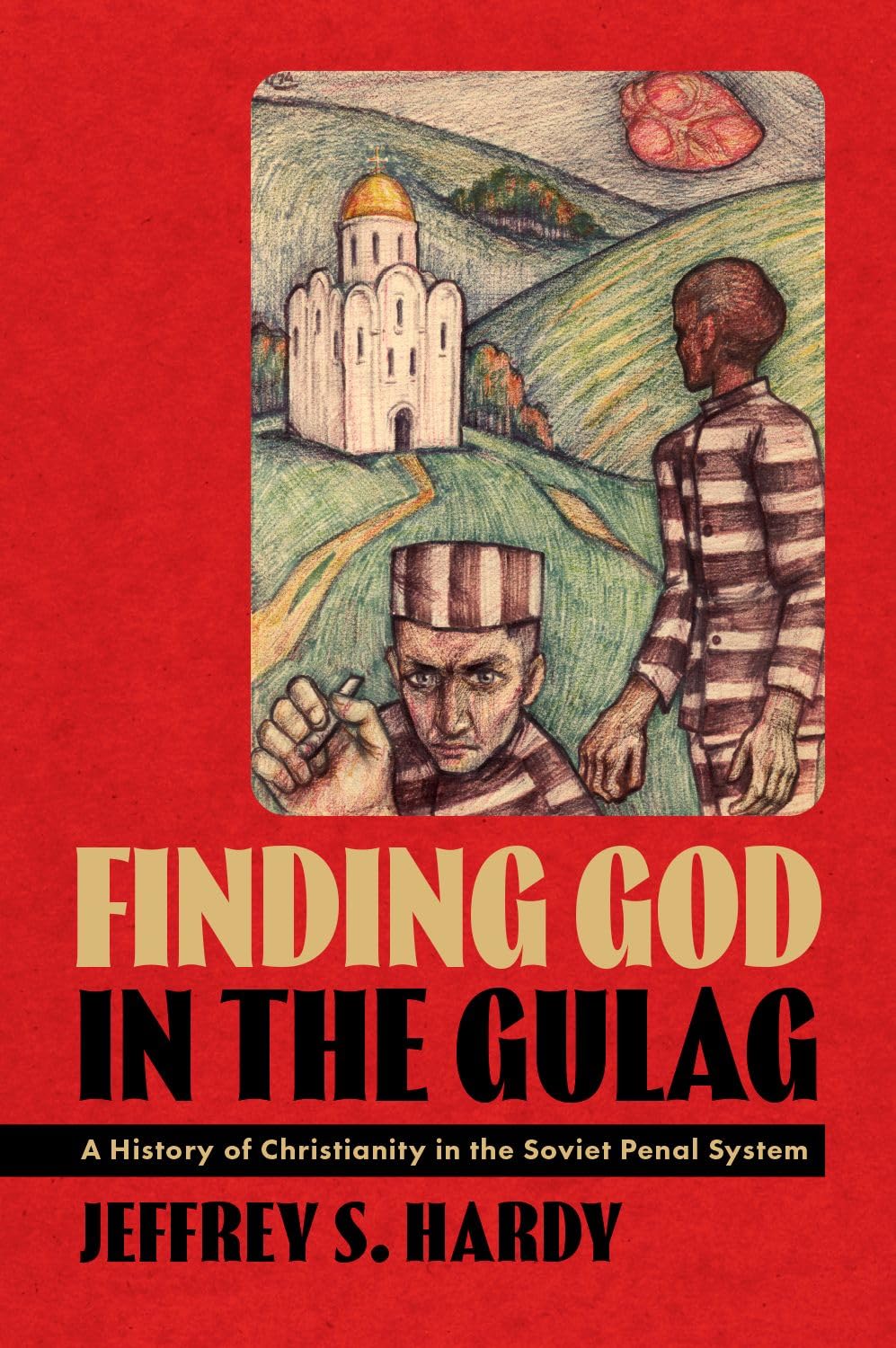
 Finding God in the Gulag: A History of Christianity in the Soviet Penal System by Jeffrey S. Hardy (ISBN: 978-0-19-775167-1) is a book that gives readers a chance to know more about life in the Gulag. Unlike Solzhenitsyn’s based-on-a-true-story novel, this book is an academic look at Christianity in the Soviet camps from the earliest days under Lenin to the dying days of the Soviet Union under Gorbachev with a little post-script about a few things in the post-Soviet times. It catalogs both attempts by inmates to life and express their religions and attempts by the prison management to suppress religion. It was interesting to note that efforts to extinguish religion in prisoners was not uniform in the Soviet Union. It was more lax in some camps than in others. There wasn’t always a central policy that camp managers could look to, so they did it their own way. Sometimes that meant believers were beaten and spent time in solitary confinement. Sometimes that meant a Christian guard did nothing when a prisoner prayed or sang a hymn or made an icon. There was a short section on faith among thieves and other such common criminals, including a few paragraphs about the fascinating world of Russian prison tattoos. The book also catalogs people losing their faith, which was unsurprising, and one that is not judged neither by the author nor by most prisoners who are cited in the book. They tended to believe the camps were inhumane and that one should not be judged too harshly or even at all for what they did in the camps. There was also a little proselyting that happened in the labor camps. This was especially true of Baptists and Jehovah’s Witnesses, but Orthodox and Catholic priests also preached and even baptized people. Toward the end of the Soviet regime, religion was sometimes encouraged because it generally had a good influence on prisoners and mediated their violent behavior.
The book was an interesting read and would be interesting to people interested in Russian or Soviet history or religion. It only briefly discussed non-Christian religions, which are major players in Russia, but either weren’t the focus of the book or weren’t such a concern in the Gulag. I did think the book was slightly disorganized and it felt like the narrative jumped around a lot, but I am not sure how I would’ve better organized it. I thought the stories about people finding faith and maintaining faith despite great psychological and physical pressure were inspiring. People sacrificed a lot to maintain their belief in God and to live it according to their conscience. It’s worth looking to many of these people as examples of standing up for what’s right no matter the consequences.

|
This work, including all text, photographs, and other original work, is licensed under a Creative Commons Attribution-NonCommercial-NoDerivatives 4.0 International License and is copyrighted © MMXXI John Pruess. |


 Reagan and Gorbachev: How the Cold War Ended by Jack F. Matlock, Jr. (ISBN: 0-679-46323-2) is a very detailed, play-by-play recounting of most (all?) of the diplomatic events leading up to the end of the Cold War. Matlock was a career diplomat that served on the National Security Council. This position and his academic and diplomatic career as a specialist on Russia provided him with an insider’s perspective on the processes that led up to the end of the Cold War. The book chronicles, often in great detail, various meetings, negotiations, summits, and communications that involved leaders of the United States and the Soviet Union. The focus was, of course, on what the two countries’ leaders, Reagan and Gorbachev, did, including their preparations before their meetings, their political efforts in their home countries in order to secure the ability to push their preferred policies forward. Matlock talked about the papers prepared for Reagan and how Reagan studied them. He talked about the negotiation processes. He recounted meetings between secretaries of state and foreign ministers. Those meetings, though, and the preparations were made possible by the leaders’ efforts to put people in place that would assist them. The preparations were made because the leaders desired that, something that was not always the case with the leaders who came before them. While Matlock endeavored to explain that so-called summit meetings weren’t the most important things in the diplomatic arsenal, those are what got headlines and what, ultimately, required the most preparation and resulted in the headline deals that moved the West and the Soviets away from nuclear war and toward peace. He, therefore, spent most of the book talking about these meetings that took place in Moscow, Washington, Geneva, and Reykjavík.
 The Czech Black Book, edited by Robert Littell, is a collection of original source documents from the first week of the invasion. There are press releases, official announcements, and news stories that were curated in response to Russian propaganda that claimed Russia and other Warsaw Pact countries came to Czechoslovakia to help and at the request of the Czechoslovaks (the Russians called their collection the White Book, hence the Czech one being black). The documents from the Czechs show a much different picture. The news reports feature interviews of high-level Czechoslovaks as well as from men on the street, and the feeling is that they simply wanted to be left alone and chart their own course through history unhindered by the Russians, whom they had previously considered friends. There was often a feeling expressed that the invasion had done unrepairable damage to that relationship. The government press releases and communiqués showed a government united around the reformers in the Czechoslovak Communist Party and a total disdain for the few leaders who preferred the Russian socialist path. The Czechoslovak leaders weren’t ready to throw communism or socialism away (it reminded me of Gorbachev a little), but they certainly wanted to be able to choose their own way, and the Russians weren’t ready for their satellites to have that level of independence. Trade unions, clubs, and other organizations also called on the citizens of Czechoslovakia to resist the invaders, although not violently, but by the interesting peaceful means of ignoring them. They were to refuse to help the Russians whenever possible, to continue their everyday lives as if nothing was happening around them since strikes and other resistance would simply give the Russians the excuse they needed to escalate the action. Even when a few Czechoslovak citizens lost their lives, were arrested, or otherwise assaulted, the general population kept its cool, and the Czechoslovak leaders attributed the end of the invasion, in large part, to this reaction (or non-reaction, as the case may be) by the people. In the end, negotiations were carried out, and the invaders left, although not under the conditions that the Czechoslovaks would’ve desired.
 Русская Прага (Russian Prague, my translation) by Natalya Ivanovna Komandorova (ISBN: 978-5-9533-3746-5) presents an overview of some of the common history between Russia and the Czech Republic. It starts in tsarist times and ends with a small section about post-Communist interaction between the two countries. The medieval links between the two countries were focused largely on trade with a little religion thrown in, typical for a time when church and state were intimately intertwined. The many interfamilial marriages and constantly changing alliances during the 1700s and 1800s resulted in some interaction between the two nations, and academic and intellectual interests were added to the subjects of correspondence. These reasons for a Russian presence in what was then Czechoslovakia exploded in the early 1900s as Russia experienced what is nowadays referred to as brain drain when the Bolsheviks came to power. Czechoslovakia, and Prague in particular, proved to be a welcoming place for Russian academics, politicians, and intellectuals who wanted to escape persecution and restrictions on their freedoms in Soviet Russia. There were links between the two countries in the post-World War II era, too, but they tended to be less positive. The Soviets worked to keep tabs on and even control the Russian diaspora. Russian-Czechoslovak relations took a hit they would never really recover from when the Soviets invaded in 1968. Modern relations between the two countries have returned to the medieval focus on trade with a significant level of distrust toward the Russians on the part of many Czechs.
 Iron Curtain: The Crushing of Eastern Europe, 1944–1956 by Anne Applebaum (ISBN: 978-1-4000-9593-3) discusses just how Communist regimes came to power in Europe following World War II. The book chronicles how the Communists came to power in Eastern Europe, focusing on Hungary, Poland, and East Germany, with a fair number of examples from Czechoslovakia and occasionally Romania. The Communists rose to power quickly in post-war Europe through a comprehensive strategy that thoroughly encompassed the lives of the people. This included the police, youth organizations, the media, political organizations, the arts, and the economies of the countries where the Soviet Union was victorious over Germany. In many cases, a combination of factors worked together to make the Communist takeover work. First, it was the Soviet Union that was in control in these areas. Even in places where there was arguable Allied control, it was the Soviets doing the day-to-day administration, so they worked to install people and organizations that were compatible with their ideas of how things should work. Second, there had already been strong support for Communist, socialist, and other Left-leaning ideologies before and during the war. This only continued after the war. Third, the activists were the ones most involved. They were also the ones who were willing to use violence to reach their goals. While most regular people were concerned about getting a job, rebuilding their homes and businesses, and helping their friends and families, activists were getting involved in politics, unions, youth and religious organizations, and the media. This helped them make sure that things were done they way they wanted. In the rare cases when there was some push-back, the activists, often with help from the police or the newly formed secret police organizations, violently quashed any dissent. Applebaum does discuss resistance a little, but this is a short section, which seems to accurately represent the proportions of active and passive support or acquiescence to the regime and resistance.


 In Europe’s Shadow: Two Cold Wars and a Thirty-year Journey through Romania and Beyond by Robert D. Kaplan (ISBN: 978-0-8129-8662-4) is a wide-ranging survey of Romanian history, focusing on the post-World War I XX century and the first decade or so of the XXI century. Kaplan has
 In Spy Dust: Two Masters of Disguise Reveal the Tools and Operations That Helped Win the Cold War (ISBN: 978-0-7434-2853-8) by Antonio and Jonna Mendez with Bruce Henderson, spy dust itself plays a rather minor role. The two authors and their craft, disguises, get the majority of the attention. The story follows both authors in their CIA careers a few years before they came to know about spy dust through an operation that saw them defeat the theretofore undefeated powder. Antonio was a master of disguise with years and years of experience; Jonna more of an extremely talented up-and-coming star in the CIA. The book focuses on their teamwork to exfiltrate someone they claim was a well-connected and high-placed Soviet spying for the U.S. The operation included a handful of Americans and the Russian and his family. They used all their disguise know-how, which includes a lot of things that aren’t so much about disguises, but simply about how one ports oneself and how people are not able to notice every little thing if what one is doing mostly follows the normal routine. The daring operation defeated the Russians’ spy dust and got everyone out of the country safely.
 In The Long Walk: The True Story of a Trek to Freedom (ISBN: 978-1-59921-975-2) by Sławomir Rawicz, one can read about just such an escape and one that combines World War II history, the Gulag, and adventure travel into one. Billed as a true story, the reader follows Rawicz, a Polish cavalry officer, from Moscow's notorious Lubyanka to the a small outpost of a prison camp in northern Siberia, and then about 4,000 miles south, to India, after his escape. The escape itself is one of the few truly exciting scenes in the book, as the rest reads much like a travelogue, but it is all adventure after adventure as the small party of fugitives walks through Russia and then the wastelands of Mongolia and China. They pick up a fellow escapee near Lake Baikal and experience Oriental hospitality over and over again in their travels through the deserts and mountains of western East Asia. These usually touching, sometimes comical, visits are a major reason the travelers made it to India alive. As is to be expected, they lose a few of the party along the way to starvation and exhaustion. In the end, though, their desire to be free is triumphant, as they walk out of the hills and into the arms of a British Indian patrol.
 Leon Aron, author of Russia’s Revolution: Essays, 1989–2006 (ISBN: 978-0-8447-4242-7), was always interested in Russia because he was born in the USSR. Although he emigrated and came to America after the Soviets started letting Jews leave, he remained interested in his homeland and became a respected commentator and scholar on the land of Peter the Great, Ivan the Terrible, Stalin, and now Vladimir Putin. Aron has written extensively on all things Russia, and in this book, he compiled essays that take the reader through life in Russia from the early days of Boris Yeltsin through the middle years of Putin’s first term in office as Russia’s president. Aron describes Yeltsin and his democratization efforts. He is quite a fan of Yeltsin, praising his statesmanship and ability to hold together a country that had partially fallen apart and threated to completely implode on a daily basis. Aron touches on every aspect of Russia reborn, including food, oil, politics, oligarchs, literature, the military, and international relations. All of these vastly different aspects of life in the post-Soviet Russia give an idea of what was happening in the country at the time the essay was written. Aron finishes up his compilation with discussions of Putin, a — to put it mildly — controversial figure and one of Russia’s largest struggles during the 1990s, Chechnya. Aron’s point, even with the various negatives that Putin and Chechnya seemed to usher in, was that much good has happened since the Soviet Union fell apart in Russia and even though there have been and continue to be bumps in the road (and they’re often big bumps), things are probably going in the right direction, but the only way to tell is to wait and see. The West didn’t get to its heights in 20 years, and Russia won’t either.
 Anne Applebaum’s Pulitzer Prize-winning and critically acclaimed-by-everyone book, Gulag: A History (ISBN: 978-1-4000-3409-3) is, obviously, not a memoir. Instead, it draws heavily on memoirs and other existing literature, including what little has been made available by the Russian government in their state archives, to give the reader an idea of just what the Gulag was, how it functioned (or didn’t function, as the case may be), who ran it, why they ran it, who the prisoners were, and why it, like the Soviet Union, eventually came crashing down as the result of an implosion more than anything else. The history is quite detailed and dutifully footnoted. It takes the reader from the pre-Bolshevik use of forced labor in imperial Russia through the very end of the system with the collapse of the Soviet Union. Every angle of the story is explored, some of them in more detail than others, but always in such a way that the impact of a particular decision or event is clearly seen. The individual anecdotes that make up a significant portion of the book are both colorful and illustrative, often giving an even more detailed look at what it was like to live, work, and sometimes die (interestingly, it wasn’t all bad, and there was time in some camps for music, theater, and storytelling) in the notorious prison camps of the Soviet Union. One comes away with not just a basic overview, but probably an intermediate-level understanding of the Gulag thanks to the complete coverage of the subject by the author.