 In his book The Gift of Fear: Survival Signals That Protect Us from Violence (ISBN: 978-0-440-50883-0), Gavin de Becker attempts to help people push irrational fear out of their lives so they can be properly attuned to true fear, which he claims is a positive aspect of our bodies' natural reaction to things. Fear, he says, helps us respond appropriately to situations that have a real chance of resulting in our being harmed or killed. De Becker is an expert on security issues, criminal justice, and public safety. His book reflects that in that most of the examples and the topics of discussion involve things like corporate safety, dating safety, and child abuse. As one with a wide range of experience — personal, research, and professional — the examples given are not only gripping, but provide lessons learned. De Becker explains how we can often predict violence and gives some suggestions on how to get out of those potentially violent situations with minimal damage done. As someone who has found much of what Glenn Latham says in his book The Power of Positive Parenting: A Wonderful Way to Raise Children to be true, I was intrigued by de Becker's claim that stalking, whether from an estranged spouse to a crazed fan to a disgruntled employee or anything in between, can usually be solved by ignoring the stalker. The overarching message of the book, of course, is that our natural intuition will help us in most dangerous situations, but only if we are informed enough to not have our head full of worries and anxieties caused by unfounded fear.
While the message of the book was a good one, I was rather underwhelmed by the book. While child abuse, spousal abuse (mostly wife abuse), rape, and stalking are real problems, I found that robbery, burglary, and assault were under-represented in the book. I wanted to know how to deal with walking down the street at night and being met suddenly by a few people out of nowhere. I found de Becker's obvious political leanings to grate on the reading. His explanations of fear were solid, but always included a final note about how we got this through evolution. The explanation stood without evolution — evolution or creation doesn't matter in this discussion; the fact that we work the way we do is sufficient. The same line of reasoning applies to de Becker's grossly unfounded position on gun control. In an appendix, de Becker goes so far as to say the right to bear arms is a "so-called right." He may be a security expert, but he's obviously no historian. He should just leave politics out of it and tell us how to deal with violent people who happen to have guns. Finally, I was no big fan of the author's philosophy, even though it's a wide-spread philosophy. He claimed we only truly fear something when death is the result of that something (this is based, in part, on the current interpretations of evolutionary theory (and maybe on older interpretations, but I don't know enough about them to really comment)). This is, of course false, and the author admits as much when later in the book he writes that we truly fear only that which can harm us or kill us. There are many things I fear worse than being killed, and being educated about those types of crimes would vastly improve the book as would a little more effort on de Becker's part to focus on the subject at hand and not tangential opinions.
 | This work, including all text, photographs, and other original work, is licensed under a Creative Commons Attribution Non-Commercial No Derivatives 3.0 License and is copyrighted © MMXI John Pruess. |


 In his book, Blue Planet in Green Shackles: What Is Endangered: Climate or Freedom? (ISBN: 978-1-889865-09-6), Czech president Václav Klaus presents his reasons for why environmentalism and its liberal, leftist, and radical tendencies is dangerous not only for the planet, but for people who cherish their liberty. The book is largely written from an economic point of view (Klaus is an economist by training), but also includes a chapter on the many scientific fallacies present in various environmentalist arguments for global warming (or, now that global warming has largely been discredited, the environmentalists have changed the label once again, and we have "climate change" to be all freaked out about). The economics-heavy chapters explain why environmentalist policies are bad for the economy and why they also tend to be bad for the planet. There is also a section on how environmentalist policy limits economic and personal liberty. Finally, Klaus gives the reader a policy recommendation regarding so-called climate change: do nothing. Based on his analysis of real numbers (in contrast to environmentalists, who have brought us endless fake numbers, including the famous so-called statistics of the Climatic Research Unit of the University of East Anglia and those rain forest destruction statistics, that if true, would’ve resulted in the complete extermination of rain forests decades ago), Klaus convincingly points out that slow and measured responses to problems are much more effective at preserving solid economic conditions as well as personal liberty. When we look at everything as a crisis, we (or, at the very least, politicians) make knee-jerk reactions that almost universally compound the original problem. When you are facing a problem like global warming, which is far from having a scientific consensus, let alone from being fact, a reaction causes not a worse problem, but new problems.
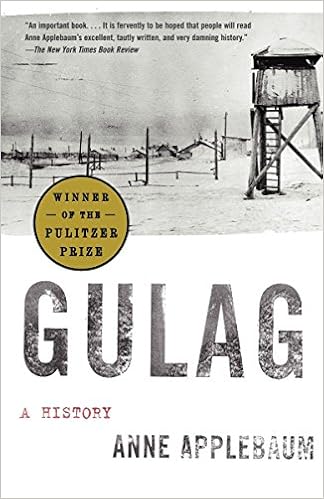 Anne Applebaum’s Pulitzer Prize-winning and critically acclaimed-by-everyone book, Gulag: A History (ISBN: 978-1-4000-3409-3) is, obviously, not a memoir. Instead, it draws heavily on memoirs and other existing literature, including what little has been made available by the Russian government in their state archives, to give the reader an idea of just what the Gulag was, how it functioned (or didn’t function, as the case may be), who ran it, why they ran it, who the prisoners were, and why it, like the Soviet Union, eventually came crashing down as the result of an implosion more than anything else. The history is quite detailed and dutifully footnoted. It takes the reader from the pre-Bolshevik use of forced labor in imperial Russia through the very end of the system with the collapse of the Soviet Union. Every angle of the story is explored, some of them in more detail than others, but always in such a way that the impact of a particular decision or event is clearly seen. The individual anecdotes that make up a significant portion of the book are both colorful and illustrative, often giving an even more detailed look at what it was like to live, work, and sometimes die (interestingly, it wasn’t all bad, and there was time in some camps for music, theater, and storytelling) in the notorious prison camps of the Soviet Union. One comes away with not just a basic overview, but probably an intermediate-level understanding of the Gulag thanks to the complete coverage of the subject by the author.
 The Caucasus is a complex region because it has traditionally been a bit of a crossroads and its famous mountains have always made it strategically desirable. This situation was the same during the Nagorno-Karabakh War of 1988–1994 (the uneasy cease-fire has more or less held since then to the present day). Like most anything in the Caucasus, a romantic region shrouded in mountain mystery, the truth about the current strife between the Armenians and the Azerbaijanis (and the Turks) is not always easy to come by. Although the war was long over by the time of my mission, I was not alone in knowing nothing about Nagorno-Karabakh, and longtime Caucasus expert and journalist Thomas de Waal tried to solve that problem for people with his 2003 book Black Garden: Armenia and Azerbaijan through Peace and War (ISBN: 0-8147-1945-7). De Waal’s book is an attempt to acquaint the Western reader with the region, its history, and the modern-day conflict. He focuses on XX-century history, and the reader is acquainted with how Soviet Armenia and Soviet Azerbaijan came to be. Then, the majority of the books is spent dealing with the details of the Nagorno-Karabakh War. De Waal is meticulous in his presentation of the story of the war from Yerevan, Baku, and Stepanakert. The book concludes with an overview of the negotiations process since 1994 and how they have proved rather fruitless. De Waal, unlike many writers on the subject, offers no faultfinding, finger-pointing, or one-sided calls to action, just a simple overview of a historical subject.