World War II has always fascinated me. This is likely related to two things. One is familial involvement. One grandpa was a soldier in the war. The other set of grandparents were children in Germany. The other thing is that I loved drawing aircraft as a kid, and the bombers of World War II figured prominently in my usual repertoire. What I didn’t necessarily understand as a kid is the large part that prison camps played in the war. From the little reading that I have done and the little that I know, there are atrocious things that happened in the war’s prison camps, but I have heard more than a few stories of people rising above the horror and rising above the temptation to give up or to forever hate those who have treated them so evilly. These stories are an interesting and often inspiring piece of history.
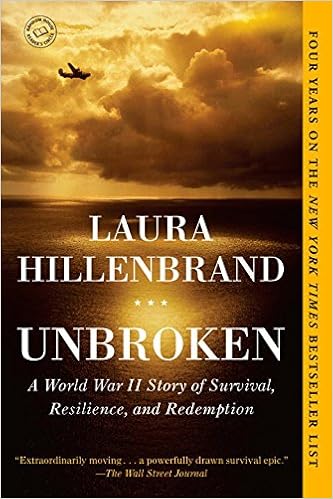 Unbroken: A World War II Story of Survival, Resilience, and Redemption by Laura Hillenbrand (ISBN: 978-0-679-60375-7) is just such a story about overcoming trials. Like so many stories of resilience in the face of overwhelming odds, the story starts with humble origins. Louis Zamperini was the son of Italian immigrants struggling to make ends meet along with most other Depression-era Americans. A caring older brother discovered the track and invited Louie along, later serving as an unofficial coach, and Louie became as star, eventually qualifying for the Olympics, running a race (5,000 meters) he didn’t usually do. He competed admirably in Berlin, finishing eighth against some of the world’s greatest runners. His running career, though, was cut short by the onset of war, and he served as a bombardier. That, too, was cut short because his plane went down during a rescue mission, and he was captured by the Japanese after some time floating in a raft at sea. Floating around for weeks was already an amazing act of survival and resilience, but the worst was yet to come. Zamperini then spent more than two years in various Japanese prison camps undergoing brutal treatment. He and others kept their wits about them by resolving to beat the system and not give in to their captors and abusers. Some made it, some did not. There were some funny stories along the way, but most of it was monotony, drudgery, and pain. Eventually, Zamperini and the others that survived were done with the horrors of the camps because the war ended. Unfortunately, for many, that was not the concrete ending they would’ve preferred. The horrors lived on in many of the former POWs’ minds, causing more than one to turn to alcohol, destructive behaviors, and even suicide to end the pain. Zamperini’s story included a lot of post-war alcoholism, but he eventually quit that thanks to a conversion to evangelical Christianity, in part because of him remembering some promises he made to God while floating aimlessly on the Pacific Ocean in the first few days after his plane went down. Zamperini used this redeeming experience in his life to later inspire and help others as well as come to terms with and even forgive his war-time tormentors.
I thought the book was good. It was an inspiring story and it included some interesting information on the war. It is best classified as a biography of Zamperini, not a history book. There are many aspects of the book that were worth remembering, including the hard work and dedication the subject put into his running, his service in the military, and then his life after the war. There were so many times he could’ve given up and probably justifiably so, but he didn’t. He used the overwhelmingly negative experiences to make himself better, which is something worth emulation. As noted above, this was a trait that was fairly common in his generation and one that is definitely missing in many today. I was intrigued to read that faith and religion played such a large role in his post-war healing. Such an aspect to story was not surprising, though, since a trust in the atonement of Christ is the surest way to redemption. Finally, I would be lying if I didn’t note that I liked the stories about the running, which included some thoughts about Zamperini being one of the contenders for breaking the 4-minute mile barrier, and the Olympics in pre-war Germany, which are a subject of interest in and of themselves.
Unbroken: A World War II Story of Survival, Resilience, and Redemption by Laura Hillenbrand (ISBN: 978-0-679-60375-7) is just such a story about overcoming trials. Like so many stories of resilience in the face of overwhelming odds, the story starts with humble origins. Louis Zamperini was the son of Italian immigrants struggling to make ends meet along with most other Depression-era Americans. A caring older brother discovered the track and invited Louie along, later serving as an unofficial coach, and Louie became as star, eventually qualifying for the Olympics, running a race (5,000 meters) he didn’t usually do. He competed admirably in Berlin, finishing eighth against some of the world’s greatest runners. His running career, though, was cut short by the onset of war, and he served as a bombardier. That, too, was cut short because his plane went down during a rescue mission, and he was captured by the Japanese after some time floating in a raft at sea. Floating around for weeks was already an amazing act of survival and resilience, but the worst was yet to come. Zamperini then spent more than two years in various Japanese prison camps undergoing brutal treatment. He and others kept their wits about them by resolving to beat the system and not give in to their captors and abusers. Some made it, some did not. There were some funny stories along the way, but most of it was monotony, drudgery, and pain. Eventually, Zamperini and the others that survived were done with the horrors of the camps because the war ended. Unfortunately, for many, that was not the concrete ending they would’ve preferred. The horrors lived on in many of the former POWs’ minds, causing more than one to turn to alcohol, destructive behaviors, and even suicide to end the pain. Zamperini’s story included a lot of post-war alcoholism, but he eventually quit that thanks to a conversion to evangelical Christianity, in part because of him remembering some promises he made to God while floating aimlessly on the Pacific Ocean in the first few days after his plane went down. Zamperini used this redeeming experience in his life to later inspire and help others as well as come to terms with and even forgive his war-time tormentors.I thought the book was good. It was an inspiring story and it included some interesting information on the war. It is best classified as a biography of Zamperini, not a history book. There are many aspects of the book that were worth remembering, including the hard work and dedication the subject put into his running, his service in the military, and then his life after the war. There were so many times he could’ve given up and probably justifiably so, but he didn’t. He used the overwhelmingly negative experiences to make himself better, which is something worth emulation. As noted above, this was a trait that was fairly common in his generation and one that is definitely missing in many today. I was intrigued to read that faith and religion played such a large role in his post-war healing. Such an aspect to story was not surprising, though, since a trust in the atonement of Christ is the surest way to redemption. Finally, I would be lying if I didn’t note that I liked the stories about the running, which included some thoughts about Zamperini being one of the contenders for breaking the 4-minute mile barrier, and the Olympics in pre-war Germany, which are a subject of interest in and of themselves.
 | This work, including all text, photographs, and other original work, is licensed under a Creative Commons Attribution Non-Commercial No Derivatives 3.0 License and is copyrighted © MMXIV John Pruess. |


 The Boys in the Boat: Nine Americans ad Their Epic Quest for Gold at the 1936 Berlin Olympics (ISBN: 978-1-101-62274-2) by Daniel James Brown tells a story in which sports and life worked together to teach just such lessons as young men who made up some of the Greatest Generation strove for excellence in their athletic endeavors and in life, garnering a gold medal along the way. The story follows the life of Joe Rantz the closest, but the reader also gets fairly well acquainted with his rowing teammates, some of his family, his girlfriend, and his coaches along the way. They all were the kind of people that made America great — hard workers who were responsible and self-reliant, expecting nothing from others but the best from themselves. Rantz had an interesting childhood in which his mother died, he spent some time living in a mining camp, his step-mother was the stuff of fairy tales, brutally controlling toward his dad and eventually kicking Rantz out of the house when he was still a young teenager. Joe fended for himself, living in the house the rest of his family abandoned, working his way through high school and college. It bordered, in a way, on a tale of survival during his early years. In college, he tried out for and made the rowing team, showing immense potential as a freshman. Hard work over the next three years eventually landed him and his teammates in the Olympics in Berlin, Germany, where Hitler was in his heyday. Rantz and his fellow oarsman from Washington had overcome a lot throughout their lives, many from similar backgrounds to Joe’s, to make it to the Olympics in a sport historically dominated by elites and other from the moneyed class. In Berlin, they overcame more challenges and the home team to capture gold literally right from underneath Hitler’s nose.
 The Oligarchs: Wealth and Power in the New Russia (ISBN: 1-58648-001-4) by David E. Hoffman starts long before the ruble crash and financial crisis, telling the story of how Russia came to that point after the fall of Communism. The story is told in a very personal way, relying heavily on the author’s many personal interviews with the major players in industry and politics, as well as his and other journalists’ first-hand experiences during the “wild ’90s” in Russia. The book provides short biographies of the major players, household names in Russia and sometimes beyond well into the early 2000s: Aleksandr Smolensky, Yuri Luzhkov, Anatoly Chubais, Mikhail Khodorkovsky, Boris Berezovsky, and Vladimir Gusinsky. The book chronicles these men’s rise to power. They were entrepreneurs, opportunists, risk takers, visionaries, and criminals all rolled into one. The book also provides a lot of information on Boris Yeltsin since the story of the oligarchs is inseparably woven into Yeltsin’s story. From the dying throes of Communism to the dawn of
 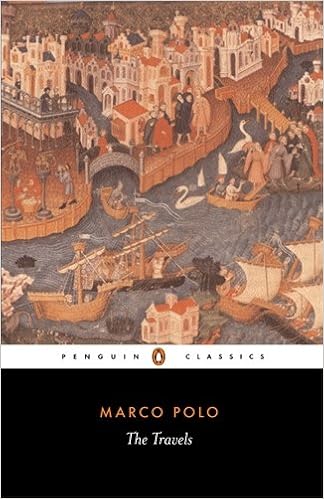 The Travels of Marco Polo translated by Ronald Latham (ISBN: 978-0-14-044057-7) is the famous and influential (Columbus was inspired by reading Polo’s account of his travels) tale of travel and adventure that is really quite ethnographic in nature. There is no authoritative version of the book since there are over 150 extant manuscripts, and there are many significant differences. Latham, a Polo scholar, did this translation in 1958 and worked to meld the major manuscripts together, giving the reader a very complete view of Polo’s travels. The focus of Polo’s account is his time in the court of the Mongolian khans, but he discusses his time in what is now Turkey, Iran, Burma, China, Sumatra, India, and Arabia. The descriptions of the people and places are often quite detailed, especially when it comes to court life. Commoners’ lives aren’t given the same level of detail, but the major industries and agricultural pursuits of each region are listed, along with general religious customs, and usually a note or two about interesting flora, fauna, and cultural customs (for instance, sharing wives seems to have been a thing in more than one Asian culture 700 years ago). Polo talked about the spread of Christianity. He talked about various technologies, shipping methods, and Oriental warfare. He always took time to describe the local take on alcohol. He also relayed tales of the supernatural and used interesting words, like “unicorn” (argued by some scholars to mean “rhinoceros”) that renders some of the description of the travels rather hard to believe.
 In The Original Argument: The Federalists’ Case for the Constitution, Adapted for the 21st Century by Glenn Beck with Joshua Charles (ISBN: 978-1-4516-5061-7), an attempt is made at making history more accessible to the modern reader. The book is essentially a translation of the majority of the famous
  Visions of Freedom: Wilford Woodruff and the Signers of the Declaration of Independence by Michael de Groote and Ronald L. Fox (ISBN: 978-1-60861-227-7) is a book about Wilford Woodruff’s visions (he had two of them on this subject) and the men that appeared to him. The first part of the book discusses the history behind modern vicarious ordinances in the Church of Jesus Christ of Latter-day Saints (anciently, the Bible contains
  Dream Team: How Michael, Magic, Larry, Charles, and the Greatest Team of All Time Conquered the World and Changed the Game of Basketball Forever (ISBN: 978-0-345-52050-0) by Jack McCallum takes a pretty in-depth look at that most famous of basketball teams. The book goes into a lot of detail about how it even came about that the pros were allowed in the Olympics. It was a long, drawn-out process that involved FIBA, the USOC, and the NBA. Once all the egos involved in such organizations were sorted to an acceptable degree, the path was open, and the U.S. got to work putting the Dream Team together. McCallum, who was an NBA writer for a long time, chronicles how each member of the team was selected. He profiles them, some briefly, some in great detail. The qualifying tournament and the Olympics themselves are also described, with the Olympics, obviously, getting more attention even though the games had similar outcomes: blowouts. Since there is so much spectacle that attends the Olympics, and the Dream Team only compounded this effect, there was a bit more to cover. The book finishes with a short section on how the Dream Team had a large impact on the the global game of basketball and talks about the mess that were the next to U.S. Olympic teams.
 The Contract: The Journey of Jimmer Fredette from the Playground to the Pros by Pat Forde (ISBN: 978-1-60907-140-0) is essentially the story of how Fredette overcame naysayers like myself throughout his life and achieved one of the lofty goals he has set for himself in his life by making it from a backwater in New York to the NBA. The book draws its name from the highly publicized contract that Fredette signed with his older brother, TJ, pledging that he would do whatever it took to get to the NBA. Fredette had a supportive family, and the book chronicles bouncing balls in the house and a makeshift full court in the back yard that was the place the neighborhood kids wanted to be. Most of all, though, he had TJ there to support him and serve as an unofficial coach and trainer throughout his formative years. The book actually spends a significant number of pages discussing TJ because of his large role in Fredette’s progress both as a basketball player and person. The book chronicles Fredette’s rise through high school and college, where he proved me and about a few million other people wrong by sweeping national player-of-the-year awards his senior year and being the tenth pick in the NBA draft.
 The Princess Bride by William Goldman (ISBN: 978-0-15-101544-3), now in a 30th anniversary edition, is the book form of the famous movie. I wasn’t even aware that there was a book until a few years ago. As I tend to be a books-are-better-than-movies person, it immediately went on my list when I heard about it. If one has seen the movie, one has read the book. There are very few differences. I think the only difference is that in the movie the grandpa interrupts the story sometimes, but in the book, it’s the author doing that. In fact, Goldman has concocted an entire alternate persona for himself that is part of the introduction, the main story, and even some end matter. The story, of course, follows the hero after his return to the kingdom where the farm girl he once served is about to be wed to the evil prince, who has devised a plan to have her killed. The story follows the death-defying adventures of Westley as he pursues Buttercup (the names are somewhat ridiculous, but there’s a definite element of humor to the book) and dispatches a few villains on the way. Ultimately, he reaches his prize and defeats the evil, yet ultimately cowardly, prince in an anti-climactic scene where he successfully bluffs that he could get up and fight the prince in a duel, but, in reality, is mostly dead (to quote another famous movie), having recently been brought back to life.
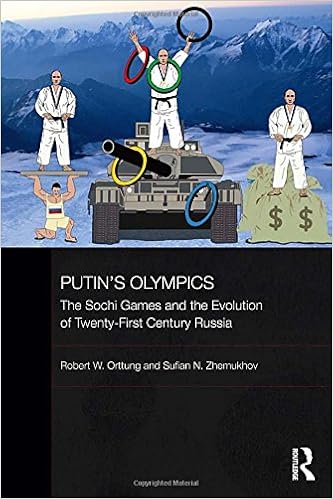 Putin’s Olympics: The Sochi Games and the Evolution of Twenty-First Century Russia (ISBN: 978-1-315-81728-6) is a book by Robert W. Orttung and Sufian N. Zhemukhov that brings both of those interests together. It takes a deeper look than the usual press on the subject at the Sochi Olympics and their greater context in Russia’s domestic and international politics. The book looks at the problems surrounding the hosting of the Olympics in Sochi, which included corruption, a marginalization of civil society, problematic international relations, and the relation of security during the Olympics and its connection to the Russian invasion of Ukraine. The viewpoint of the book was from that of the Olympics being something the authors defined as a “mega-project” and how Russia’s rulers, especially President Putin, tried to use that to their own advantages, both personally and to bring Russia’s standing up on the international stage. The authors come to what I consider mixed conclusions, noting that the Sochi games were secure, did result in much-needed infrastructure upgrades in Sochi, and, from Putin’s standpoint, his position was secured because Russians saw the Olympics as a positive for their country, although, as the Shenderovich quote above notes, this is not necessarily a good thing. On the other hand, the successes came at a great price, both monetarily and in prestige internationally, where Russia was hurt by the scandals surrounding the games.
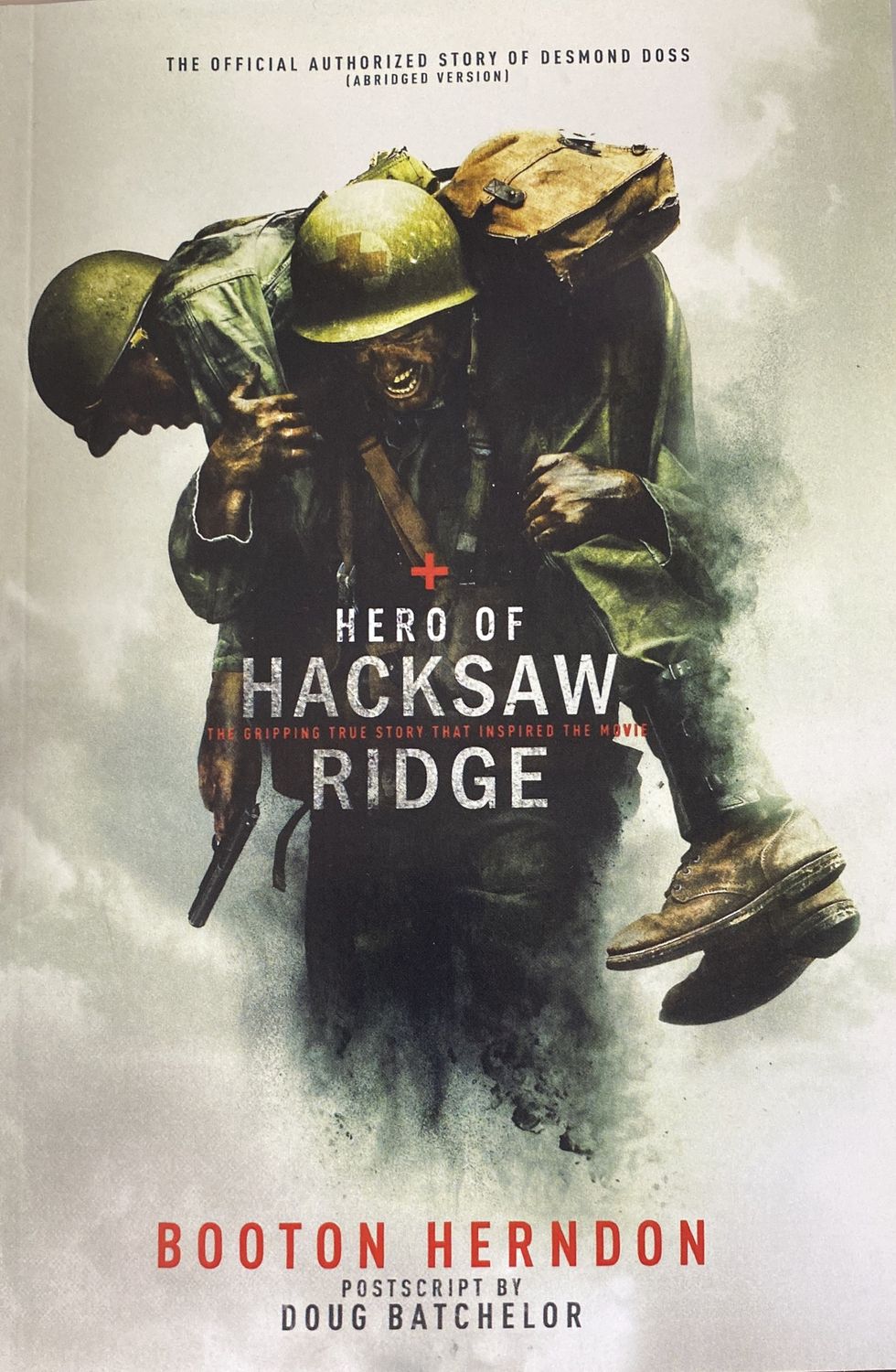 Hero of Hacksaw Ridge: The Gripping True Story That Inspired the Movie (ISBN: 978-1-629131-54-2) by Booton Herndon is an abridged version of the story of Desmond Doss, a medic who served in the U.S. Army during World War II and saw action in the Pacific theater as the army advanced on various Japanese positions. What makes the story unusual is that he was awarded the Congressional Medal of Honor and not once during his training or active duty did he use arms since he was a Seventh-day Adventist and believed it was wrong to bear arms. The story chronicles his time in the military from his joining to his discharge after being wounded in action in Japan. Doss is unwaveringly strong in his religious convictions, including an extremely temperate and patient attitude with those around him. He displays great faith in standing up for his beliefs when those around him threaten him and ridicule him at every opportunity. He doesn't hold a grudge when it comes time to perform his duty, and more than once wile fighting in the Pacific, he helps and saves the lives of others, usually at great risk to himself. The story ends with what truly are “gripping” details of battles on Okinawa where he saved likely around 100 lives while himself being injured. He is then awarded the much-deserved medal and is able to return to civilian life. The book also includes a post-script with information about Adventist beliefs (many are similar to those held by members of the
 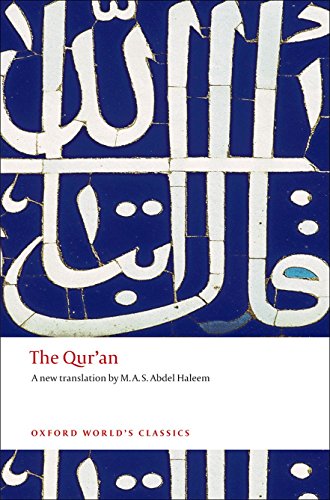 To do that, I read the Qur’an (ISBN: 978-0-19-953595-8), translated by Abdel Haleem. The Koran (there are lots of possible spellings for this) is Islam's holy book, purported to be a recording of revelation given to the prophet Mohammed (lots of spellings for his name, too). It focuses on the nature of God as the only God, as opposed to idols, pantheons of pagan gods, or even God as Christians know him, the Father of Jesus Christ. The Koran talks about Mary and Jesus, but Jesus is not God’s Son. It talks about Muslims’ duties to the poor and orphans. It discusses the afterlife and the resurrection. It warns evildoers against their course of action. There are some details about domestic life, finances, and there is the well-known injunction to prayer, which results in the call to prayer that happens five times a day wherever there is a functioning mosque. There are some instructions regarding Muslims’ dealings with non-believers, or infidels.
 The Power of Positive Parenting by Glenn I. Latham (ISBN: 1-56713-175-1) doesn't have all the answers either, but after reading it together with my wife, we decided that it has many of the answers, and even where it doesn't it tends to point the reader in the right direction. The book is full of guidance on how to deal with all kinds of different behaviors that children (and adults) engage in. There are sections for younger kids, for teenagers, for small problems, for sibling rivalry, and for larger, more destructive behaviors. There are a couple over-arching themes in the book that course through the suggestions for each kind of problem. One is to ignore things that doen't really cause any harm since most people just want attention and will take it however they can get it. Igoring kids’ whining, for example, is the most effective way to get them to stop. The other thing that was presented over and over was the need to positively reinforce good behavior. Default parent settings seem to be set to find negative behavior and call it out. What about the good? Fidning and reinforcing good behavior gives kids the attention they need and teaches them that good behavior will be rewarded.
 In the early 2000s, as people in poor countries got desparate and the security situation deteriorated in many parts of the world, piracy made a comeback. There was nothing romantic about it, and it didn't involve the big ships with masts and sails, but usually small boats and a couple Russian-made machine guns instead of swords. A Captain's Duty: Somali Pirates, Navy SEALs, and Dangerous Days at Sea (ISBN: 978-1-4013-1044-8) by Richard Phillips with Stephan Talty tells one such story with a happy ending for the good guys. Phillips and his crew made international news when Somali pirates boarded the ship he was captain of and took him hostage. He preserved the lives of his crew and saved his ship, but felt it was likely that he would end up sacrificing his life for that. After a few harrowing days at sea with the pirates in one of the ship's lifeboats, U.S. Navy SEALs rescued Phillips and killed the pirates in a stroke of incredible marksmanship. The book also includes a little bit of the story of what Phillips's wife and family were going through during the ordeal.
 KGB: The Secret Work of Soviet Secret Agents by John Barron tells some of the stories of the main Soviet agency of oppression and secrecy, the KGB. It provides an overview of all the Soviet intelligence agencies, but focuses on the KGB, which the author assessed to be the brains behind all of them. After the more academic portion of the book, it recounts a few fantastic stories. Most of the stories, a few which I had read elsewhere previously, had to do with the stuff of movies. The book contains the stories of Americans who betrayed their country and of Russians who betrayed theirs. They are fascinating accounts full of sneaking around big cities, breaking into vaults, offers of money, international intrigue, “seductresses” (as promised by the paperback version’s typically sensationalist cover art), and, of course, spies. It was interesting to read of a disgruntled U.S. Army soldier, his former prostitute wife, and his giving the Russians access to something they likely figured was impossible to access. I was also really intrigued by the stories of Russians and other eastern Europeans who risked it all to do what they figured was their part in the battle against authoritarianism and for liberty. One interesting story was that of a Czech who was sent to Canada by the Russians, but who ultimately decided that all he had been taught in years of intense training was not true now that he’d been in the West and seen how things really worked.
 We Die Alone (ISBN: 978-1-59921-063-6) by David Howarth, re-tells the true account of a man surviving the harsh Norwegian winter using his own survival skills and the goodwill of his fellow countrymen as they resisted Nazi occupation. The Norwegians worked together with the English to bring people and supplies from England to Norway to sabotage the Nazis. The title of the book is taken from the idea that while sent up as a team, the saboteurs would split up, if necessary, in order to carry out their mission. The book’s hero, Jan Baalstrud, was betrayed by a local, maybe not intentionally, helped self-destruct the sabotage materials, and then escaped the Nazi patrols on the hunt for him. He used athletic prowess and backcountry know-how to stay away from the Germans, but could eventually go no further after a debilitating blizzard trapped him. Locals loyal to their country helped hide him and then help him escape the Germans, who seemed to be narrowing in. Baalstrud spent a few harrowing weeks on his own in snow caves, and his body suffered greatly, including frostbitten limbs, but his will to survive, although sometimes tried, never died, and he never gave up, eventually being pulled to safety in Sweden by Lapps and their reindeer sleds.
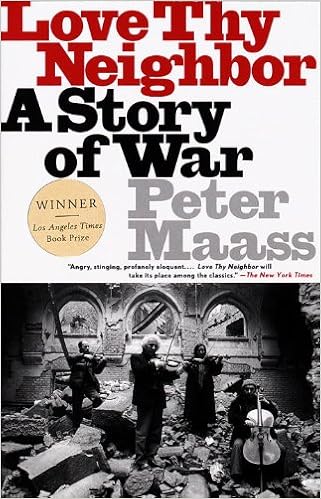 Love Thy Neighbor: A Story of War (ISBN: 978-0-679-76389-5) by Peter Maass is a collection of notes from the author’s time in Bosnia & Herzegovina as a journalist during the Bosnian War, but since the stories are all told from his point of view, it reads like a memoir. There isn’t a lot of continuity, and it just jumps from one story to another, but roughly follows the timeline of the war. The bit of continuity that is there is Maass wondering how people can forget so easily the need to respect those around them. The stories are very real and personal, as Maass interacts with fellow jouranlists, soldiers on both sides, government officials, and what would normally be called everyday people, but can’t be in this situation because there was no such thing as normalcy in the Bosnian War. Maass interviewed a Serb sniper, Bosnian soldiers, dealt with a Serb checkpoint — ultimately unsuccessfully, had Christmas dinner with a Croat family in Sarajevo, experienced what it was like to be under attack while in a gas station, and was, like most who dealt with the Bosnian War, flabbergasted by the impotence of the so-called world superpowers to get anything accomplished in Bosnia. His account holds nothing back and it presents the war in all of grizzly horror that is war.
 This Is Serbia Calling: Rock 'n' Roll Radio and Belgrade's Underground Resistance by Matthew Collin (ISBN: 1-85242-776-0), tells about a few of the people who tried to change the minds of Serbians during the war with Bosnia & Herzegovina. I found the very idea of someone going against what Serbia's ironically-named (his first named means free) despot, Slobodan Milošević, worth reading about. The book tells the story of how what is now Serbia's second-largest TV and radio station came to be, how it presented a constant message that went against the ultra-nationalist propaganda of the Serbian ruler. It was often a dangerous message, one that resulted in jail time, seized property, and the constant fear of death and beatings. Most of the radio station's personnel suffered only lightly, but others in the political opposition were murdered. B92 struggled to present a message that would galvanize the people of Serbia against the war, and once that was over, against the government that had brought so much trouble to their land. B92 was no great supporter of NATO or the West when they started bombing Serbia during the Serbian campaign in Kosovo, but mostly stayed on message as they continued to denounce the their corrupt president. They brought a message of hope and freedom to the people, which ultimately resulted in the people of Serbia taking to the streets and quickly, with minimal bloodshed, throwing Milošević out of power.
 Blood and Vengeance: One Family’s Story of the War in Bosnia by Chuck Sudetic (ISBN: 978-0-393-33548-4) is, indeed, and incredible story. It follows one Bosniak (Muslim) family from the final few years of Yugoslavia through the end of the Bosnian War. The information about life in an obscure village on the border of Bosnia and Serbia serves a great purpos in the book; it sets up what life was like in so many places. Ethnic hatred simmered under the Communist cover of “brotherhood and unity.” When the lid provided by party was gone, it boiled over and escalated quickly. Based on personal interviews in the first few years after the war, the stories of fights, flights, bomb shelters, forced marches, and genocide are raw and personal. The Muslim villgers, chased from their homes, their neighbors floating face down in Bosnia’s famous Drina river, seek shelter in neighboring villages progressively farther and farther from the fields and dirt paths of their nativity before finally reaching Srebrenica, where many would meet their ultmate demise. Along the way, they face a very personal enemy, their former friends and neighbors. At Srebrenica, the Bosniaks think they have found relief since the UN has provided for them a safe zone. They soon find out that the realities of international policy are far from cut and dry, and the safe zone has little in common with the word “safe.” Here, Sudetic relies on articles, documents, and archive material, painting a picture of great power ineptitude. Eventually, the war comes to an end, but not without changing forever the lives of those involved, some, paradoxically, possibly for the better.
 In When Character Was King: A Story of Ronald Reagan by Peggy Noonan (ISBN: 978-0-14-200168-4), the former Reagan staffer (speechwriter), journalist, and columnist gives her take on the fortieth president. The story starts when Reagan was a kid and ends as he succumbs to the Alzheimer's and the ailments of time. One learns where he got his worldview from and how his early life influenced where he got. Reagan's father, I learned, was an alcoholic, but he still imbued his son with principles that served him well in seeing the greatness in all people and in upholding America's tradition of equality. Reagan's mother was a strongly and actively Christian woman, which also became a major part of his character. He believed in God and believed God wanted to be part of people's lives. One reads about Reagan's involvement in Hollywood. He was arguably an up-and-coming star, but never went big time because he got involved in the actors' union and the more political side of things. His political career was dogged by accusations of being just an actor, and acting likely helped him as he campaigned, but his real talent was likely in speechmaking to begin with. The book recounts Reagan's entry into politics. He was not, it seems, overly ambitious, but saw his involvement as a chance to help people, and that's where character came in. Reagan had standards and stuck to them, providing for people a stable and strong standard behind which they could rally. He was unabashedly religious, had no tolerance for racism, and knew that there was a distinct difference between democratic forms of government with capitalistic and those of the "