In fact, this was a continuation of last year’s disturbance
which had never altogether ceased, but smoldered on in muffled silence,
waiting for a convenient excuse to erupt again.
As soon as one learns anything about the ex-Yugoslavia (commonly, but rather incorrectly referred to in the West as “the Balkans”), one hears about the Yugoslav writer Ivo Andrić. Andrić was born in Bosnia and Herzegovina while it was under Austro-Hungarian rule. He later published a number of works, the most famous being The Bridge on the Drina, for which he was awarded the Nobel Prize in Literature. That book is usually thought of as part of a trilogy of books that tells all about the clash of civilizations that was a big part of Andrić’s life in Bosnia, home to four distinct ethnic groups who adhere to four different religious traditions, all under the reign of various foreign conquerors throughout history.
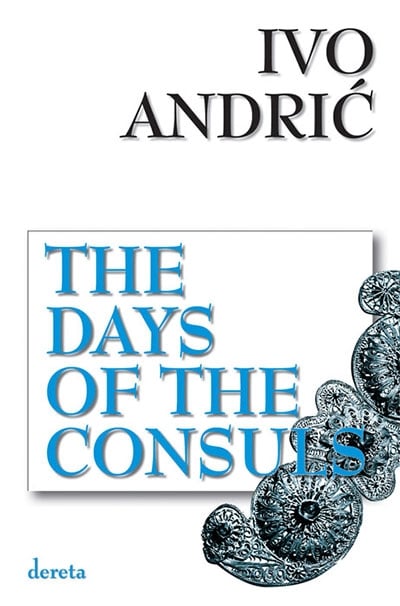 The Days of the Consuls by Ivo Andrić (ISBN: 978-86-6457-018-3), which has been published in English under the alternative titles of Travnik Chronicle and Bosnian Chronicle, fits right into Andrić's main motif, telling the story of the city of Travnik, which is medium-sized for Bosnia today, but was historically much more important as the seat of the Ottoman Empire in Bosnia, during a few short years while the Austro-Hungarian Empire and Napoleon’s France kept consuls in the town. The story is told from an omniscient narrator point of view, but focuses largely on French consul, his entourage, and his interactions with the others in Travnik, be they local or outsider. The French consul deals with being an outsider himself, shunned by the local Muslims and never really understood by the Ottoman representative, although their relationship was cordial. He remains the enemy of the Austro-Hungarian consul, although he sees many similarities between the two men and carries on professional, if not friendly, relations with him. The members of the consuls’ families and entourages are met with varying degrees of acceptance or disgust by those around them, including those from the local clergy. The Muslim population seems to be the most vocal in their distaste for the outsiders, but the Orthodox, Catholic, and Jewish populations also steer clear and are distrustful of the changes the presence of the consuls seems to be ushering into their otherwise simple lives. When Napoleon is finally defeated, the French no longer see the need for a consul in Travnik, and the French consul is recalled. The Austrians also remove from Bosnia. With all that has changed, all has remained the same.
I had always intended on reading Andrić’s so-called trilogy in the order they were published, but it didn’t happen thanks to the vagaries of translation. I bought this book not being aware that it was the same book as the Travnik Chronicle. All the same, I enjoyed it and still look forward to someday really pushing my brain to its limit by reading it in its original language. More than once, while reading, I thought of Tolstoy and his sweeping historical epic, War and Peace. This does not attain those heights, but I found the style to be very similar. I enjoyed the thorough descriptions of people and place achieved through masterful use of language instead of relying, like so many modern authors, on cliché and overly vulgar and expressive language. It might mean more to me because of my own extensive travel in the country and the familiarity inherent to reading about something one knows relatively well. Andrić believed that Yugoslavia had a unique and uniquely turbulent past that presented many opportunities for learning, learning that would help people avoid the ethnic and religious conflict that has seemingly always plagued the region. In the book, which is, in a way, plotless, as it simply chronicles the day-to-day lives of Travnik’s citizens, one can see this theme, but I would argue it is meshed with one that emphasizes similarities over differences, and that is the lesson, one that is, unfortunately, unheeded in modern-day Bosnia and Herzegovina, and unheeded elsewhere. Slightly different approaches to the same fears, concerns, and goals hindered all parties in the book from a more mutually beneficial co-existence.
 | This work, including all text, photographs, and other original work, is licensed under a Creative Commons Attribution Non-Commercial No Derivatives 3.0 License and is copyrighted © MMXIV John Pruess. |


 Love Thy Neighbor: A Story of War (ISBN: 978-0-679-76389-5) by Peter Maass is a collection of notes from the author’s time in Bosnia & Herzegovina as a journalist during the Bosnian War, but since the stories are all told from his point of view, it reads like a memoir. There isn’t a lot of continuity, and it just jumps from one story to another, but roughly follows the timeline of the war. The bit of continuity that is there is Maass wondering how people can forget so easily the need to respect those around them. The stories are very real and personal, as Maass interacts with fellow jouranlists, soldiers on both sides, government officials, and what would normally be called everyday people, but can’t be in this situation because there was no such thing as normalcy in the Bosnian War. Maass interviewed a Serb sniper, Bosnian soldiers, dealt with a Serb checkpoint — ultimately unsuccessfully, had Christmas dinner with a Croat family in Sarajevo, experienced what it was like to be under attack while in a gas station, and was, like most who dealt with the Bosnian War, flabbergasted by the impotence of the so-called world superpowers to get anything accomplished in Bosnia. His account holds nothing back and it presents the war in all of grizzly horror that is war.
 Blood and Vengeance: One Family’s Story of the War in Bosnia by Chuck Sudetic (ISBN: 978-0-393-33548-4) is, indeed, and incredible story. It follows one Bosniak (Muslim) family from the final few years of Yugoslavia through the end of the Bosnian War. The information about life in an obscure village on the border of Bosnia and Serbia serves a great purpos in the book; it sets up what life was like in so many places. Ethnic hatred simmered under the Communist cover of “brotherhood and unity.” When the lid provided by party was gone, it boiled over and escalated quickly. Based on personal interviews in the first few years after the war, the stories of fights, flights, bomb shelters, forced marches, and genocide are raw and personal. The Muslim villgers, chased from their homes, their neighbors floating face down in Bosnia’s famous Drina river, seek shelter in neighboring villages progressively farther and farther from the fields and dirt paths of their nativity before finally reaching Srebrenica, where many would meet their ultmate demise. Along the way, they face a very personal enemy, their former friends and neighbors. At Srebrenica, the Bosniaks think they have found relief since the UN has provided for them a safe zone. They soon find out that the realities of international policy are far from cut and dry, and the safe zone has little in common with the word “safe.” Here, Sudetic relies on articles, documents, and archive material, painting a picture of great power ineptitude. Eventually, the war comes to an end, but not without changing forever the lives of those involved, some, paradoxically, possibly for the better.
 Bosnia: A Short History by Noel Malcolm (ISBN: 0-8147-5561-5) explains just who the Bosnians are and who they have been throughout history. Their history, like those of all the peoples of the Balkan region, is muddled thanks to it being at the crossroads of the East and the West. Although rarely sought after militarily, both the Ottomans and the Hapsburgs brought it under control at different times. Before that, though, Bosnia had carved out its own identity seperate from its neighbors, Croatia, Serbia, and Slovenia. Bosnian history goes back to the ancient Illyrians and continues through Rome, Byzantium, and various Slavic tribes and rulers. It continued, to a certain extent, in the short time period between World War I and the introduction of Communism. It made it through the fall of Yugoslavia and continues its unique fractured and rather dysfunctional way today. Religion, both Christianity and Islam, as well as earlier, pagan forms of worship, have played a major role in the forming of the Bosnian people. The history, like much of Eastern Europe, is fragmented and often overly complicated, but it is rich and features a people who present something unique to the world.
 Bosnia: In the Footsteps of Gavrilo Princip by Tony Fabijančić (ISBN: 978-0-88864-519-7) is a travelogue that traces the route of Gavrilo Princip’s travels through the former Yugoslavia and the Austro-Hungarian Empire. Set largely in the modern-day Balkans, the book uses Princip and his story as a way to understand the region’s complicated history and its rather sticky present through observation, interviews, and referencing historical sources. The author, rather sympathetic to Princip before undertaking his research and travels, was also optimistic at the outset about the chances for the various ethnic and religious groups of the former Yugoslavia to mend things up a little bit. By the end of his efforts and the end of the book, after traveling through thick forests, high alps, Mediterranean coastline, and the smog of big cities, he has changed his tune on both counts, considering Princip to have misjudged the impact of his actions, and not just misjudged, but having brought about more harm than good as well as coming to the realization that the peoples of the region, harboring some of the same prejudices and stereotypes as those held about 100 years ago as WWI broke out, aren’t breaking out of those molds any time soon.
 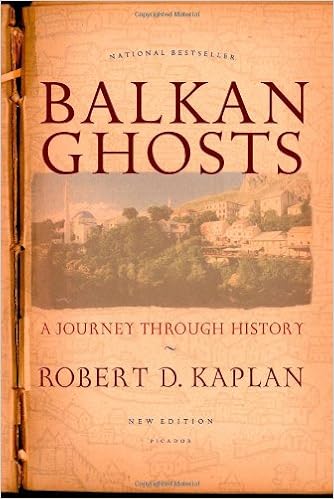 Balkan Ghosts by Robert D. Kaplan (ISBN: 978-0-312-42493-0), is self-styled as a travelogue, but is more akin to a feature story in a national magazine on current affairs. Kaplan weaves his extensive travels and living experience in the region and the accompanying interviews and everyday events with historical perspective and the relevant biographical information pertaining to the important figures in the Balkans’ history, his “ghosts.” Kaplan’s definition of the Balkans is a bit wider than most Americans’, so not only the former Yugoslavia, but Romania, Bulgaria, and Greece, too, are included in the discussion of this fascinating geographical region. Each country and each nation (ethnic group) has a few figures in its past who lived in such a way and made decisions in such a way as to continue to influence the way things are done and the way people think. With the exception of Greece, the Balkans also deal with a specter of a different type, the continued need to deal with the harsh consequences of communist dictatorships that broke people and destroyed countries immediately after the Nazis and fascism gave the same thing a whirl. It’s worth noting that the Nazis followed right on the heels of the Hapsburgs, who were, in most people’s estimation, better rulers than the succeeding ones, but on occasion no less ruthless. The great figures and great histories of the various peoples are presented with all the raw emotion that is associated with Balkanization, and Kaplan points out that since the histories are great, the people pick those moments when their histories were at an apex and claim that cultural, linguistic, and territorial summit as the way things should be now before any other discussions can be had. It puts them all in a hard place, but Kaplan argues that considering all the things these groups of people and these countries have been through, there’s really no way but up, although, as his reference to Shakespeare alludes to, it might be a painful process.