 The Airmen and the Headhunters: A True Story of Lost Soldiers, Heroic Tribesmen, and the Unlikeliest Rescue of World War II by Judith M. Heiman (ISBN: 978-0-15-101434-7) tells a fascinating story from the Pacific. As the Allies tried to claw their way toward Japan, while a ground invasion was still a potential plan, territory in what is now Indonesia was of strategic importance to the belligerents. Japan held what was then referred to as Borneo because of its oil reserves. The Allies wanted to cut that off. During a bombing mission against Japanese forces and industry in Borneo, a few U.S. planes were shot down. The occupants of one met death, either in the wreck or at the hands of the Japanese. Two other planes, though, had survivors who avoided capture. While this was initially thanks mostly to good luck, later capture was avoided because of the efforts of the natives, some of whom were formerly formidable headhunting tribes. The case of characters involved Malaysians, various highland jungle tribes, and the Americans. Later, Australian forces joined made it to the jungle and helped the natives fight the Japanese and the Americans get home. In the six months between the downed planes and the exfiltrations, though, the natives and the Malay helped the Americans avoid detection by the Japanese. They provided the Americans with hiding places, food, and taught them some of their ways to help make survival in the jungle a little easier. It wasn’t easy and involved sickness, insects, leeches, and injury, but the downed American soldiers eventually made it back home. In fighting the Japanese and keeping them off the Americans’ trail, the natives brought back their age-old tradition of headhunting. It might not have been exactly the same since it was revitalized out of necessity, but it served its purpose and aided in keeping the Japanese out of the interior jungles.
The book was really interesting. I know almost nothing about Indonesia, Malaysia, and other island nations in Asia. I had never heard about this particular bit of World War II history, but I am glad I did. It was fascinating to read about the jungles, their many potential threats, and the native people who so willingly sacrificed for the well-being of the American soldiers, especially since they might have not been so excited about doing so given the sometimes harsh history of the Dutch in that part of the world. Kind American missionaries who worked in the jungles mitigated some of the Dutch-induced problems, though, and even non-Christian natives respected the Western missionaries who had truly been good examples and good followers of Christ. There was an element of adventure in the book and some excitement in the story as the Japanese came close to capturing the Americans a couple times. Other than a quote from an old army song that included the F-word, the book was great and well worth reading for anyone interested in history.

|
This work, including all text, photographs, and other original work, is licensed under a Creative Commons Attribution-NonCommercial-NoDerivatives 4.0 International License and is copyrighted © MMXXI John Pruess. |


 A River in Darkness: One Man's Escape from North Korea by Masaji Ishikawa (ISBN: 978-1-5420-4719-7) is just such a tale, although it does have an interesting twist. The author was not born in North Korea; in fact, he was born in Japan and was ethnically half Japanese. His dad, who was not native to Japan, moved his family to North Korea under pressure from ethnic compatriots and the pressure of being an ethnic minority in re-building, post-war Japan, where such minorities weren’t always welcome. The promises of the Communist utopia were very quickly discovered to be a total sham by the author and his family. However, there was no real opportunity to get out. The author's family had nothing to offer the Communist Party, so they lived as peasants, eventually finding that living under the radar of the authorities was easier than trying to conform to the system in North Korea. Eventually, Ishikawa tires of the poverty, starvation, racism, hypocritical inequality, and lack of freedom. He heads toward the border with China, fearful, but determined to make a break for it since, although that would mean an uncertain future, it was better than the future he could easily predict inside North Korea. He made it to China, eventually linking up with the Japanese embassy there, which, with great difficulty, helped exfiltrate him to Japan. Once back, Japan had jumped forward forty or so years, while North Korea had steadily gone backward. Ishikawa struggled to adjust and felt abandoned by Japan.
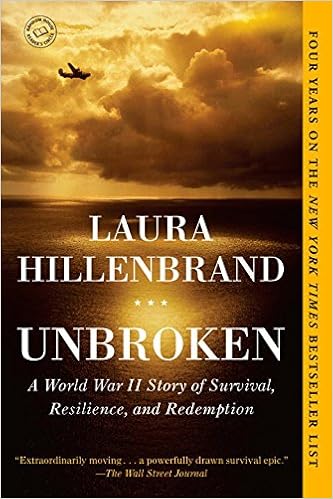 Unbroken: A World War II Story of Survival, Resilience, and Redemption by Laura Hillenbrand (ISBN: 978-0-679-60375-7) is just such a story about overcoming trials. Like so many stories of resilience in the face of overwhelming odds, the story starts with humble origins. Louis Zamperini was the son of Italian immigrants struggling to make ends meet along with most other Depression-era Americans. A caring older brother discovered the track and invited Louie along, later serving as an unofficial coach, and Louie became as star, eventually qualifying for the Olympics, running a race (5,000 meters) he didn’t usually do. He competed admirably in Berlin, finishing eighth against some of the world’s greatest runners. His running career, though, was cut short by the onset of war, and he served as a bombardier. That, too, was cut short because his plane went down during a rescue mission, and he was captured by the Japanese after some time floating in a raft at sea. Floating around for weeks was already an amazing act of survival and resilience, but the worst was yet to come. Zamperini then spent more than two years in various Japanese prison camps undergoing brutal treatment. He and others kept their wits about them by resolving to beat the system and not give in to their captors and abusers. Some made it, some did not. There were some funny stories along the way, but most of it was monotony, drudgery, and pain. Eventually, Zamperini and the others that survived were done with the horrors of the camps because the war ended. Unfortunately, for many, that was not the concrete ending they would’ve preferred. The horrors lived on in many of the former POWs’ minds, causing more than one to turn to alcohol, destructive behaviors, and even suicide to end the pain. Zamperini’s story included a lot of post-war alcoholism, but he eventually quit that thanks to a conversion to evangelical Christianity, in part because of him remembering some promises he made to God while floating aimlessly on the Pacific Ocean in the first few days after his plane went down. Zamperini used this redeeming experience in his life to later inspire and help others as well as come to terms with and even forgive his war-time tormentors.