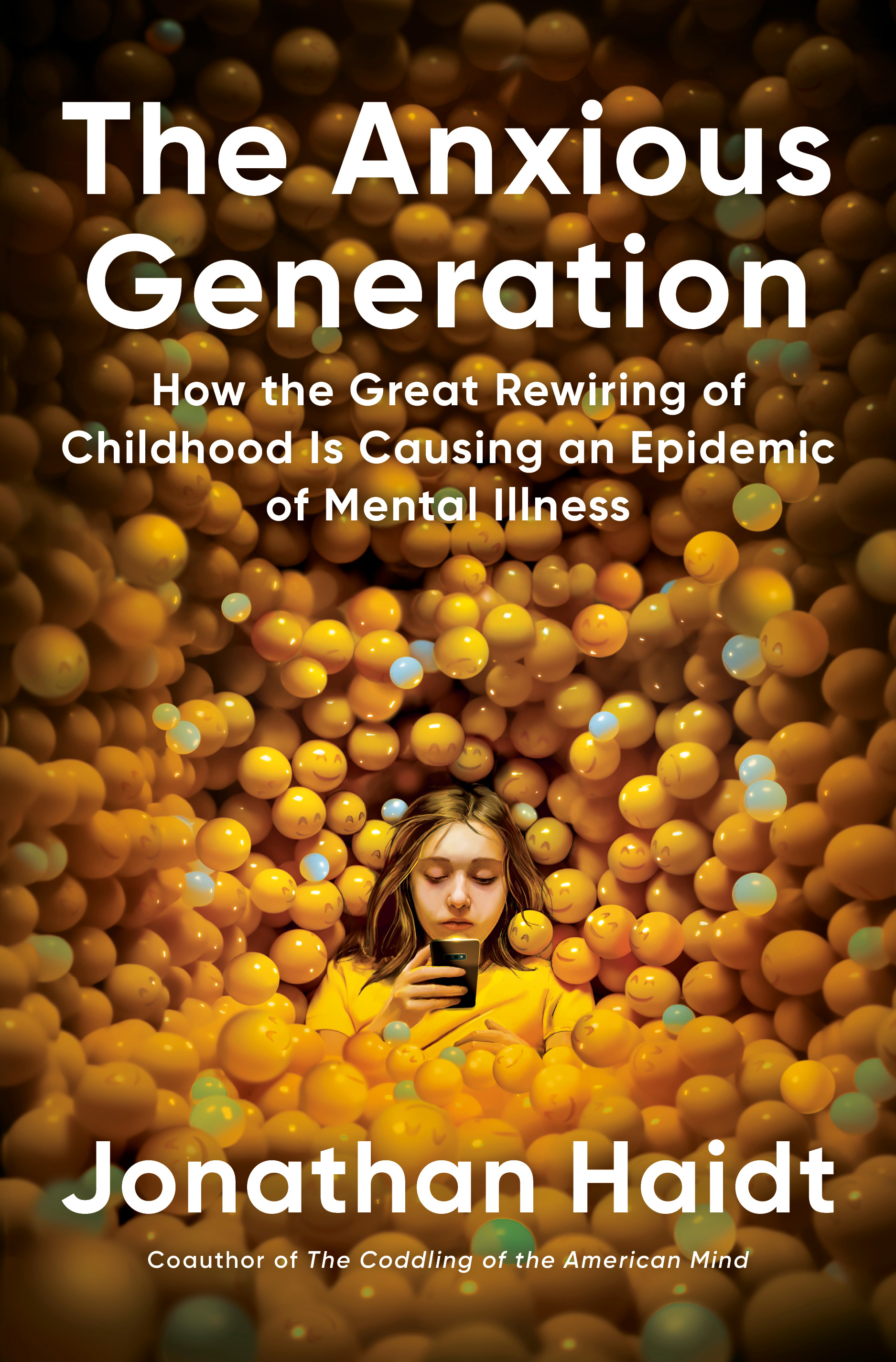
 The Anxious Generation: How the Great Rewiring of Childhood Is Causing an Epidemic of Mental Illness by Jonathan Haidt (ISBN: 978-0-593-65503-0) explores why anxiety and other so-called mental health problems have exploded over the last fifteen years. The author believes that most of the blame lies with smart phones. He doesn’t deny that there are good things about smart phones, but he points out that because they allow unfettered access to the Internet and social media in particular, children and teenagers who spend time on the Internet lose out on formative experiences that steel them against anxiety and other mental problems while increasing their likelihood of being negatively affected. Haidt first argues that children need to be exposed to a certain level of risk while they are young to attune the body’s natural response to risk. Throughout history, kids have generally done this by playing outside with other kids, usually unsupervised. A culture of safetyism (eliminating all risks even when the positives of some risk are considered) encourages — in some places, usually more liberal places, forces — parents to keep their kids indoors and only let them out when they or other adults can supervise. This tends to make kids view the world around them as a large and constant threat. The perception of a constant threat is just what so-called clinical anxiety is. Additionally, without being exposed to little risks (the risk of falling off a swing or the risk of being rejected by a peer) that come with interacting with others while outdoors conditions kids to be comfortable only when there is no risk. The second half of Haidt’s argument is that social media exasperates these feelings in most people. Social media generally presents only the good side of things, which is something people on it then worry about it. It is also designed to be addictive (people experience hormone-induced positive sensations when their posts are liked, for example), so it’s a cycle of doom where people endlessly scroll, looking at the supposedly perfect lives of those around them while the post themselves, hoping to feel the dopamine-caused high of the next like or comment. If those are few and far between, the anticipation of the next like keeps people scrolling, all the while increasing negative feelings toward oneself. Haidt notes that girls are particularly prone to this type of activity. Boys are also negatively affected by constant time online. They are less likely to be anxious about social media, but video games and pornography easily engage the young male mind, pulling them away from reality. Since it’s relatively easy to exist in a world where you don’t have to engage in real-world situations that may have negative consequences, boys withdraw into these virtual worlds and try to not emerge. The book ends with some ideas on how to overcome the problems caused by smart phones. He has ideas for governments and for individuals, led by eliminating smart phone exposure for those under fourteen and limiting it for those over, both in school (complete bans on smart phones at schools are his preferred option) and at home. He also advocates letting kids get out and play and do other things on their own, like run simple errands, do chores around the house, and other things that are relatively safe, but still have distinct negative consequences for not accomplishing them.
I liked the book. I may have had a preconceived bias since I find most of what kids do on cell phones to be a waste of time (although, I, like the author, see that there are some good things). However, I went into my reading not knowing about the reasons behind the market change in kids’ behavior over the last fifteen years or so. There are lots of things that people can do by opening their eyes and seeing what is going on, and I think the negative trend when it comes to things like resiliency, critical thinking, and mental fortitude in young people is obvious, but a book like provides all kind of solid charts, graphs, and analysis of that. I always like having the data behind the things I see and believe. I also thought the prescriptive section of the book was a little stronger than most are. Usually that is the weakest section in these types of books, but here I thought the author provided some relatively realistic suggestions for both governments and individuals. I also liked that they were more concrete than those of most authors. That might be because the data was so straightforward. If it’s painfully obvious that teens under 16 are hurt by exposure to social media, it’s pretty easy to say parents should do all they can to keep kids off social media. If all the data says kids do better at school when they have to set their phones aside for the entire school day, it’s not hard to recommend that schools ban cell phone entirely (not just during class). I thought all the policy and parenting prescriptions were solid. If you want to understand why the youth of today don’t seem to measure up to what you remember, this is a great read, especially because it provides some realistic suggestions to help not only kids, but also adults improve their quality of life and make them more resilient, forward-thinking people.

|
This work, including all text, photographs, and other original work, is licensed under a Creative Commons Attribution-NonCommercial-NoDerivatives 4.0 International License and is copyrighted © MMXXI John Pruess. |


 The Power of Positive Parenting by Glenn I. Latham (ISBN: 1-56713-175-1) doesn't have all the answers either, but after reading it together with my wife, we decided that it has many of the answers, and even where it doesn't it tends to point the reader in the right direction. The book is full of guidance on how to deal with all kinds of different behaviors that children (and adults) engage in. There are sections for younger kids, for teenagers, for small problems, for sibling rivalry, and for larger, more destructive behaviors. There are a couple over-arching themes in the book that course through the suggestions for each kind of problem. One is to ignore things that doen't really cause any harm since most people just want attention and will take it however they can get it. Igoring kids’ whining, for example, is the most effective way to get them to stop. The other thing that was presented over and over was the need to positively reinforce good behavior. Default parent settings seem to be set to find negative behavior and call it out. What about the good? Fidning and reinforcing good behavior gives kids the attention they need and teaches them that good behavior will be rewarded.