One didn’t hear much about the Taliban before the infamous events of September 11th, 2001, even if one was relatively informed and kept up with the news. Here and there, they made the news as they continued to make living in Afghanistan less and less desirable, but they weren’t an every-day item. In my mind, they were most famous for blowing up the Buddhas of Bamyan. With al-Qaeda’s attacks, though, things changed and changed quickly. Afghanistan became a military target for the U.S., putting the Taliban in the crosshairs. With the interconnectedness and fluidity of the region, it was easy for many Taliban members to cross borders and blend into society elsewhere, including Pakistan, where they had already had a small presence since the mid 1990s. After September 11th and as the Taliban went international, they were in the news every day, and when Taliban gunmen shot a girl named Malala in Pakistan, both the Islamist Taliban and the girl became household names around the world.
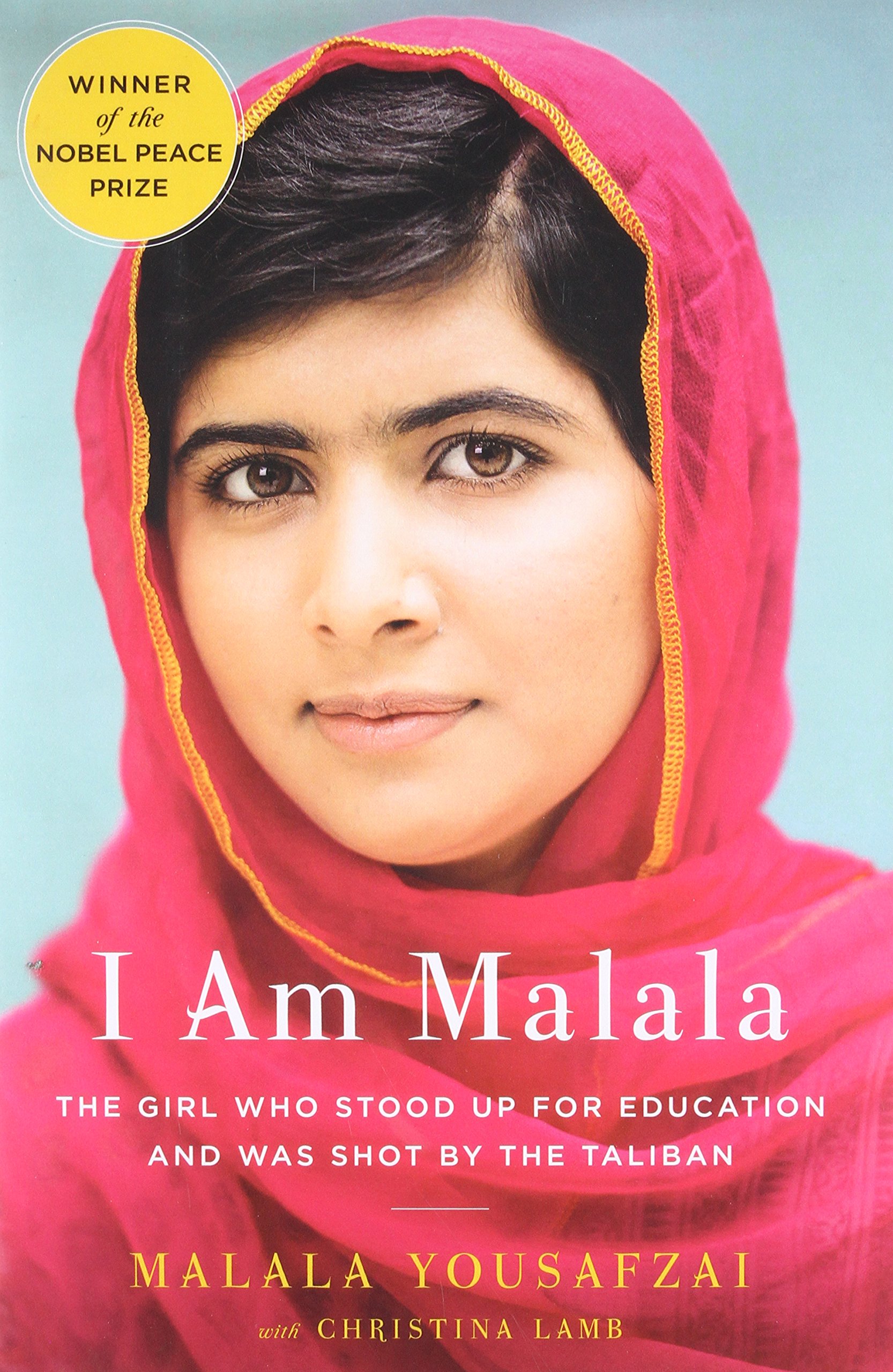 I Am Malala by Malala Yousafzai (ISBN: 978-0-297-87092-0) is the story of the schoolgirl from the time she was a little girl to the beginning of her recovery in England. The book starts with her young childhood and takes the reader through day she was shot in great detail. Interwoven into her discussion of cricket with friends, friendly competition among classmates, and trips to ancestral villages to visit extended family are brief lessons on Pakistani history and geography, which adequately set the stage for Malala’s life and what would become important to her as she got older. Far away from the bigger cities where more liberal attitudes existed, life in the villages of Swat went on much like it had for centuries, following traditional Islamic custom. Malala’s father was a trend-setter in many ways and surrounded himself with others who wanted to see progress in the field of education. He believed everyone should have an education. He also didn’t have a lot of use for many of the traditions that prevented women from freely moving about, going to school, or otherwise expressing themselves. His oldest daughter followed in his footsteps and was nationally prominent by the time she was of junior high age, having won a few national awards, having met with various Pakistani dignitaries on the way. She enjoyed school, enjoyed learning, and wished everyone had the same opportunity. She saw how the lack of such opportunities negatively affected others in her community, including her own mother, who was illiterate. She and two others were shot by Taliban gunmen in 2012, and because she needed long-term intensive care and was under continued threat, she and her family were evacuated to the UK, where they have lived ever since.
I was unsure how I would react to this book. It was wildly popular a few years ago, but I was reluctant to read it, thinking it would push either Islam or women’s rights in an overbearing fashion. It did neither and was refreshing in its agenda-free message. I didn’t know that the Taliban shooting was not indiscriminate. She was a very specific target thanks to her involvement in Pakistan in trying to get women and girls more involved in education. (If nothing else, it rubbed off on her mom, who had begun reading lessons near the end of the book.) While I got the impression that Malala was and is a devout Muslim, she seemed to have a “big-tent“ mentality, simply explaining and never criticizing (other than Taliban policy and actions). Women in burqas and bazaar dancers were equal in her eyes. In a world where many in the West are looking for the moderate Muslim voice, this may be one of them. Her same level-headedness came through in her discussion of women and girls and schooling. She saw the advantages that it afforded and wanted all to be able to participate. Neither poverty nor tradition should stand in the way of those who wanted to go to school. Such a concept seems so basic to Westerners and one that fits well into the idea of equal opportunity, but stories like this show that there is much to yet to be done in spreading these basic norms around the world (and not forgetting them at home at the same time).
I Am Malala by Malala Yousafzai (ISBN: 978-0-297-87092-0) is the story of the schoolgirl from the time she was a little girl to the beginning of her recovery in England. The book starts with her young childhood and takes the reader through day she was shot in great detail. Interwoven into her discussion of cricket with friends, friendly competition among classmates, and trips to ancestral villages to visit extended family are brief lessons on Pakistani history and geography, which adequately set the stage for Malala’s life and what would become important to her as she got older. Far away from the bigger cities where more liberal attitudes existed, life in the villages of Swat went on much like it had for centuries, following traditional Islamic custom. Malala’s father was a trend-setter in many ways and surrounded himself with others who wanted to see progress in the field of education. He believed everyone should have an education. He also didn’t have a lot of use for many of the traditions that prevented women from freely moving about, going to school, or otherwise expressing themselves. His oldest daughter followed in his footsteps and was nationally prominent by the time she was of junior high age, having won a few national awards, having met with various Pakistani dignitaries on the way. She enjoyed school, enjoyed learning, and wished everyone had the same opportunity. She saw how the lack of such opportunities negatively affected others in her community, including her own mother, who was illiterate. She and two others were shot by Taliban gunmen in 2012, and because she needed long-term intensive care and was under continued threat, she and her family were evacuated to the UK, where they have lived ever since.I was unsure how I would react to this book. It was wildly popular a few years ago, but I was reluctant to read it, thinking it would push either Islam or women’s rights in an overbearing fashion. It did neither and was refreshing in its agenda-free message. I didn’t know that the Taliban shooting was not indiscriminate. She was a very specific target thanks to her involvement in Pakistan in trying to get women and girls more involved in education. (If nothing else, it rubbed off on her mom, who had begun reading lessons near the end of the book.) While I got the impression that Malala was and is a devout Muslim, she seemed to have a “big-tent“ mentality, simply explaining and never criticizing (other than Taliban policy and actions). Women in burqas and bazaar dancers were equal in her eyes. In a world where many in the West are looking for the moderate Muslim voice, this may be one of them. Her same level-headedness came through in her discussion of women and girls and schooling. She saw the advantages that it afforded and wanted all to be able to participate. Neither poverty nor tradition should stand in the way of those who wanted to go to school. Such a concept seems so basic to Westerners and one that fits well into the idea of equal opportunity, but stories like this show that there is much to yet to be done in spreading these basic norms around the world (and not forgetting them at home at the same time).
 | This work, including all text, photographs, and other original work, is licensed under a Creative Commons Attribution Non-Commercial No Derivatives 3.0 License and is copyrighted © MMXIV John Pruess. |


 To do that, I read the Qur’an (ISBN: 978-0-19-953595-8), translated by Abdel Haleem. The Koran (there are lots of possible spellings for this) is Islam's holy book, purported to be a recording of revelation given to the prophet Mohammed (lots of spellings for his name, too). It focuses on the nature of God as the only God, as opposed to idols, pantheons of pagan gods, or even God as Christians know him, the Father of Jesus Christ. The Koran talks about Mary and Jesus, but Jesus is not God’s Son. It talks about Muslims’ duties to the poor and orphans. It discusses the afterlife and the resurrection. It warns evildoers against their course of action. There are some details about domestic life, finances, and there is the well-known injunction to prayer, which results in the call to prayer that happens five times a day wherever there is a functioning mosque. There are some instructions regarding Muslims’ dealings with non-believers, or infidels.
 In It Is about Islam (ISBN: 978-1-5011-2612-3) by Glenn Beck, part of Beck’s “Control” series (although I’m not entirely sure because it doesn’t fit the government overstep discussion that is so central to the other two books in the series), the reader is given a crash course in Islam, then typical media and government lies about Islamic extremism (Beck uses the word “Islamism” for this) are discusses and exposed, and then Beck gives a couple basic suggestions on how to move forward. Based on my own understanding, the background information was solid. I was intrigued to learn about the contact early Americans had with Islam and the process they went through to properly educate themselves about it. The “Lies” section was good. It was likely easy for the research team to gather the material. There was no need to go into statistics or anything like that. Simply gathering material from the Koran, the Hadith, and the words of the extremists themselves, did it and showed just how the extremists come up with what they believe. Finally, there were a couple suggestions on how people should arm themselves with real information and not be willing to be stuck with what the media and politicians try to feed the American public.
 American Sniper by Chris Kyle (ISBN: 978-0-06-223886-3) is a book that does just that. It also visits, in a very personal way, the other realities of being a soldier, such as separation from friends and family, and the stress that comes from that and from always being in such high-adrenaline situations in war zones. The book is the first-hand account of a Navy SEAL and his experiences throughout his time in the service of his country and his fellow man. It follows him from high school to his helping form a company to train other security professionals once he got out of the military. Most of the details in the book come during his time as a sniper in Iraq. He explains how the American soldiers went about their business in the hostile areas where they operated. He explains what goes through a soldier’s mind before, during, and after action. He goes through the extremely painful process of losing a friend in battle. The book also describes the heroic efforts of those who were seriously injured to work hard to overcome their new disabilities and make something of their lives. Readers are let in, to a certain degree, to the psyche of the author as he describes, mostly in general terms, his philosophy on life and on some of the things he did while in the Navy. There’s a little fun along the way, but the journey is mostly hard work, a lot of sweat, and quite a bit of blood, too.

 The collection of essays contained in Volatile Borderland: Russia and the North Caucasus (ISBN: 978-0-9830842-1-1), edited by Glen E. Howard, is an attempt at shedding some light on the movers and shakers of the Russian North Caucasus, what the future holds, and what is driving current reforms, repressions, and realities. The authors are experts on Russia and the Caucasus, all either professors, journalists, or similarly qualified experts and policy advisors. Chechnya, Dagestan, Krasnodar, and Sochi and the various peoples that inhabit them are prominent players in the analysis, but exotic-sounding places like Adygeya and Kabardino-Balkaria also garner significant attention because they form a buffer zone between the explosive and more Islamic eastern North Caucasus and the rest of European Russia. As with most places in the world where high unemployment, Islamist thought, and rampant corruption have mixed, the North Caucasus is a tinderbox. The Russian authorities have tried a mixture of ridiculously high federal subsidies and oppressive, totalitarian-style control, which seems to be tenuously holding things under control, but most of the essayists agree that this situation could go at any time.
 No matter my view of the world, a gripping story of international intrigue, raw, primordial bravery, faith, and patriotism, is told by Betty Mahmoody and William Hoffer in Not without My Daughter (ISBN: 0-312-92588-3), a memoir of Mahmoody's experiences when her husband took her and their daughter to Iran and then forcibly kept them there. Mahmoody starts with her flight to Iran from America's heartland, where she spent her entire life and moved from her blue-collar beginnings to entertaining and comfort of the upper middle class thanks to her Iranian husband. She had various reasons for agreeing on the flight to Iran, but staying there indefinitely wasn't one of them. That such a plan is her husband's plan is apparent within a week of arrival, and it's made worse by the fact that most of his family, and like most eastern cultures, family connections are extensive, is in on the kidnapping. Mahmoody and her kindergarten-age daughter, Mahtob, endure the next two years under what amounts to house arrest in an unfamiliar and usually hostile foreign land where hatred for America is not only the official line, but something many citizens openly and actively agree with. Eventually, Mahmoody is able to make contacts with various people, some simple shopkeepers, some foreign government officials, and others who are just the universal kind-hearted person you always hope exists out there. She uses these contacts to organize a treacherous escape for her and her daughter, and through a few minor miracles, they are smuggled to freedom.