You have to fight for your freedom and for peace.
You have to fight for it every day, to keep it.
It’s like a glass boat; it’s easy to break. It’s easy to lose.
— Joachim Rønneberg
World War II played out on a much larger stage than I was aware of growing up. In my mind, in Europe it was the U.S. and the UK with some marginal help from France taking on Germany, which had some marginal help from the Italians. Russia got involved late and helped beat the Germans, but brought Communism with them. In Asia, the U.S. fought Japan. My guess is that is the fairly standard portrayal given by American schools. What isn’t always so obvious to kids is that while those countries were the big-shots, their actions cut a much wider swath. The book Snow Treasure, a kids’ book about a bunch of gold being snuck out of Norway, likely with the help of some kids on sleds, to keep it out of Nazi hands, although only “based on a true story,” piqued my interest in the way World War II had an impact on the countries other than the ones that come immediately to mind.
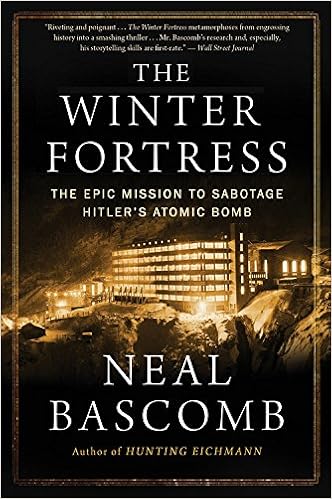 The Winter Fortress: The Epic Mission to Sabotage Hitler’s Atomic Bomb by Neal Bascomb (ISBN: 978-0-544-36806-4) is a story that tells just such a story (incidentally, also in Norway). The book tells part of the story of Nazi Germany’s efforts to acquire an atomic bomb. Those efforts were tightly tied to Norway’s hydroelectric capabilities and a substance known as heavy water, or water with extra deuterium in it. Early experiments by Allied and Axis scientists alike indicated that heavy water could be used in making an atomic bomb. Germany pursued this theory rather aggressively. After occupying Norway, the Germans used Norway’s production of heavy water to accelerate their nuclear experiments. The Allies knew this and wanted to come up with a plan to prevent the German scientists from getting what they needed. Norwegians in the resistance did a lot in their day-to-day efforts to sabotage the heavy water without doing too much damage to the plants where it was produced since that would lead to German reprisals and put many Norwegians out of work. It was something the Norwegians had to carefully balance. As things got down to the wire, though, even the Norwegians could see that their efforts would have to increase in scale. With help from the UK, various plans were set in motion, including one that led to some disastrous deaths in the Norwegian outback as saboteurs rode gliders into Norway only to crash land with horrible results. Later attempts were more successful with Norwegian commandos, already in Norway, conducting two successful raids against heavy water, one damaging the plant and one preventing a large delivery of the water from being completed. After the first raid on the plant, the production capabilities were eventually brought back on line, but when they were, the U.S. bombed the plant, putting down for the count until the end of the war. The book chronicles these operations, all that led up the them, and many of the brave people it took to make them successful.
The book was extremely interesting and well written, easily keeping my interest, even in places where the discussions were more scientific in nature. The arctic adventure and sneaky military operation aspects were really cool. As with most such stories, the story also includes a significant portion discussing the sacrifices so many made to keep their homelands free. One often thinks of that in terms of casualties, but I was reminded in this book that it’s not always so cut and dry. One of the main resistance figures lived through the war, but he lost his family, as his wife and kids moved to Sweden and his wife found another man there. The soldier also never recovered from the mental stresses of fighting, starving (I learned a lot about the edible properties of all parts of a reindeer and how well moss can be added to soup), freezing, not sleeping, and working under cover. There were also civilian casualties, for which all involved were sorry, but the general feeling was that people knew and understood that was part of war and they were willing to sacrifice for the greater good of their country and for the greater blessing of being free. The book, then, is what good history should be, solid storytelling about interesting events that had far-reaching impacts and inspiring actions by the people involved.
They shall grow not old, as we that are left grow old:
Age shall not weary them, nor the years condemn.
At the going down of the sun and in the morning,
We will remember them.
— Laurence Binyon, “For the Fallen”
 | This work, including all text, photographs, and other original work, is licensed under a Creative Commons Attribution Non-Commercial No Derivatives 3.0 License and is copyrighted © MMXIV John Pruess. |


 We Die Alone (ISBN: 978-1-59921-063-6) by David Howarth, re-tells the true account of a man surviving the harsh Norwegian winter using his own survival skills and the goodwill of his fellow countrymen as they resisted Nazi occupation. The Norwegians worked together with the English to bring people and supplies from England to Norway to sabotage the Nazis. The title of the book is taken from the idea that while sent up as a team, the saboteurs would split up, if necessary, in order to carry out their mission. The book’s hero, Jan Baalstrud, was betrayed by a local, maybe not intentionally, helped self-destruct the sabotage materials, and then escaped the Nazi patrols on the hunt for him. He used athletic prowess and backcountry know-how to stay away from the Germans, but could eventually go no further after a debilitating blizzard trapped him. Locals loyal to their country helped hide him and then help him escape the Germans, who seemed to be narrowing in. Baalstrud spent a few harrowing weeks on his own in snow caves, and his body suffered greatly, including frostbitten limbs, but his will to survive, although sometimes tried, never died, and he never gave up, eventually being pulled to safety in Sweden by Lapps and their reindeer sleds.