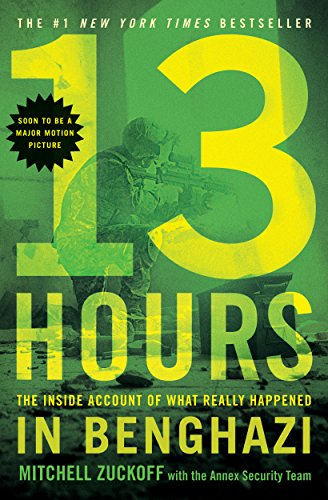
13 Hours: The Inside Account of What Really Happened in Benghazi by Mitchell Zuckoff (ISBN: 978-1-4555-8229-7) tells that story from the perspective of the contract security officers, referred to as “operators” in the book. This small team of men was assigned to provide security to the diplomats and analysts working out of the small diplomatic facilities in Benghazi. The book gives us a little background on each of them and then jumps right in to the fateful day when two of them, the ambassador, and a government computer specialist would die. The security officers all had military backgrounds. They would put that to the test when the facilities they were hired to protect came under attack. The diplomatic compound came under attack first and was, sadly, overrun before the security officers could do much. It was there that the U.S. ambassador and one of the IT specialists lost their lives. As told by the security team, that may have been preventable given a quicker or a more powerful response, had more U.S. assets been able to respond in a timely fashion. They got their truest test a little later, when the annex where they lived came under fire. They repulsed three separate attacks, but since the third attack included mortars, two of the contractors were killed. All, though, fought bravely, as did some of the other government employees involved. The story presented by the author, who worked directly with the surviving team members as he wrote the book, is lively, action-packed, and keeps its distance from anything political. The security team is presented as a few guys who were there to do their job, and like hard-working Americans everywhere, worked extremely hard and sacrificed to get the job done.
Overall, I enjoyed the book. As mentioned above, it’s fast paced and tells an interesting story. I appreciated that it steered clear of politics. This was the story of the security team. It certainly had their opinions in it, and since they are all self-assured people, the opinions are strong, but they also come off as genuine people, real patriots, guys who were just trying to do their jobs. These were dangerous, somewhat thankless jobs that most people are unwilling to take despite the good pay. It was a quick read thanks to being drawn into the story and being able to feel oneself there with smoke in the air and bullets flying. The security team was decorated, although not very much compared to some of the others even though they likely did more than the others, but did come across as pretty humble about that and the fact that they were just doing their job, a job they had signed up for because they believed in their country and its ideals. I sensed some bitterness about their downed comrades and their perceived shackling when it came to just how they would’ve responded, but it didn’t bother me, probably because most people feel that way at one time or another about a supervisor or some regulations they have to deal with. The reported dialogue was salty, as one would expect from career military and security men. My feeling at the end, though, was that they should be held up as people worth emulating given their hard work, sacrifice, and patriotism.

|


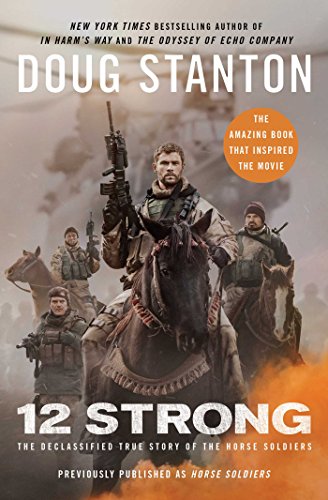 12 Strong: The Declassified True Story of the Horse Soldiers by Doug Stanton (ISBN: 978-1-5011-7995-2) tells the story of the earliest American soldiers to go into Afghanistan after the attacks that rocked America. The book starts with the airplanes flying into the World Trade Center and the reactions of the Army Special Forces soldiers who would eventually be the first to respond. The reader learns quite a bit about the lives of the twelve guys to go into Afghanistan. There were a variety of backgrounds, but all were committed to serving their country and making sure the terrorists didn’t strike again. The book tells of their preparations, some of which were rather unorthodox, including buying things from local stores or ordering supplies from catalogs. Actually getting into Afghanistan was a complicated matter, even with bases nearby in Uzbekistan. The helicopter rides from Uzbekistan to Afghanistan were harrowing experiences with pilots flying blind in unfamiliar territory with unfamiliar weather patterns. They eventually made it, though, and then the soldiers got to doing what they were trained to do. It wasn’t just fighting, though, as they were also trained to adapt to local conditions and get in the heads of the people they would be fighting with and against. They had to make allies out of temperamental Afghan warlords. The book portrays this as happening fairly easily and quickly, which may have been the case, but the men expressed a lot of trepidation about how their interactions with the Afghan leaders would go and were grateful for the American firepower that backed up what they were claiming they’d be able to help with. The initial American soldiers were careful to remain in their advisory roles and let the Afghans run the war. This also built respect and trust, and was a key to both building alliances and successful military action. The special forces soldiers were convinced that their work in Afghanistan was so successful because it was really the Afghans’ fight against the Taliban — America was just helping. One subplot, if it can be called that, in the book is the story of John Walker Lindh, the American who joined the Taliban. He was a prisoner that some of the soldiers in the book came in contact with. The book closes with happy reunions for the soldiers after completing their tour of duty, but then some must turn around and go to Iraq. They answered the call of duty, but most did not see the war in Iraq in the same light as that in Afghanistan, and it ended in the loss of life for some of them. They didn’t see the same system in Iraq, where the Americans were simply advisors and the suppliers of firepower, and that bode badly, according to them.
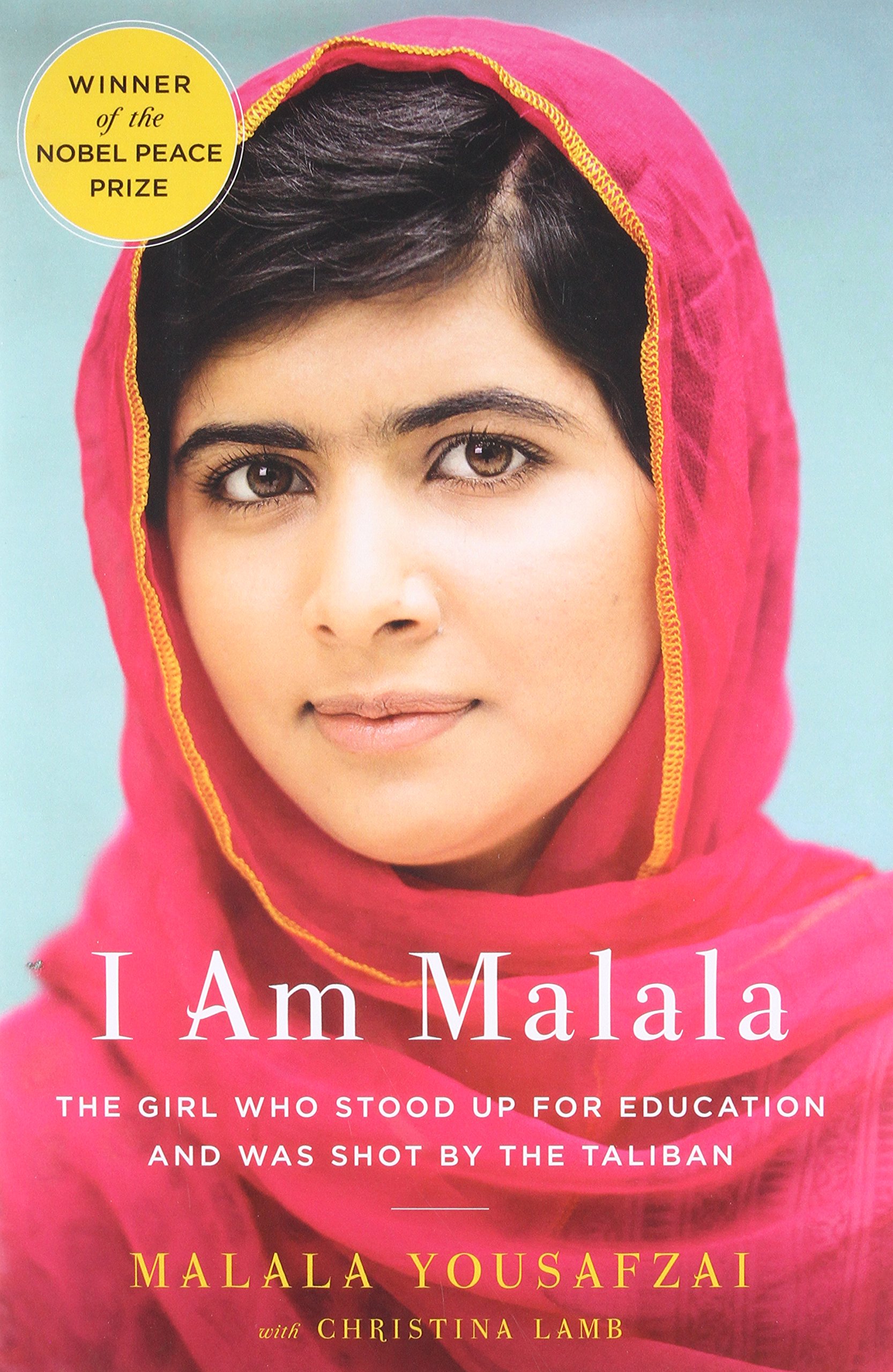 I Am Malala by Malala Yousafzai (ISBN: 978-0-297-87092-0) is the story of the schoolgirl from the time she was a little girl to the beginning of her recovery in England. The book starts with her young childhood and takes the reader through day she was shot in great detail. Interwoven into her discussion of cricket with friends, friendly competition among classmates, and trips to ancestral villages to visit extended family are brief lessons on Pakistani history and geography, which adequately set the stage for Malala’s life and what would become important to her as she got older. Far away from the bigger cities where more liberal attitudes existed, life in the villages of Swat went on much like it had for centuries, following traditional Islamic custom. Malala’s father was a trend-setter in many ways and surrounded himself with others who wanted to see progress in the field of education. He believed everyone should have an education. He also didn’t have a lot of use for many of the traditions that prevented women from freely moving about, going to school, or otherwise expressing themselves. His oldest daughter followed in his footsteps and was nationally prominent by the time she was of junior high age, having won a few national awards, having met with various Pakistani dignitaries on the way. She enjoyed school, enjoyed learning, and wished everyone had the same opportunity. She saw how the lack of such opportunities negatively affected others in her community, including her own mother, who was illiterate. She and two others were shot by Taliban gunmen in 2012, and because she needed long-term intensive care and was under continued threat, she and her family were evacuated to the UK, where they have lived ever since.
 In It Is about Islam (ISBN: 978-1-5011-2612-3) by Glenn Beck, part of Beck’s “Control” series (although I’m not entirely sure because it doesn’t fit the government overstep discussion that is so central to the other two books in the series), the reader is given a crash course in Islam, then typical media and government lies about Islamic extremism (Beck uses the word “Islamism” for this) are discusses and exposed, and then Beck gives a couple basic suggestions on how to move forward. Based on my own understanding, the background information was solid. I was intrigued to learn about the contact early Americans had with Islam and the process they went through to properly educate themselves about it. The “Lies” section was good. It was likely easy for the research team to gather the material. There was no need to go into statistics or anything like that. Simply gathering material from the Koran, the Hadith, and the words of the extremists themselves, did it and showed just how the extremists come up with what they believe. Finally, there were a couple suggestions on how people should arm themselves with real information and not be willing to be stuck with what the media and politicians try to feed the American public.
 Bosnia: In the Footsteps of Gavrilo Princip by Tony Fabijančić (ISBN: 978-0-88864-519-7) is a travelogue that traces the route of Gavrilo Princip’s travels through the former Yugoslavia and the Austro-Hungarian Empire. Set largely in the modern-day Balkans, the book uses Princip and his story as a way to understand the region’s complicated history and its rather sticky present through observation, interviews, and referencing historical sources. The author, rather sympathetic to Princip before undertaking his research and travels, was also optimistic at the outset about the chances for the various ethnic and religious groups of the former Yugoslavia to mend things up a little bit. By the end of his efforts and the end of the book, after traveling through thick forests, high alps, Mediterranean coastline, and the smog of big cities, he has changed his tune on both counts, considering Princip to have misjudged the impact of his actions, and not just misjudged, but having brought about more harm than good as well as coming to the realization that the peoples of the region, harboring some of the same prejudices and stereotypes as those held about 100 years ago as WWI broke out, aren’t breaking out of those molds any time soon.
  Leon Aron, author of Russia’s Revolution: Essays, 1989–2006 (ISBN: 978-0-8447-4242-7), was always interested in Russia because he was born in the USSR. Although he emigrated and came to America after the Soviets started letting Jews leave, he remained interested in his homeland and became a respected commentator and scholar on the land of Peter the Great, Ivan the Terrible, Stalin, and now Vladimir Putin. Aron has written extensively on all things Russia, and in this book, he compiled essays that take the reader through life in Russia from the early days of Boris Yeltsin through the middle years of Putin’s first term in office as Russia’s president. Aron describes Yeltsin and his democratization efforts. He is quite a fan of Yeltsin, praising his statesmanship and ability to hold together a country that had partially fallen apart and threated to completely implode on a daily basis. Aron touches on every aspect of Russia reborn, including food, oil, politics, oligarchs, literature, the military, and international relations. All of these vastly different aspects of life in the post-Soviet Russia give an idea of what was happening in the country at the time the essay was written. Aron finishes up his compilation with discussions of Putin, a — to put it mildly — controversial figure and one of Russia’s largest struggles during the 1990s, Chechnya. Aron’s point, even with the various negatives that Putin and Chechnya seemed to usher in, was that much good has happened since the Soviet Union fell apart in Russia and even though there have been and continue to be bumps in the road (and they’re often big bumps), things are probably going in the right direction, but the only way to tell is to wait and see. The West didn’t get to its heights in 20 years, and Russia won’t either.
 The collection of essays contained in Volatile Borderland: Russia and the North Caucasus (ISBN: 978-0-9830842-1-1), edited by Glen E. Howard, is an attempt at shedding some light on the movers and shakers of the Russian North Caucasus, what the future holds, and what is driving current reforms, repressions, and realities. The authors are experts on Russia and the Caucasus, all either professors, journalists, or similarly qualified experts and policy advisors. Chechnya, Dagestan, Krasnodar, and Sochi and the various peoples that inhabit them are prominent players in the analysis, but exotic-sounding places like Adygeya and Kabardino-Balkaria also garner significant attention because they form a buffer zone between the explosive and more Islamic eastern North Caucasus and the rest of European Russia. As with most places in the world where high unemployment, Islamist thought, and rampant corruption have mixed, the North Caucasus is a tinderbox. The Russian authorities have tried a mixture of ridiculously high federal subsidies and oppressive, totalitarian-style control, which seems to be tenuously holding things under control, but most of the essayists agree that this situation could go at any time.