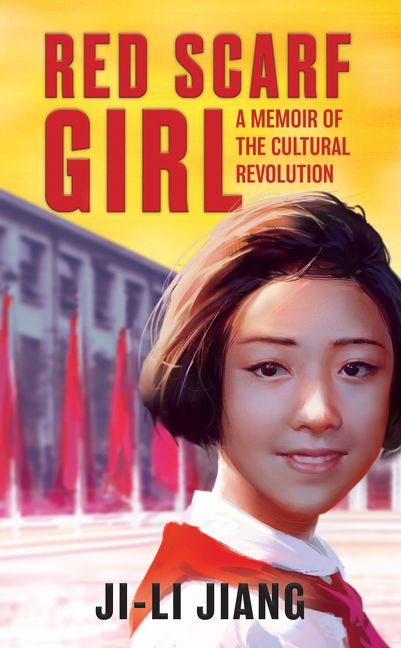
 Red Scarf Girl: A Memoir of the Cultural Revolution by Ji-li Jiang (ISBN: 978-0-06-446208-2) details one of the worst parts of China’s Communist history, the Cultural Revolution. The book, a memoir, is told from the viewpoint of the author as the events unfolded. Her family history included a well-to-do grandfather, a Muslim grandmother, and a father who had joined the Communist Party in its infancy when it was still illegal and then had a falling out with its leaders. This put her at a disadvantage when Mao began the Cultural Revolution to retain his power (power struggles seem to be a fixture of Communist regimes) since her family was not considered “red” enough. Ji-li was a true believer in Mao and the Revolution at the beginning of the book, but as things went along and friends and neighbors were denounced, goals and dreams shattered, lives ruined (or lost), and her own family affected, she came to understand that devotion to a cause or a leader should not trump one’s devotion to the truth and to one’s family. Like many Chinese, she was later disappointed when she found out that the Cultural Revolution and all the damage it had done was not really to advance Communism, but to allow Chairman Mao to hang on to power. Ji-li paints a descriptive picture of what life was like before the chaos, and it actually didn’t seem too bad. When the Cultural Revolution starts, though, things change quickly and they change drastically, as all things old are thrown out. Kids can no longer read comics, neighbors stop talking to each other and some look for ways to harm neighbors and former friends. School is changed, favoring class status instead of merit. Houses are ransacked, people imprisoned, beat, sometimes killed. Hope is lost for many. Some, like Ji-li’s father, resist heroically, never admitting to the accusations leveled falsely against him. Life eventually settles down, but it’s never the same again, and even to a young girl, it’s obvious that there were freedoms and opportunities lost.
I found the book to be quite interesting and informative even though it is written as juvenile literature. For those who know more about the history of China, the experience might not be the same. I found it interesting to see so many similarities between other authoritarian regimes (I couldn’t help but remember the Taliban blowing up ancient statues in Afghanistan as I read about Chinese Red Guards destroying anything they felt like labeled “Four Olds”) and Leftist ideologies (anti-religious views and class and racial tension, for example). It was sometimes a little jarring to read simply because the author narrated from her point of the view as the events unfolded. This meant there is a lot of pro-Communist, even pro-Cultural Revolution sentiment expressed. As noted, this wanes as the story progresses, but it sometimes makes one have to stop and think as one reads. I see having to think things through and a need for analysis and evaluation as a good thing, though. Here, the analysis of the author’s experiences leads to a greater appreciation for freedom and liberty, as well as, hopefully, a greater commitment to protect those values and to be kind to those around us.

|
This work, including all text, photographs, and other original work, is licensed under a Creative Commons Attribution-NonCommercial-NoDerivatives 4.0 International License and is copyrighted © MMXXI John Pruess. |


