Eastern Europe is, in general, a fascinating part of our world. There are many reasons for this, ranging from greasy, tasty street food to dilapidated concrete housing blocks, as well as the contrasts and conflicts such as earthy traditionalism coupled with rich and vibrant cultures that have produced many world-class authors, artists, and musicians that are embedded in the cultures of the peoples of Eastern Europe. It seems that conflict, in one form or another, has also been a fairly stable part of a history otherwise riddled with instability thanks to imperial conquest, religious disputations, and the natural result of a mixing of conflicting cultural values because of the region’s geographical location between the East and West. The countries of the former Yugoslavia all, to one level or another, suffer from these divisions and contradictions. Bosnia and Herzegovina may be at the forefront when it comes to so many opposing ideas, views, and cultures shoved into one country’s borders. The Balkans’ similarities to the Caucasus have intrigued me for a while, so learning more about the history of the Bosnian people seemed like a natural fit for my curiosities.
 Bosnia: A Short History by Noel Malcolm (ISBN: 0-8147-5561-5) explains just who the Bosnians are and who they have been throughout history. Their history, like those of all the peoples of the Balkan region, is muddled thanks to it being at the crossroads of the East and the West. Although rarely sought after militarily, both the Ottomans and the Hapsburgs brought it under control at different times. Before that, though, Bosnia had carved out its own identity seperate from its neighbors, Croatia, Serbia, and Slovenia. Bosnian history goes back to the ancient Illyrians and continues through Rome, Byzantium, and various Slavic tribes and rulers. It continued, to a certain extent, in the short time period between World War I and the introduction of Communism. It made it through the fall of Yugoslavia and continues its unique fractured and rather dysfunctional way today. Religion, both Christianity and Islam, as well as earlier, pagan forms of worship, have played a major role in the forming of the Bosnian people. The history, like much of Eastern Europe, is fragmented and often overly complicated, but it is rich and features a people who present something unique to the world.
Books about obscure topics have a tendency to by dry. That only applied to this book in the section about the Bosnian Church. Malcolm decided to dedicate an entire chapter to the church, which, in my opinion, was a debatable choice. The subject matter was definitely relevant to the book’s overall argument, but there just wasn’t enough material to keep things moving in that section. One would really have to be a specialist in the field to care enough to get into that chapter, which dragged because of arcane details about an enigmatic at best religious organization. Other than that one flaw, I thought the book was interesting and presented on a relatively small number of pages a lot of essential information about the region and its people. Given that the Balkans are such a complex collection of peoples, histories, religions, and modern states, it was quite a feat to get it sorted into coherent chapters and present any kind of argument. Malcolm tried to make two major arguments. First, Bosnians were and are a distinct ethnic group in the Balkans. They are not some kind of off-shoot from the Serbs, Croats, or any other people. They have a clear and distinct history. This argument I think he succeeded at making. Second, he contended that Bosnians have lived in relative peace with their neighbors, the Croats and Serbs, and the modern-day state of affairs, which led to the wars and attendant war crimes after the break-up of Yugoslavia were actually anomalies. I did not quite agree with his assertion because whatever peace did exist, it seemed to live under a surface taught with tension. Maybe the Bosnians did not enter into out-and-out warfare with their neighbors on a regular basis, but they certainly did not go out of their way to cooperate or increase connections. In fact, his drawn-out bit about the Bosnian Church seems to support my idea in that they went for their own church not because of any great theological differences as compared to Orthodoxy or Catholocism, but simply because they preferred isolation from their neighbors, who presented a real and present threat. The book was informative and makes one think, no matter the conlusions the reader reaches.
Bosnia: A Short History by Noel Malcolm (ISBN: 0-8147-5561-5) explains just who the Bosnians are and who they have been throughout history. Their history, like those of all the peoples of the Balkan region, is muddled thanks to it being at the crossroads of the East and the West. Although rarely sought after militarily, both the Ottomans and the Hapsburgs brought it under control at different times. Before that, though, Bosnia had carved out its own identity seperate from its neighbors, Croatia, Serbia, and Slovenia. Bosnian history goes back to the ancient Illyrians and continues through Rome, Byzantium, and various Slavic tribes and rulers. It continued, to a certain extent, in the short time period between World War I and the introduction of Communism. It made it through the fall of Yugoslavia and continues its unique fractured and rather dysfunctional way today. Religion, both Christianity and Islam, as well as earlier, pagan forms of worship, have played a major role in the forming of the Bosnian people. The history, like much of Eastern Europe, is fragmented and often overly complicated, but it is rich and features a people who present something unique to the world.Books about obscure topics have a tendency to by dry. That only applied to this book in the section about the Bosnian Church. Malcolm decided to dedicate an entire chapter to the church, which, in my opinion, was a debatable choice. The subject matter was definitely relevant to the book’s overall argument, but there just wasn’t enough material to keep things moving in that section. One would really have to be a specialist in the field to care enough to get into that chapter, which dragged because of arcane details about an enigmatic at best religious organization. Other than that one flaw, I thought the book was interesting and presented on a relatively small number of pages a lot of essential information about the region and its people. Given that the Balkans are such a complex collection of peoples, histories, religions, and modern states, it was quite a feat to get it sorted into coherent chapters and present any kind of argument. Malcolm tried to make two major arguments. First, Bosnians were and are a distinct ethnic group in the Balkans. They are not some kind of off-shoot from the Serbs, Croats, or any other people. They have a clear and distinct history. This argument I think he succeeded at making. Second, he contended that Bosnians have lived in relative peace with their neighbors, the Croats and Serbs, and the modern-day state of affairs, which led to the wars and attendant war crimes after the break-up of Yugoslavia were actually anomalies. I did not quite agree with his assertion because whatever peace did exist, it seemed to live under a surface taught with tension. Maybe the Bosnians did not enter into out-and-out warfare with their neighbors on a regular basis, but they certainly did not go out of their way to cooperate or increase connections. In fact, his drawn-out bit about the Bosnian Church seems to support my idea in that they went for their own church not because of any great theological differences as compared to Orthodoxy or Catholocism, but simply because they preferred isolation from their neighbors, who presented a real and present threat. The book was informative and makes one think, no matter the conlusions the reader reaches.
 | This work, including all text, photographs, and other original work, is licensed under a Creative Commons Attribution Non-Commercial No Derivatives 3.0 License and is copyrighted © MMXI John Pruess. |


 Bosnia: In the Footsteps of Gavrilo Princip by Tony Fabijančić (ISBN: 978-0-88864-519-7) is a travelogue that traces the route of Gavrilo Princip’s travels through the former Yugoslavia and the Austro-Hungarian Empire. Set largely in the modern-day Balkans, the book uses Princip and his story as a way to understand the region’s complicated history and its rather sticky present through observation, interviews, and referencing historical sources. The author, rather sympathetic to Princip before undertaking his research and travels, was also optimistic at the outset about the chances for the various ethnic and religious groups of the former Yugoslavia to mend things up a little bit. By the end of his efforts and the end of the book, after traveling through thick forests, high alps, Mediterranean coastline, and the smog of big cities, he has changed his tune on both counts, considering Princip to have misjudged the impact of his actions, and not just misjudged, but having brought about more harm than good as well as coming to the realization that the peoples of the region, harboring some of the same prejudices and stereotypes as those held about 100 years ago as WWI broke out, aren’t breaking out of those molds any time soon.
 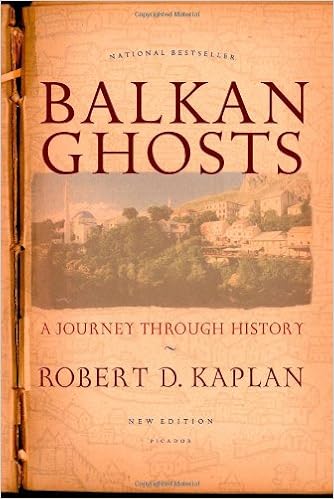 Balkan Ghosts by Robert D. Kaplan (ISBN: 978-0-312-42493-0), is self-styled as a travelogue, but is more akin to a feature story in a national magazine on current affairs. Kaplan weaves his extensive travels and living experience in the region and the accompanying interviews and everyday events with historical perspective and the relevant biographical information pertaining to the important figures in the Balkans’ history, his “ghosts.” Kaplan’s definition of the Balkans is a bit wider than most Americans’, so not only the former Yugoslavia, but Romania, Bulgaria, and Greece, too, are included in the discussion of this fascinating geographical region. Each country and each nation (ethnic group) has a few figures in its past who lived in such a way and made decisions in such a way as to continue to influence the way things are done and the way people think. With the exception of Greece, the Balkans also deal with a specter of a different type, the continued need to deal with the harsh consequences of communist dictatorships that broke people and destroyed countries immediately after the Nazis and fascism gave the same thing a whirl. It’s worth noting that the Nazis followed right on the heels of the Hapsburgs, who were, in most people’s estimation, better rulers than the succeeding ones, but on occasion no less ruthless. The great figures and great histories of the various peoples are presented with all the raw emotion that is associated with Balkanization, and Kaplan points out that since the histories are great, the people pick those moments when their histories were at an apex and claim that cultural, linguistic, and territorial summit as the way things should be now before any other discussions can be had. It puts them all in a hard place, but Kaplan argues that considering all the things these groups of people and these countries have been through, there’s really no way but up, although, as his reference to Shakespeare alludes to, it might be a painful process.