I didn’t know much about “conscientious objectors” before hearing about this book (and the related movie). I think the term was abused during the Vietnam era when many people did all they could to not serve in the military, but I honestly know very little. That's what made reading this book so interesting — a way to learn more about this, especially what it originally meant and how someone made it work for them and ultimately was of great service to his fellow countrymen. As someone who is active in one's church, the religious aspect of the story was also compelling, as such things seem to make the stories seem more relevant.
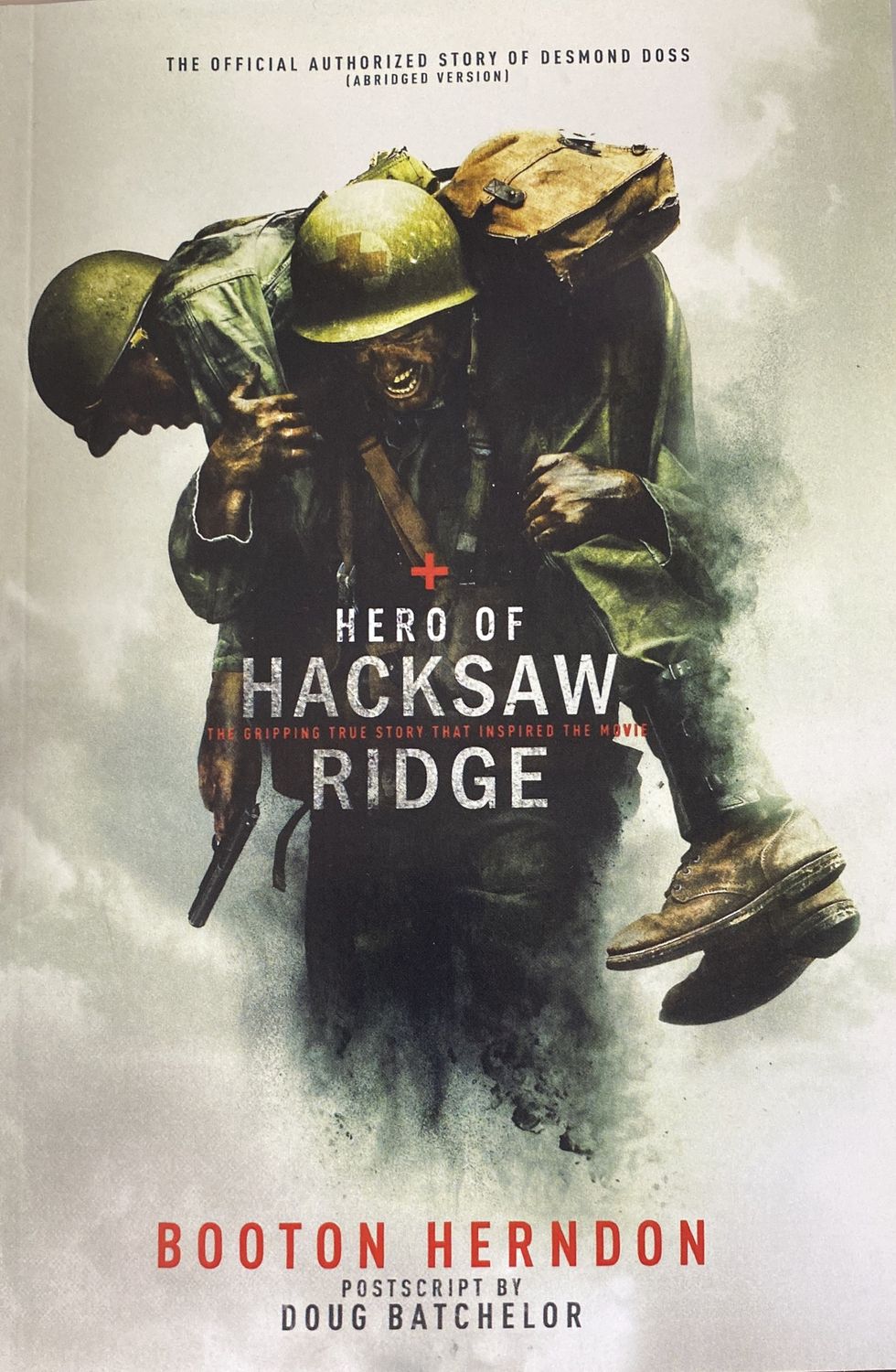 Hero of Hacksaw Ridge: The Gripping True Story That Inspired the Movie (ISBN: 978-1-629131-54-2) by Booton Herndon is an abridged version of the story of Desmond Doss, a medic who served in the U.S. Army during World War II and saw action in the Pacific theater as the army advanced on various Japanese positions. What makes the story unusual is that he was awarded the Congressional Medal of Honor and not once during his training or active duty did he use arms since he was a Seventh-day Adventist and believed it was wrong to bear arms. The story chronicles his time in the military from his joining to his discharge after being wounded in action in Japan. Doss is unwaveringly strong in his religious convictions, including an extremely temperate and patient attitude with those around him. He displays great faith in standing up for his beliefs when those around him threaten him and ridicule him at every opportunity. He doesn't hold a grudge when it comes time to perform his duty, and more than once wile fighting in the Pacific, he helps and saves the lives of others, usually at great risk to himself. The story ends with what truly are “gripping” details of battles on Okinawa where he saved likely around 100 lives while himself being injured. He is then awarded the much-deserved medal and is able to return to civilian life. The book also includes a post-script with information about Adventist beliefs (many are similar to those held by members of the Church of Jesus Christ of Latter-day Saints).
I found the short book to be extremely interesting and often an exciting read. The persecution he experienced, especially during training was disheartening, and I consider myself lucky to have never experienced anything like that. I always envision myself being strong like he was, and pray for that to be true. The combat scenes were intense, but well-written and not too graphic. There was also a lesson to be learned in the combat scenes because by then, his fellow soldiers knew Doss and respected him, in part because he was uncompromising his his duty, both to God and his country. He was no longer ridiculed, but respected. As is usually the case, sticking to one’s beliefs results in respect in the long run. It was also refreshing to see a person who was able to understand how he could serve the country without compromising his beliefs. One has a clear duty to one's nation, and it's too bad that so many peoople don't understand that today.
Hero of Hacksaw Ridge: The Gripping True Story That Inspired the Movie (ISBN: 978-1-629131-54-2) by Booton Herndon is an abridged version of the story of Desmond Doss, a medic who served in the U.S. Army during World War II and saw action in the Pacific theater as the army advanced on various Japanese positions. What makes the story unusual is that he was awarded the Congressional Medal of Honor and not once during his training or active duty did he use arms since he was a Seventh-day Adventist and believed it was wrong to bear arms. The story chronicles his time in the military from his joining to his discharge after being wounded in action in Japan. Doss is unwaveringly strong in his religious convictions, including an extremely temperate and patient attitude with those around him. He displays great faith in standing up for his beliefs when those around him threaten him and ridicule him at every opportunity. He doesn't hold a grudge when it comes time to perform his duty, and more than once wile fighting in the Pacific, he helps and saves the lives of others, usually at great risk to himself. The story ends with what truly are “gripping” details of battles on Okinawa where he saved likely around 100 lives while himself being injured. He is then awarded the much-deserved medal and is able to return to civilian life. The book also includes a post-script with information about Adventist beliefs (many are similar to those held by members of the Church of Jesus Christ of Latter-day Saints).I found the short book to be extremely interesting and often an exciting read. The persecution he experienced, especially during training was disheartening, and I consider myself lucky to have never experienced anything like that. I always envision myself being strong like he was, and pray for that to be true. The combat scenes were intense, but well-written and not too graphic. There was also a lesson to be learned in the combat scenes because by then, his fellow soldiers knew Doss and respected him, in part because he was uncompromising his his duty, both to God and his country. He was no longer ridiculed, but respected. As is usually the case, sticking to one’s beliefs results in respect in the long run. It was also refreshing to see a person who was able to understand how he could serve the country without compromising his beliefs. One has a clear duty to one's nation, and it's too bad that so many peoople don't understand that today.
 | This work, including all text, photographs, and other original work, is licensed under a Creative Commons Attribution Non-Commercial No Derivatives 3.0 License and is copyrighted © MMXIV John Pruess. |


 To do that, I read the Qur’an (ISBN: 978-0-19-953595-8), translated by Abdel Haleem. The Koran (there are lots of possible spellings for this) is Islam's holy book, purported to be a recording of revelation given to the prophet Mohammed (lots of spellings for his name, too). It focuses on the nature of God as the only God, as opposed to idols, pantheons of pagan gods, or even God as Christians know him, the Father of Jesus Christ. The Koran talks about Mary and Jesus, but Jesus is not God’s Son. It talks about Muslims’ duties to the poor and orphans. It discusses the afterlife and the resurrection. It warns evildoers against their course of action. There are some details about domestic life, finances, and there is the well-known injunction to prayer, which results in the call to prayer that happens five times a day wherever there is a functioning mosque. There are some instructions regarding Muslims’ dealings with non-believers, or infidels.
 The Power of Positive Parenting by Glenn I. Latham (ISBN: 1-56713-175-1) doesn't have all the answers either, but after reading it together with my wife, we decided that it has many of the answers, and even where it doesn't it tends to point the reader in the right direction. The book is full of guidance on how to deal with all kinds of different behaviors that children (and adults) engage in. There are sections for younger kids, for teenagers, for small problems, for sibling rivalry, and for larger, more destructive behaviors. There are a couple over-arching themes in the book that course through the suggestions for each kind of problem. One is to ignore things that doen't really cause any harm since most people just want attention and will take it however they can get it. Igoring kids’ whining, for example, is the most effective way to get them to stop. The other thing that was presented over and over was the need to positively reinforce good behavior. Default parent settings seem to be set to find negative behavior and call it out. What about the good? Fidning and reinforcing good behavior gives kids the attention they need and teaches them that good behavior will be rewarded.
 In the early 2000s, as people in poor countries got desparate and the security situation deteriorated in many parts of the world, piracy made a comeback. There was nothing romantic about it, and it didn't involve the big ships with masts and sails, but usually small boats and a couple Russian-made machine guns instead of swords. A Captain's Duty: Somali Pirates, Navy SEALs, and Dangerous Days at Sea (ISBN: 978-1-4013-1044-8) by Richard Phillips with Stephan Talty tells one such story with a happy ending for the good guys. Phillips and his crew made international news when Somali pirates boarded the ship he was captain of and took him hostage. He preserved the lives of his crew and saved his ship, but felt it was likely that he would end up sacrificing his life for that. After a few harrowing days at sea with the pirates in one of the ship's lifeboats, U.S. Navy SEALs rescued Phillips and killed the pirates in a stroke of incredible marksmanship. The book also includes a little bit of the story of what Phillips's wife and family were going through during the ordeal.
 KGB: The Secret Work of Soviet Secret Agents by John Barron tells some of the stories of the main Soviet agency of oppression and secrecy, the KGB. It provides an overview of all the Soviet intelligence agencies, but focuses on the KGB, which the author assessed to be the brains behind all of them. After the more academic portion of the book, it recounts a few fantastic stories. Most of the stories, a few which I had read elsewhere previously, had to do with the stuff of movies. The book contains the stories of Americans who betrayed their country and of Russians who betrayed theirs. They are fascinating accounts full of sneaking around big cities, breaking into vaults, offers of money, international intrigue, “seductresses” (as promised by the paperback version’s typically sensationalist cover art), and, of course, spies. It was interesting to read of a disgruntled U.S. Army soldier, his former prostitute wife, and his giving the Russians access to something they likely figured was impossible to access. I was also really intrigued by the stories of Russians and other eastern Europeans who risked it all to do what they figured was their part in the battle against authoritarianism and for liberty. One interesting story was that of a Czech who was sent to Canada by the Russians, but who ultimately decided that all he had been taught in years of intense training was not true now that he’d been in the West and seen how things really worked.
 We Die Alone (ISBN: 978-1-59921-063-6) by David Howarth, re-tells the true account of a man surviving the harsh Norwegian winter using his own survival skills and the goodwill of his fellow countrymen as they resisted Nazi occupation. The Norwegians worked together with the English to bring people and supplies from England to Norway to sabotage the Nazis. The title of the book is taken from the idea that while sent up as a team, the saboteurs would split up, if necessary, in order to carry out their mission. The book’s hero, Jan Baalstrud, was betrayed by a local, maybe not intentionally, helped self-destruct the sabotage materials, and then escaped the Nazi patrols on the hunt for him. He used athletic prowess and backcountry know-how to stay away from the Germans, but could eventually go no further after a debilitating blizzard trapped him. Locals loyal to their country helped hide him and then help him escape the Germans, who seemed to be narrowing in. Baalstrud spent a few harrowing weeks on his own in snow caves, and his body suffered greatly, including frostbitten limbs, but his will to survive, although sometimes tried, never died, and he never gave up, eventually being pulled to safety in Sweden by Lapps and their reindeer sleds.
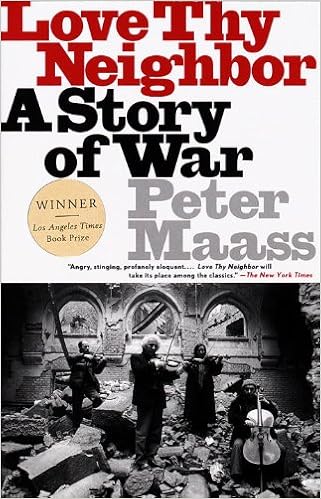 Love Thy Neighbor: A Story of War (ISBN: 978-0-679-76389-5) by Peter Maass is a collection of notes from the author’s time in Bosnia & Herzegovina as a journalist during the Bosnian War, but since the stories are all told from his point of view, it reads like a memoir. There isn’t a lot of continuity, and it just jumps from one story to another, but roughly follows the timeline of the war. The bit of continuity that is there is Maass wondering how people can forget so easily the need to respect those around them. The stories are very real and personal, as Maass interacts with fellow jouranlists, soldiers on both sides, government officials, and what would normally be called everyday people, but can’t be in this situation because there was no such thing as normalcy in the Bosnian War. Maass interviewed a Serb sniper, Bosnian soldiers, dealt with a Serb checkpoint — ultimately unsuccessfully, had Christmas dinner with a Croat family in Sarajevo, experienced what it was like to be under attack while in a gas station, and was, like most who dealt with the Bosnian War, flabbergasted by the impotence of the so-called world superpowers to get anything accomplished in Bosnia. His account holds nothing back and it presents the war in all of grizzly horror that is war.
 This Is Serbia Calling: Rock 'n' Roll Radio and Belgrade's Underground Resistance by Matthew Collin (ISBN: 1-85242-776-0), tells about a few of the people who tried to change the minds of Serbians during the war with Bosnia & Herzegovina. I found the very idea of someone going against what Serbia's ironically-named (his first named means free) despot, Slobodan Milošević, worth reading about. The book tells the story of how what is now Serbia's second-largest TV and radio station came to be, how it presented a constant message that went against the ultra-nationalist propaganda of the Serbian ruler. It was often a dangerous message, one that resulted in jail time, seized property, and the constant fear of death and beatings. Most of the radio station's personnel suffered only lightly, but others in the political opposition were murdered. B92 struggled to present a message that would galvanize the people of Serbia against the war, and once that was over, against the government that had brought so much trouble to their land. B92 was no great supporter of NATO or the West when they started bombing Serbia during the Serbian campaign in Kosovo, but mostly stayed on message as they continued to denounce the their corrupt president. They brought a message of hope and freedom to the people, which ultimately resulted in the people of Serbia taking to the streets and quickly, with minimal bloodshed, throwing Milošević out of power.
 Blood and Vengeance: One Family’s Story of the War in Bosnia by Chuck Sudetic (ISBN: 978-0-393-33548-4) is, indeed, and incredible story. It follows one Bosniak (Muslim) family from the final few years of Yugoslavia through the end of the Bosnian War. The information about life in an obscure village on the border of Bosnia and Serbia serves a great purpos in the book; it sets up what life was like in so many places. Ethnic hatred simmered under the Communist cover of “brotherhood and unity.” When the lid provided by party was gone, it boiled over and escalated quickly. Based on personal interviews in the first few years after the war, the stories of fights, flights, bomb shelters, forced marches, and genocide are raw and personal. The Muslim villgers, chased from their homes, their neighbors floating face down in Bosnia’s famous Drina river, seek shelter in neighboring villages progressively farther and farther from the fields and dirt paths of their nativity before finally reaching Srebrenica, where many would meet their ultmate demise. Along the way, they face a very personal enemy, their former friends and neighbors. At Srebrenica, the Bosniaks think they have found relief since the UN has provided for them a safe zone. They soon find out that the realities of international policy are far from cut and dry, and the safe zone has little in common with the word “safe.” Here, Sudetic relies on articles, documents, and archive material, painting a picture of great power ineptitude. Eventually, the war comes to an end, but not without changing forever the lives of those involved, some, paradoxically, possibly for the better.
 In When Character Was King: A Story of Ronald Reagan by Peggy Noonan (ISBN: 978-0-14-200168-4), the former Reagan staffer (speechwriter), journalist, and columnist gives her take on the fortieth president. The story starts when Reagan was a kid and ends as he succumbs to the Alzheimer's and the ailments of time. One learns where he got his worldview from and how his early life influenced where he got. Reagan's father, I learned, was an alcoholic, but he still imbued his son with principles that served him well in seeing the greatness in all people and in upholding America's tradition of equality. Reagan's mother was a strongly and actively Christian woman, which also became a major part of his character. He believed in God and believed God wanted to be part of people's lives. One reads about Reagan's involvement in Hollywood. He was arguably an up-and-coming star, but never went big time because he got involved in the actors' union and the more political side of things. His political career was dogged by accusations of being just an actor, and acting likely helped him as he campaigned, but his real talent was likely in speechmaking to begin with. The book recounts Reagan's entry into politics. He was not, it seems, overly ambitious, but saw his involvement as a chance to help people, and that's where character came in. Reagan had standards and stuck to them, providing for people a stable and strong standard behind which they could rally. He was unabashedly religious, had no tolerance for racism, and knew that there was a distinct difference between democratic forms of government with capitalistic and those of the "
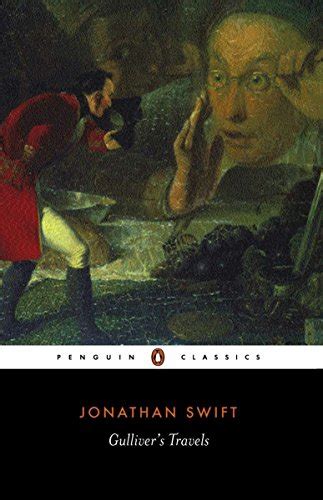 Gulliver’s Travels (ISBN: 0-14-143949-1) by Jonathan Swift is an interesting novel that was originally published as political satire. Now far removed from the contentious political scene of XVIII-century Great Britain, it has withstood the test of time and continues to be popular. This is mostly thanks to the first part of the book, where the book’s hero, Lemuel Gulliver, visits Lilliput, home to a humanoid race only inches tall. Gulliver has a number of adventures in this part of the world, including participating in a battle and putting out fires, which saves the island’s royalty. He also ends up being trapped in some distant land where the inhabitants are giants, which also provides for some adventure, but mostly being carried around in a box by a girl. Gulliver’s third voyage features a few different islands and a people who have figured out how to live on a machine that perpetually floats in the sky, landing only if the inhabitants are trying to crush the people on the ground below. Finally, Gulliver finds himself in a land where the ruling inhabitants are horses. The most inferior race in this quarter of the world are essentially humans, but in a wild and feral form. In each place, Gulliver is exposed to differing methods of government and people. He seems to learn from each, although always very patriotic when it comes to his homeland. Finally, after his visit to the land of the horse beings, he is disgusted with mankind, claiming it to not think and to be disgusting and wild in nature.
 Rise and Fall by Milovan Djilas (ISBN: 0-15-177572-9) provides one man’s (Djilas (Đilas) himself) view of the Communist rise to power in Yugoslavia. Since he was one of Tito’s closest aides and advisors, he provides an inside perspective that is largely unrivaled. He also chronicles what he considers the falling away of the Yugoslav Communists from their revolutionary ideals. As he comes to realize that Communism, as implemented in Yugoslavia, isn’t what was promised, he becomes disillusioned with it, enough so that he published material critical of Tito and the Communists, leading to nine years as a political prisoner. Djilas covers a lot of ground in a little over 400 pages. He gives a short account of the wartime Communists, but mostly focuses on life under Tito after the war. He talks about foreign relations, internal politics, bizarre Communist Party perks like special stores for the elite party members, the cult of personality surrounding Tito, and the oppressive nature of a totalitarian or dictatorial political system. Interestingly, Djilas’s falling out was not with Communism; it was with what Communism had developed into in Yugoslavia. The reader even gets a small glimpse into Djilas’s personal life as he discusses his marriages. Finally, the totalitarian oppression claims the once high-ranking government official and he spends almost a decade as a prisoner because of his ideas, not necessarily even that radical.
 To the Rescue: The Biography of Thomas S. Monson by Heidi S. Swinton (ISBN: 978-1-60641-898-7) chronicles the amazing life of service that President Monson has led from an early age through the present day. The timeline for the biography is straight forward, starting with his early childhood and ending with his time as the leader of the Church. He learned from parents and family around him in what was, at the time, a typical childhood. It follows him through high school, a mission, early marriage, employment, and a variety of Church callings. Along the way, there are many familiar stories, but there are sometimes some additional details that weren’t always part of the many sermons President Monson has given. There were also some additional stories. It was interesting to read about President Monson’s family a little bit and about his professional experienes. There was a lot of time spent on President Monson’s service as an apostle in what was then East Germany. The Church history aspect was interesting, as it was with some of the other episodes from his life, but they often seemed more like pioneer stories because of the great faith shown and the hardships endured. What was consistent no matter what part of his life was being discussed was the dedication he showed to serving others, whether that be in his family or those around him. President Monson was never too busy to help someone out, talk to them, visit them, give them a blessing, or share time and possessions with them. It becomes abundantly clear as the life of this man is chronicled that he understands very well that Heavenly Father is serious when He says that the worth of souls is great in His sight. President Monson has cultivated that genuine love and concern that is a trait of our divine Father and made it a part of his own personality.
  Surviving Hitler: The Unlikely True Story of an SS Soldier and a Jewish Woman by O. Håkan Palm (ISBN: 978-1-60907-847-8) tells the story of two of the everyday people that made it through the horrors of war. A memoir- or journal-style narrative takes the reader through the lives of the young woman, Agnes Erdös, a Hungarian ethnic Jew, and Gustav Palm, a Norwegian, as World War II placed its heavy imprint on their lives. The Germans invaded Norway and Gustav joined the German army. He was a good soldier who had luck on his side a couple times. Agnes was raised in a well-to-do family, but as Hungary fell to the occupying forces, her life abruptly changed, and she ended up as one of the many in the Nazi concentration camps. Sheer determination, coupled with a strength fortified by faith in God, got her through that most awful experience. Through a series of events, both of them found themselves in Scandinavia after the war, trying to put their lives back together. They met each other, fell in love, and were married. Part of the healing process was a search for ultimate truth, and they found the
  In It Is about Islam (ISBN: 978-1-5011-2612-3) by Glenn Beck, part of Beck’s “Control” series (although I’m not entirely sure because it doesn’t fit the government overstep discussion that is so central to the other two books in the series), the reader is given a crash course in Islam, then typical media and government lies about Islamic extremism (Beck uses the word “Islamism” for this) are discusses and exposed, and then Beck gives a couple basic suggestions on how to move forward. Based on my own understanding, the background information was solid. I was intrigued to learn about the contact early Americans had with Islam and the process they went through to properly educate themselves about it. The “Lies” section was good. It was likely easy for the research team to gather the material. There was no need to go into statistics or anything like that. Simply gathering material from the Koran, the Hadith, and the words of the extremists themselves, did it and showed just how the extremists come up with what they believe. Finally, there were a couple suggestions on how people should arm themselves with real information and not be willing to be stuck with what the media and politicians try to feed the American public.
 American Sniper by Chris Kyle (ISBN: 978-0-06-223886-3) is a book that does just that. It also visits, in a very personal way, the other realities of being a soldier, such as separation from friends and family, and the stress that comes from that and from always being in such high-adrenaline situations in war zones. The book is the first-hand account of a Navy SEAL and his experiences throughout his time in the service of his country and his fellow man. It follows him from high school to his helping form a company to train other security professionals once he got out of the military. Most of the details in the book come during his time as a sniper in Iraq. He explains how the American soldiers went about their business in the hostile areas where they operated. He explains what goes through a soldier’s mind before, during, and after action. He goes through the extremely painful process of losing a friend in battle. The book also describes the heroic efforts of those who were seriously injured to work hard to overcome their new disabilities and make something of their lives. Readers are let in, to a certain degree, to the psyche of the author as he describes, mostly in general terms, his philosophy on life and on some of the things he did while in the Navy. There’s a little fun along the way, but the journey is mostly hard work, a lot of sweat, and quite a bit of blood, too.
 Fyodor Dostoyevsky’s the
  In Spy Dust: Two Masters of Disguise Reveal the Tools and Operations That Helped Win the Cold War (ISBN: 978-0-7434-2853-8) by Antonio and Jonna Mendez with Bruce Henderson, spy dust itself plays a rather minor role. The two authors and their craft, disguises, get the majority of the attention. The story follows both authors in their CIA careers a few years before they came to know about spy dust through an operation that saw them defeat the theretofore undefeated powder. Antonio was a master of disguise with years and years of experience; Jonna more of an extremely talented up-and-coming star in the CIA. The book focuses on their teamwork to exfiltrate someone they claim was a well-connected and high-placed Soviet spying for the U.S. The operation included a handful of Americans and the Russian and his family. They used all their disguise know-how, which includes a lot of things that aren’t so much about disguises, but simply about how one ports oneself and how people are not able to notice every little thing if what one is doing mostly follows the normal routine. The daring operation defeated the Russians’ spy dust and got everyone out of the country safely.
 War and Peace (ISBN: 978-0-19-953605-4) by Leo Tolstoy (Louise and Aylmer Maude translation) is arguably what we would call historical fiction today. The only difference is that it was written soon after the events it depicts and likely had some direct impact of one sort or another on its author. He definitely paints his version of the events surrounding Napoleon’s campaigns. There is a lot of Tolstoy’s philosophy woven into the story, but essentially, the story follows a few main characters through their youth and into adulthood as they embark upon their careers and family life. Tolstoy’s characters are varied and present all kinds of different people with all sorts of different character traits. The reader also gets to become acquainted with the characters in all kinds of situations, which lets one see the best and the worst of the characters. There are hundreds of members of the supporting cast, some playing a more important role than others. With so many people in the book, it’s probably a legitimately arguable point just who the main characters are, but I think it was Pierre and Natasha, the two that one sees from beginning to end in the book. Natasha, young, beautiful, and fun-loving, is the object of just about every young man’s fancy. She falls in love, spurns her fiancé for the temporary affection of a married man and known womanizer, later repents of that mistake, but must suffer when, seemingly through chance, her original fiancé, wounded severely in the war, is evacuated from burning Moscow along with her family and dies as they make the trek. Pierre as a young man is short-sighted, rash, and searching for something more in life than the dissipated life he leads drinking, playing cards, and chasing women. Throughout the book, one sees him struggle to figure out what life is about. He tries Masonry, civil service, an ill-advised marriage, and philanthropy. None of them really do it for him. When captured by the French while observing the battles near Moscow, he meets a peasant soldier from whom he learns a lot about the meaning of life. After Napoleon’s retreat, the changed Pierre is re-acquainted with Natasha, and eventually they go on to form a happy family.
 In Conform: Exposing the Truth about Common Core and Public Education by Glenn Beck, Kyle Olson, and Kevin Balfe (ISBN: 978-1-4767-7388-9), the authors attack the federal government- and union-led approach to education in America. The first half of the book is dedicated to debunking the typical arguments one hears about why public schools are the only way to go. They also focus on the idea that the government should control schools, curricula, and even what students eat. They present argument after argument showing that centrally-controlled education fails the vast majority of students outside the average and even a good many who are average. They show that the current system encourages mediocrity, whether that be in students, teachers, or the school systems themselves. Education policy is controlled by bureaucrats far removed from the process, unions who, despite what they say, care more about collecting money for their bosses than what teachers or students need, and administrators, legislators, teachers, and union officials who have an agenda to push. The second part of the book talks about what us normal people can do to change. We don’t have to conform to the system, the authors argue, but if we want to control our own or our kids’ education, we have to be involved in bringing about the change we want to see. We have to participate in school boards, in meetings, on curriculum committees, and in elections, as voters, candidates, and campaign workers or volunteers. They cite examples of places real change has taken place and note that more can happen should we choose to make it happen.