People like to say that Russia is a big country and by so saying, infer that its physical size somehow influences the large amount of interesting things emanating from that country. I am not convinced that is really how it works, but I do know that Russia is a fascinating country. Before I went on my mission to Russia, I followed Russian politics the way most Americans did: I heard about it through the filter of American news organizations. I knew Russia was the enemy, ideologically and militarily. I also knew their athletes wore CCCP on their jerseys, and I just couldn’t figure out how in the world those letters stood for the Union of Soviet Socialist Republics. On my mission I solved the mystery of CCCP thanks to learning the Russian alphabet; I didn’t increase my knowledge of politics much, though, largely since that wasn’t something missionaries were supposed to be doing (and for good reason as there’s only so much time you have to be a missionary; politics can wait). I did, though, begin my acquaintance with Vladimir Putin, easily Russia’s most powerful man. On December 31st, 1999, I was with three other missionaries at a Church member family’s house to celebrate New Year’s Eve. I mostly remember two things. First, the Russian take on head cheese, kholodets, was pretty nasty. Second, we watched on TV as Boris Yeltsin resigned and turned the country’s reigns over to Putin.
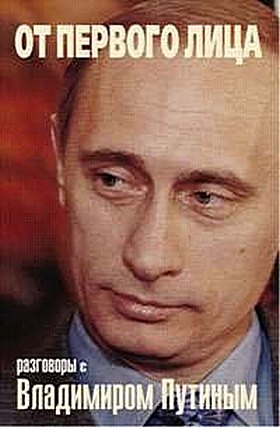 От первого лица: Разговоры с Владимиром Путиным (ISBN: 5-264-00257-6), or First Person: Discussions with Vladimir Putin (my translation), by Nataliya Gevorkyan, Natalya Timakova, and Andrei Kolesnikov is a book that consists of not much more than a series of interviews with Vladimir Putin. There were sections in which old friends, his ex-wife, an old teacher, and even his daughters made some comments, but it was mostly just transcripts of Putin talking to the three reporters. Putin talked about his childhood, his schooling, his career ambitions, his family, his time in Germany, his athletic endeavors, and his meteoric rise from unknown in St. Petersburg to the heights of power in Moscow. Putin went into quite a bit of detail about his childhood, schooling, judo exploits, and even talked quite a bit about his courtship of his ex-wife (they were still married when the book was written). He also talked a lot about the early days of real, democratic politics in St. Petersburg, which was the springboard for his political career. Finally, the reporters asked a lot of questions about the Russian issues of day, most of which had to do with Chechnya. Putin explained why he chose the positions he did on Chechnya and how he figured it made Russia a more secure country.
The book was an interesting read because of the biographical feel to it. I enjoyed reading about Putin’s early years. The section about St. Petersburg politics was a little dry, but I did understand that it was key to Putin’s rise to power. I found that Putin approached the interviews the same way he does all of his other public appearances: kind of dry and with a self-effacing element to it. Other than a few of the answers to the Chechnya-related questions, he was pretty open and ready to share details. With Chechnya and a couple internal Russian political affairs questions, the answers seemed a little more short and pointed. The biggest drawback of the book is one that is not really anyone’s fault: it was written during Putin’s first term as Russia’s president. Now that he’s in his third term, the book is quite out of date. To be fair, I don’t think an updated book would be much different. Any insight to one of post-Soviet Russia’s most intriguing figures is interesting, and this was no exception.
От первого лица: Разговоры с Владимиром Путиным (ISBN: 5-264-00257-6), or First Person: Discussions with Vladimir Putin (my translation), by Nataliya Gevorkyan, Natalya Timakova, and Andrei Kolesnikov is a book that consists of not much more than a series of interviews with Vladimir Putin. There were sections in which old friends, his ex-wife, an old teacher, and even his daughters made some comments, but it was mostly just transcripts of Putin talking to the three reporters. Putin talked about his childhood, his schooling, his career ambitions, his family, his time in Germany, his athletic endeavors, and his meteoric rise from unknown in St. Petersburg to the heights of power in Moscow. Putin went into quite a bit of detail about his childhood, schooling, judo exploits, and even talked quite a bit about his courtship of his ex-wife (they were still married when the book was written). He also talked a lot about the early days of real, democratic politics in St. Petersburg, which was the springboard for his political career. Finally, the reporters asked a lot of questions about the Russian issues of day, most of which had to do with Chechnya. Putin explained why he chose the positions he did on Chechnya and how he figured it made Russia a more secure country.The book was an interesting read because of the biographical feel to it. I enjoyed reading about Putin’s early years. The section about St. Petersburg politics was a little dry, but I did understand that it was key to Putin’s rise to power. I found that Putin approached the interviews the same way he does all of his other public appearances: kind of dry and with a self-effacing element to it. Other than a few of the answers to the Chechnya-related questions, he was pretty open and ready to share details. With Chechnya and a couple internal Russian political affairs questions, the answers seemed a little more short and pointed. The biggest drawback of the book is one that is not really anyone’s fault: it was written during Putin’s first term as Russia’s president. Now that he’s in his third term, the book is quite out of date. To be fair, I don’t think an updated book would be much different. Any insight to one of post-Soviet Russia’s most intriguing figures is interesting, and this was no exception.
 | This work, including all text, photographs, and other original work, is licensed under a Creative Commons Attribution Non-Commercial No Derivatives 3.0 License and is copyrighted © MMXI John Pruess. |


 Leon Aron, author of Russia’s Revolution: Essays, 1989–2006 (ISBN: 978-0-8447-4242-7), was always interested in Russia because he was born in the USSR. Although he emigrated and came to America after the Soviets started letting Jews leave, he remained interested in his homeland and became a respected commentator and scholar on the land of Peter the Great, Ivan the Terrible, Stalin, and now Vladimir Putin. Aron has written extensively on all things Russia, and in this book, he compiled essays that take the reader through life in Russia from the early days of Boris Yeltsin through the middle years of Putin’s first term in office as Russia’s president. Aron describes Yeltsin and his democratization efforts. He is quite a fan of Yeltsin, praising his statesmanship and ability to hold together a country that had partially fallen apart and threated to completely implode on a daily basis. Aron touches on every aspect of Russia reborn, including food, oil, politics, oligarchs, literature, the military, and international relations. All of these vastly different aspects of life in the post-Soviet Russia give an idea of what was happening in the country at the time the essay was written. Aron finishes up his compilation with discussions of Putin, a — to put it mildly — controversial figure and one of Russia’s largest struggles during the 1990s, Chechnya. Aron’s point, even with the various negatives that Putin and Chechnya seemed to usher in, was that much good has happened since the Soviet Union fell apart in Russia and even though there have been and continue to be bumps in the road (and they’re often big bumps), things are probably going in the right direction, but the only way to tell is to wait and see. The West didn’t get to its heights in 20 years, and Russia won’t either.
 The collection of essays contained in Volatile Borderland: Russia and the North Caucasus (ISBN: 978-0-9830842-1-1), edited by Glen E. Howard, is an attempt at shedding some light on the movers and shakers of the Russian North Caucasus, what the future holds, and what is driving current reforms, repressions, and realities. The authors are experts on Russia and the Caucasus, all either professors, journalists, or similarly qualified experts and policy advisors. Chechnya, Dagestan, Krasnodar, and Sochi and the various peoples that inhabit them are prominent players in the analysis, but exotic-sounding places like Adygeya and Kabardino-Balkaria also garner significant attention because they form a buffer zone between the explosive and more Islamic eastern North Caucasus and the rest of European Russia. As with most places in the world where high unemployment, Islamist thought, and rampant corruption have mixed, the North Caucasus is a tinderbox. The Russian authorities have tried a mixture of ridiculously high federal subsidies and oppressive, totalitarian-style control, which seems to be tenuously holding things under control, but most of the essayists agree that this situation could go at any time.